How to Calculate Power Factor from Utility Bill Data
How to Calculate Power Factor from Utility Bill Data
Calculate power factor from utility bill data by first identifying what the bill actually reports: kWh, kW demand, kVARh, kVA demand, a billed PF, or a penalty adjustment. If the billing period provides active and reactive energy on a compatible basis, an energy-based estimate is (PF=kWh/\sqrt{kWh^2+kVARh^2}). If it provides interval kW and kVAR, calculate each interval and aggregate the measurements with the utility’s stated method. Do not treat a single monthly average as proof of the PF at every feeder or operating state.
ال صفحة المنتج CNBYG SVG provides context for correcting measured reactive current. The bill remains the authority for the tariff definition, interval, demand calculation and penalty rule.
Read the bill before calculating
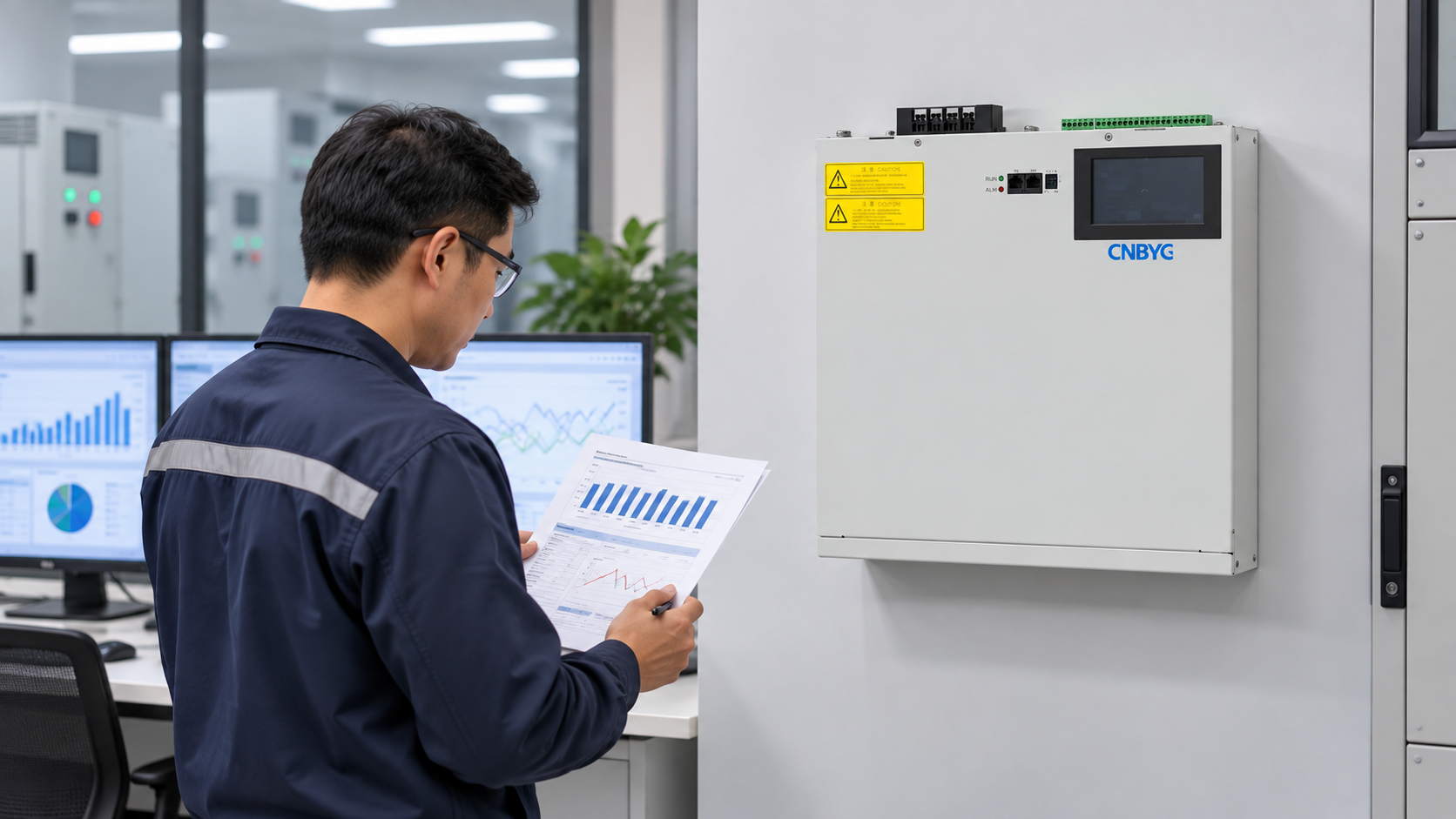
Collect the billing period, meter identifier, import/export direction, kWh, kVARh, kW demand, kVA demand, billed PF, demand interval and any reactive-energy or PF adjustment. Note whether the utility uses a coincident peak, a maximum interval, a ratchet, a sliding window or a separate leading/lagging rule. A bill can include a PF charge without exposing the exact interval data required to reproduce it.
Bill-data decision table
| Bill data available | Possible estimate | Important limitation |
|---|---|---|
| kWh and kVARh | \(kWh/\sqrt{kWh^2+kVARh^2}\) | Represents energy over the bill period, not every demand interval. |
| kW and kVAR interval data | Calculate PF per interval and summarize. | Use the utility’s sign, averaging and demand rules. |
| kW and kVA demand | Approximate PF as kW/kVA for the same interval. | Confirm both values share the same timestamp and phase basis. |
| Only billed PF | Use it as the tariff result. | Do not reverse-engineer an exact waveform from a rounded display. |
| Export and import registers | Analyze each direction separately. | Sign conventions and netting rules may differ. |
| PF penalty only | Request interval and tariff definitions. | The charge alone cannot prove a source-side PF. |
Energy-based example
Assume a bill reports 120,000 kWh and 90,000 kVARh for one billing period, with the utility defining both registers over the same import interval. An energy-based estimate is:
[
PF_{energy}=\frac{120000}{\sqrt{120000^2+90000^2}}
]
The result is an illustrative estimate. Keep the full precision in the calculation and state whether the utility treats leading and lagging kVARh separately. If the bill nets exported energy or applies a ratchet, the simple relationship may not match the billed PF.
Use this estimate to decide whether interval data is needed, not to select a correction device directly. A monthly energy PF can hide a short demand interval with a poor PF or a night period with leading reactive energy.
Demand-based calculation
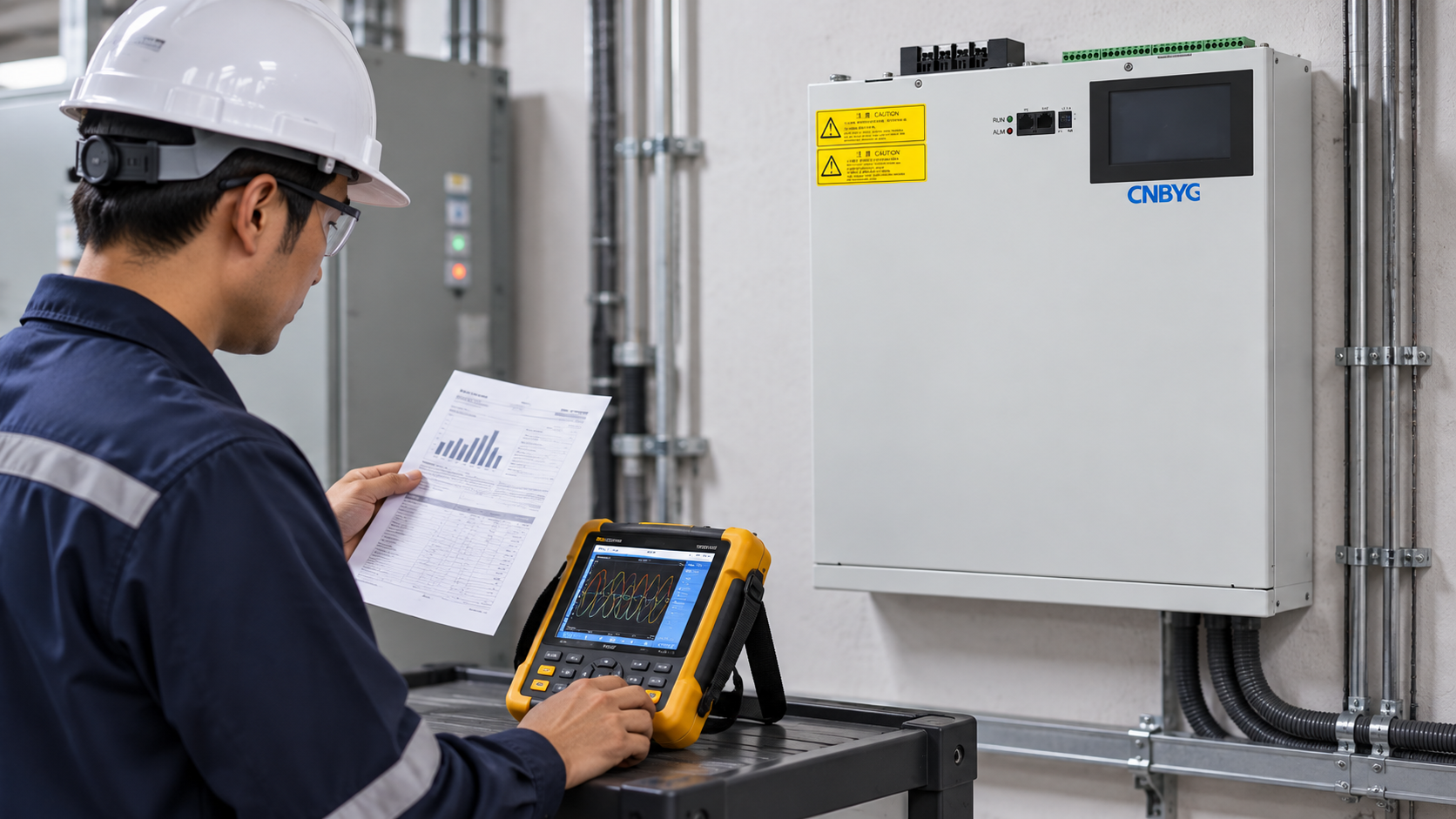
If the bill provides kW demand and kVA demand for the same interval, approximate PF as (PF=kW/kVA). If it provides kW and kVAR for the same interval, use:
[
PF=\frac{kW}{\sqrt{kW^2+kVAR^2}}
]
Keep the sign of kVAR for leading or lagging analysis. Do not combine the maximum kW interval from one timestamp with the maximum kVAR interval from another. A utility may use a demand interval, rolling average or coincident peak that is not visible in a summary line.
For a three-phase site, compare the bill result with synchronized measurements at the utility boundary. Verify CT ratio, phase, polarity and meter multiplier. The دليل تعويض التيار الكهربائي في SVG explains why a feeder meter and the utility meter can legitimately show different PF values.
From bill evidence to a correction study
Use the bill to identify the business problem and the likely time window. Request interval kW, kVAR, kVA, voltage and current if the utility can provide them. Overlay production schedule, transformer state, capacitor status, generator mode, solar output and EV charging occupancy. This shows whether the penalty is caused by steady lagging demand, a short peak, leading operation or a meter-boundary issue.
If a capacitor or SVG is considered, calculate net kvar at the same boundary and voltage. The دليل الجهد الكهربي وشبكة الطاقة الكهربية explains why a source-side kvar target must be converted to current at the lowest voltage. Reserve current for harmonics and unbalance when the load is electronic.
ال SVG maintenance checklist can preserve bill-period comparisons after settings change. The قائمة المراجعات لعملية تشغيل SVG can document the interval in which the correction is proven.
Common bill-data errors
Do not assume kVARh and kWh use the same register direction. Do not use a rounded billed PF to claim an exact source condition. Do not ignore export or net-metering rules. Do not compare a monthly energy PF with an instantaneous analyzer PF without stating the time basis. Do not size correction from the penalty amount alone.
Another error is changing the controller at the site without preserving the pre-change bill and interval data. Save the tariff, meter multiplier, register definitions and the date of any correction. If the utility changes the tariff or interval length, recalculate the baseline.
Reconcile the bill with site measurements
Start with the exact meter identifier and multiplier. A bill may show a billing-period total while the site analyzer shows a five-minute value. Exported kWh may be netted against imported kWh, while reactive registers may be separated by leading and lagging direction. Write these rules beside the calculation instead of assuming that all registers have the same sign.
Request interval data for the days that include the maximum demand and the largest PF charge. Overlay production, shift, transformer, generator, solar, battery, capacitor and EV-charging states. If the bill PF is lower only during a short interval, a slow APFC bank may not solve it. If the monthly energy PF is poor but every demand interval is acceptable, confirm whether the tariff actually uses energy PF or a separate demand rule.
Use a before-and-after comparison with the same meter, tariff period and operating state. Keep the original bill, interval export, site analyzer file, one-line diagram and controller settings together. If the utility revises a bill or changes the tariff, preserve both versions and state which one governs the design. This prevents an apparently successful correction from being judged against a different aggregation rule.
Example of a reconciliation note
Write a short note such as: “The bill reports imported energy for meter M-01 from 1–30 September. The analyzer records five-minute values at the main incomer. The bill’s PF adjustment uses the utility’s maximum demand interval, while the energy estimate uses the import kWh and lagging kVARh registers. Exported solar energy and the downstream motor feeder are outside the analyzer boundary.” This wording makes the comparison reproducible and prevents an energy result from being presented as a feeder result.
If the bill lists only a rounded PF, use it for tariff discussion but request the underlying interval data before selecting kvar. If the utility cannot provide it, size conservatively from measured site states and identify the missing evidence in the acceptance record.
Keep a separate line for unavailable data. Do not replace missing interval kVARh with zero or assume that a blank register means no reactive demand. If the bill uses a demand ratchet, record the prior-period rule and the date range that controls the current charge. When comparing two months, compare the tariff version, meter multiplier and operating schedule as well as the calculated PF.
The same approach applies when a site adds solar, storage or a new transformer.
It keeps the calculation tied to the meter rather than to an assumed plant model.
That distinction protects both the design and the billing review.
It also makes later audits easier.
For every billing cycle.
Practical workflow
- Save the complete bill and tariff page, not only the summary total.
- Identify meter number, direction, multipliers, interval and PF definition.
- Separate import, export, leading and lagging registers when available.
- Calculate energy PF or interval PF with consistent units.
- Request missing interval data before selecting equipment.
- Mark the utility boundary on the one-line diagram.
- Compare bill values with synchronized site measurements.
- Model existing capacitors, SVGs, generators, solar and other reactive sources.
- Test the correction across the billed interval and the lowest-load state.
- Keep the before/after evidence and the tariff assumptions.
أسئلة متكررة
Can a monthly utility bill give the exact plant PF?
Usually it gives an energy or billed result for the meter period. It may not show the instantaneous or maximum-demand PF at every operating state.
What is the energy-based PF formula?
When kWh and kVARh are compatible registers, use (kWh/\sqrt{kWh^2+kVARh^2}), while documenting direction and tariff rules.
Why does the bill PF differ from a feeder analyzer?
The meter boundary, time interval, phase basis, sign convention and aggregation method may be different.
What should be requested from the utility?
Ask for interval kW, kVAR, kVA, voltage, current, register definitions, multipliers, direction, demand interval and the applicable PF rule.
خاتمة
Utility-bill data can establish the billed power-factor problem, but it must be read with the tariff definition and time basis. Calculate energy or interval PF with compatible registers, reconcile it with the utility boundary and site measurements, then size correction from measured kvar and voltage rather than from a penalty amount alone.
صورة فيديو محايدة: خلفية عامل القدرة
تُقدم محاضرة NPTEL أدناه سياق تعليمي محايد بشأن معامل القدرة والقدرة رد الفعلية. ولا يشكل هذا المنتج توصية.