كيفية قراءة تقرير طيف التوافقيات
A harmonic spectrum report shows how much voltage or current exists at frequencies that are integer multiples of the fundamental supply frequency. To read it correctly, identify the measurement point, distinguish voltage from current, check the normalization used by the chart, and connect the dominant harmonic orders to operating conditions. A tall bar does not by itself prove a standards violation or identify the faulty machine. Start with the instrument settings and loading record before deciding whether filtering is necessary.
For an industrial buyer, harmonic spectrum analysis should answer three practical questions: what was measured, whether the result represents normal operation, and what additional evidence is needed before specifying equipment. Those questions prevent an attractive chart from turning into an expensive but ineffective purchase.
Start with the measurement identity
Ask for the plant single-line drawing and locate the measurement point on it. A feeder supplying one variable-speed drive answers a different question from a main incomer serving the entire factory. A utility point of common coupling is also not automatically the same location as the nearest accessible switchboard. Record the exact panel, feeder, phase arrangement, and measurement direction.
Check the start and finish timestamps, nominal frequency, nominal voltage, instrument model, firmware, sensor identification, and current-transformer ratio. A report without this information cannot be reliably compared with a second survey. Confirm whether the measurement covered startup, normal production, light load, and switching events. One quiet afternoon may miss the operating condition that creates complaints.
ال دليل مسح جودة الطاقة الصناعية explains how to define the measurement campaign. Use that campaign record alongside the spectrum rather than treating the spectrum as a complete site diagnosis.
Separate voltage harmonics from current harmonics
Current harmonics describe the nonsinusoidal current drawn or injected at the measurement location. Voltage harmonics describe distortion of the local voltage waveform. They interact through system impedance, but their numerical percentages cannot be compared as though they measure the same thing. A nonlinear load can draw significant harmonic current while the voltage remains relatively clean on a strong supply.
Conversely, a voltage-distortion problem may involve upstream conditions, resonance, or interactions with other loads. Installing a current filter on one feeder does not guarantee correction of every voltage problem. Obtain simultaneous voltage and current records, including phase-by-phase values, before assigning responsibility.
ال نظرة عامة على معيار IEEE 519 identifies the relevant standard family for harmonic control. Use the applicable purchased edition and the defined assessment location for an actual compliance evaluation. This article deliberately does not substitute a generic percentage threshold for that assessment.
Read the frequency axis and harmonic order
The fundamental is order one. In a 50 Hz system, the fifth harmonic corresponds to 250 Hz; in a 60 Hz system it corresponds to 300 Hz. The order is the same, while the physical frequency changes. Verify the nominal frequency before comparing a report from another country or generator operating condition.
A harmonic chart groups energy around integer orders according to the measurement method. Interharmonics lie between integer multiples and need appropriate grouping and reporting. A chart containing only integer bars may omit information relevant to flicker, converter interactions, or unusual modulation. Do not assume missing bars mean that no disturbance exists.
ال منشور IEC 61000-4-7 concerns harmonic and interharmonic measurement instrumentation. Request the measurement method and grouping settings when reports from different analyzers appear inconsistent. Frequency resolution, aggregation, and sensor bandwidth can change what the chart represents.
Check what the bar height means
Some reports express each component as a percentage of the fundamental. Others use volts, amperes, or a reference current defined for an assessment. Read the legend, axis units, and calculation notes. A current harmonic of ten amperes has a different engineering implication on a lightly loaded feeder and on a feeder carrying hundreds of amperes.
For a component expressed relative to the fundamental, the percentage is the component RMS value divided by the fundamental RMS value, multiplied by one hundred. For example, a fifth-harmonic current of 8 A with a 100 A fundamental is 8 percent. If the fundamental falls to 40 A while that component remains 8 A, its relative percentage becomes 20 percent. The absolute harmonic current did not increase in that example.
That distinction is particularly useful at light load. A large relative percentage can coexist with a modest absolute harmonic current. Filter sizing, transformer heating evaluation, and a standards assessment may require different reference quantities. Preserve both absolute and normalized results instead of exporting only a colored percentage chart.
Understand THD without losing individual orders
Total harmonic distortion combines the selected harmonic components using the square root of the sum of their squared RMS magnitudes, divided by the fundamental RMS magnitude. The report must identify which orders are included. Voltage THD and current THD use different measured quantities, even though the mathematical form is similar.
If the third, fifth, and seventh current components are 3 A, 8 A, and 4 A against a 100 A fundamental, the illustrative combined value is approximately 9.43 percent for those three components. Additional included orders would change the result. This example explains the calculation and is not a site acceptance limit.
Two spectra can have similar THD but distribute distortion very differently across orders. That matters when checking equipment sensitivity, neutral loading, or a proposed filter’s operating range. A summary number is useful for screening; keep the individual-order table for diagnosis and procurement.
Use a disciplined interpretation table
The following table lists checks rather than universal pass/fail limits. Select the action from the actual electrical system, equipment documents, and applicable assessment requirements.
| Report feature | Question to ask | أدلة للاحتفاظ بها | Practical next action |
|---|---|---|---|
| Large fifth and seventh components | Does the pattern track converter loading? | Simultaneous load current and equipment operating log | Compare operating states before assigning a source |
| High percentage at low load | Did the fundamental decrease? | Absolute harmonic amperes and fundamental amperes | Evaluate both quantities before filter sizing |
| Large third-order phase currents | Is neutral current measured separately? | Phase spectra, neutral RMS and sensor arrangement | Check four-wire loading and neutral assessment |
| Voltage distortion changing after capacitor switching | Could impedance or resonance be involved? | cURL Too many subrequests by single Worker invocation. To configure this limit, refer to https://developers.cloudflare.com/workers/wrangler/configuration/#limits | cURL Too many subrequests by single Worker invocation. To configure this limit, refer to https://developers.cloudflare.com/workers/wrangler/configuration/#limits |
| cURL Too many subrequests by single Worker invocation. To configure this limit, refer to https://developers.cloudflare.com/workers/wrangler/configuration/#limits | cURL Too many subrequests by single Worker invocation. To configure this limit, refer to https://developers.cloudflare.com/workers/wrangler/configuration/#limits | cURL Too many subrequests by single Worker invocation. To configure this limit, refer to https://developers.cloudflare.com/workers/wrangler/configuration/#limits | cURL Too many subrequests by single Worker invocation. To configure this limit, refer to https://developers.cloudflare.com/workers/wrangler/configuration/#limits |
| cURL Too many subrequests by single Worker invocation. To configure this limit, refer to https://developers.cloudflare.com/workers/wrangler/configuration/#limits | cURL Too many subrequests by single Worker invocation. To configure this limit, refer to https://developers.cloudflare.com/workers/wrangler/configuration/#limits | cURL Too many subrequests by single Worker invocation. To configure this limit, refer to https://developers.cloudflare.com/workers/wrangler/configuration/#limits | Repeat the measurement safely with qualified personnel |
Recognize patterns without declaring a cause
Six-pulse converters often motivate investigation of characteristic low-order harmonics, but a spectrum is not a fingerprint that uniquely identifies one machine. Supply imbalance, converter design, loading, background distortion, and network interactions can alter the observed pattern. Confirm a hypothesis by comparing measurements when the suspected load changes state.
Triplen harmonics deserve attention in suitable three-phase four-wire systems because neutral behavior can differ from the balanced fundamental-current picture. Do not infer neutral safety from phase RMS values alone. Measure the neutral with appropriate equipment and assess the installation against its actual conductor and protection design.
A resonance concern also requires more than spotting one large order. Review the transformer, cables, capacitor steps, reactors, and switching states. Adding an ordinary capacitor bank simply to improve displacement power factor can change the network response. Request an engineering analysis when distortion increases during compensation switching.
Verify the measurement chain
Check current-sensor range, orientation, ratio, and specified frequency response. A sensor chosen only for fundamental RMS current may not be suitable for the full spectrum under investigation. Saturation, incorrect scaling, or a reversed channel can distort the interpretation. Do not attempt live sensor corrections without a qualified electrical work procedure.
Confirm voltage-channel connections and phase labels from documented commissioning checks. For comparison, keep the same aggregation windows and measurement point. If a report was exported with unexplained settings, ask the survey provider to supply the configuration rather than guessing from the chart appearance.
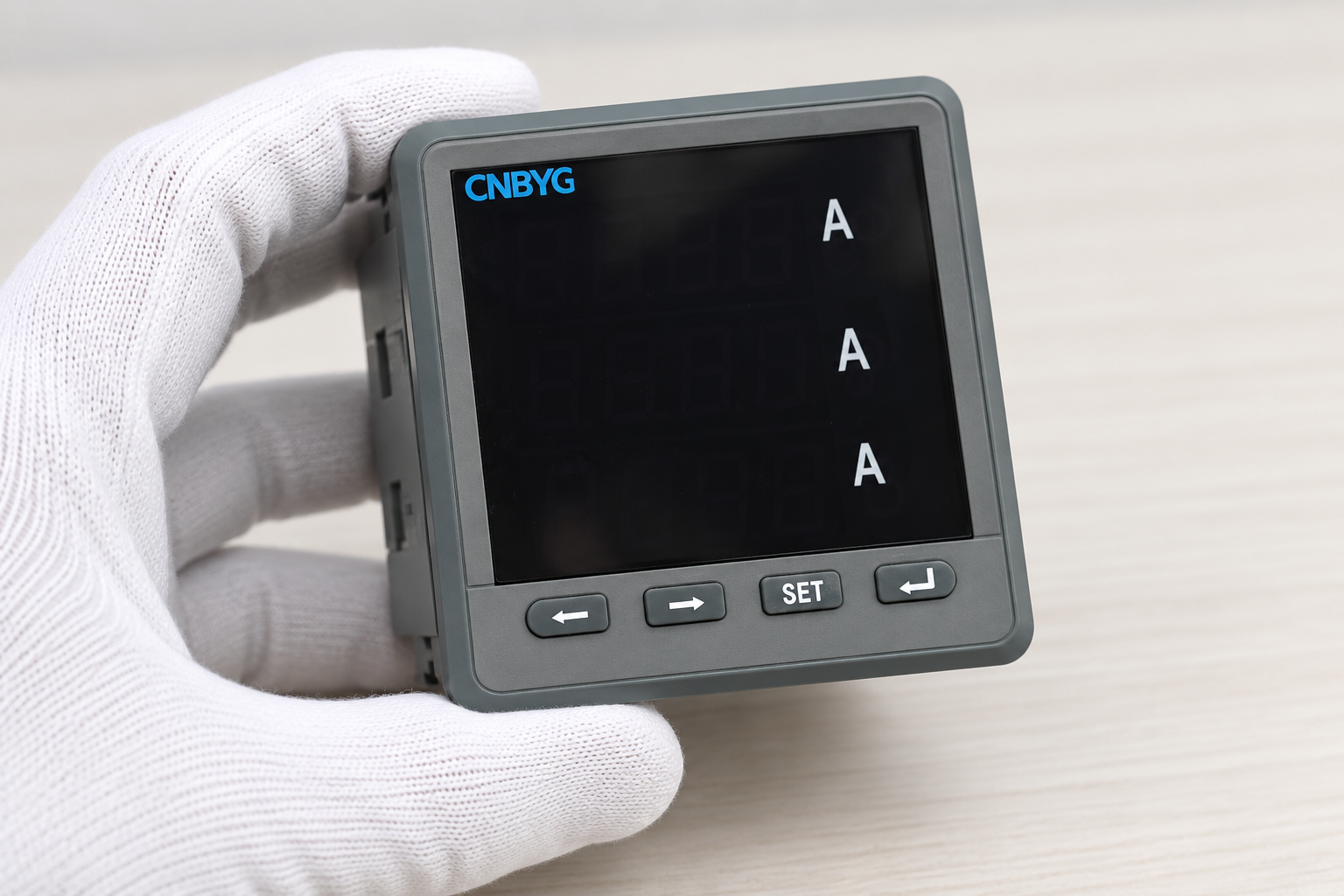
ال دليل اختيار محلل جودة الطاقة discusses instrument capabilities. A جهاز قياس القدرة متعدد الوظائف BY194 can be considered for documented panel-monitoring functions, but its exact model datasheet must confirm any harmonic capability. The product-reference images here do not establish that it records spectra or performs a standards-compliant survey.
Turn the findings into an equipment specification
For an active harmonic filter inquiry, provide the measurement location, phase arrangement, absolute harmonic currents, expected loading range, existing compensation equipment, installation environment, and the required verification method. Specify whether the project concerns source-current reduction, assessment at the point of common coupling, or another defined objective. Those are related but different acceptance questions.
اقرأ مبدأ عمل مرشح التوافقيات النشط before comparing proposed equipment. Ask suppliers to state the supported operating conditions and explain how commissioning measurements will demonstrate the requested outcome. Avoid choosing a rating from THD alone.
A sensible acceptance plan repeats measurements under representative operating conditions with comparable instruments and settings. Keep before/after spectra, load records, and the agreed assessment boundary. Record remaining voltage disturbances separately instead of treating all power quality complaints as harmonic problems.
Learn the waveform concepts
The neutral engineering lesson below supports the distinction between sinusoidal fundamentals and waveform distortion. It provides background education; the article’s measurement and selection steps remain usable without watching it.

شاهد مقطع فيديو عن جودة الطاقة: المعايير والتحليق
أسئلة متكررة
هل يُثبت شريط التوافقي العالي أن الآلة بها خلل؟
No. The bar shows a measured frequency component at one location under recorded conditions. Confirm sensor settings, loading, background distortion, and changes in suspected equipment before assigning a cause.
هل يمكن لـ THD وحده تحديد تصنيف مرشح التوافقيات النشطة؟
No. Obtain absolute harmonic currents, loading range, phase arrangement, the measurement boundary, and the supplier's documented operating conditions. Relative percentages alone do not provide the complete current requirement.
لماذا يمكن أن يرتفع توافقي التيار الكلي عندما ينخفض حمل الإنتاج؟
A percentage referenced to the fundamental can rise when fundamental current decreases, even if harmonic amperes remain unchanged. Compare absolute components with the fundamental and the operating log.
هل يمكن لكل مقياس طاقة متعدد الوظائف أن ينتج تقرير طيف موثوق به؟
No. Verify the exact model's harmonic functions, measurement method, sensor compatibility, logging, and export capabilities. A standard panel meter illustration is not evidence of professional analyzer functionality.