


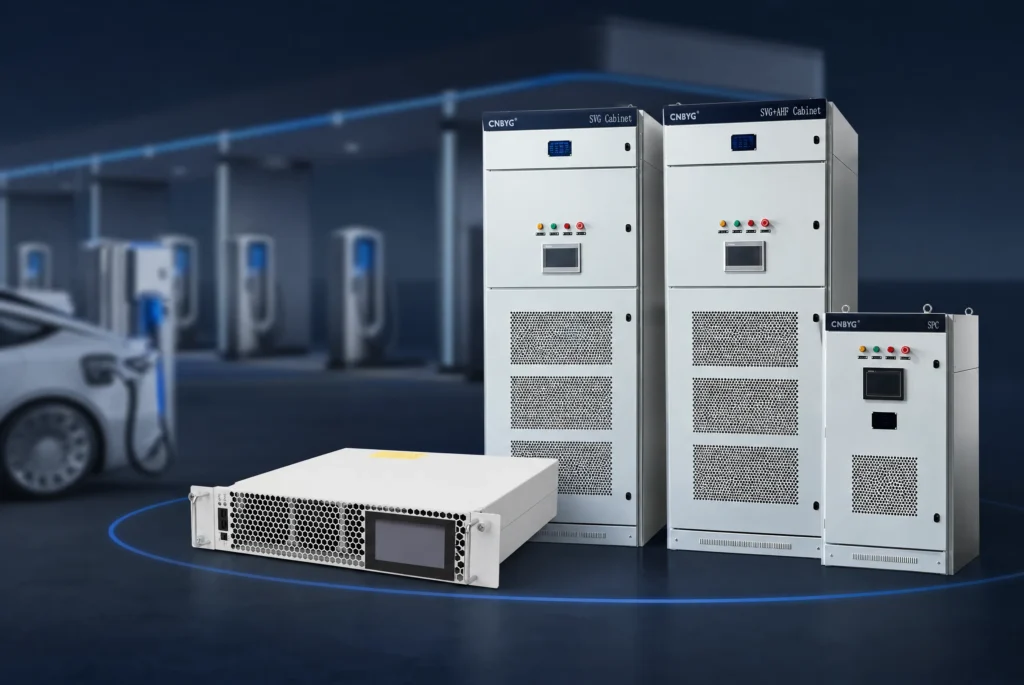
An EV charging station is far more than a simple power outlet. It is a complex electrical system integrating power distribution, energy conversion, intelligent control, and safety protection. A complete charging station electrical system mainly consists of three key parts: the power supply system, charging system, and monitoring system. Among them, the power supply system serves as the energy source of the entire station, while power quality management is essential to ensure safe, efficient, and economical operation.
As a professional manufacturer specializing in reactive power compensation and power quality solutions, CNBYG provides advanced Reactive Power Compensator solutions designed to optimize this critical part of the charging infrastructure.
CNBYG Reactive Power Compensator: A Core Power Quality Solution on the Distribution Side
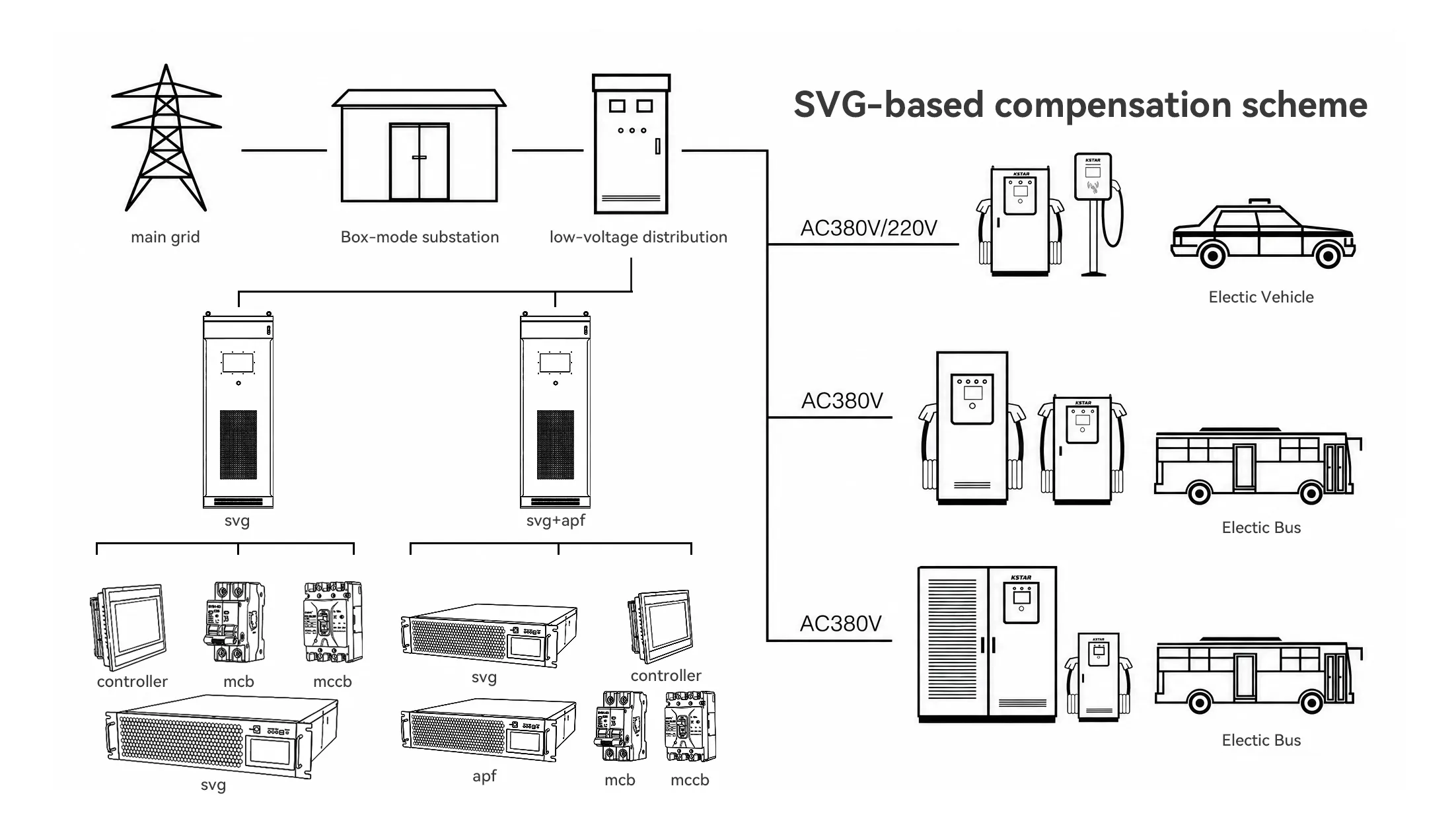
From a system architecture perspective, the Reactive Power Compensator belongs to the core power quality improvement equipment on the distribution side of an EV charging station. Physically, it is usually installed on the low-voltage side of the transformer, inside the power distribution room or compensation cabinet, positioned between the grid connection point and the charging loads.
In the electrical energy flow path, the system structure can be described as:
Transformer → Reactive Power Compensator → Distribution Lines → EV Chargers
In practical engineering applications, CNBYG commonly integrates Static Var Generator (SVG) and Active Power Filter (APF) technologies into a comprehensive compensation cabinet. Before electricity is distributed to charging terminals, the system performs centralized management of reactive power demand and harmonic distortion at the main incoming power supply point.

Reactive Power Compensation: The “Power Optimization Expert” for Charging Stations
A Reactive Power Compensator plays the role of a “power optimization expert” in EV charging infrastructure. Modern charging equipment contains transformers and power electronic components, which generate significant amounts of reactive power and harmonic currents. These issues can lead to low power factor, increased line losses, voltage fluctuations, reduced transformer capacity utilization, and additional electricity charges imposed by utilities.
CNBYG reactive power compensation solutions effectively balance inductive reactive power by supplying dynamic capacitive reactive power, improving overall electrical efficiency and power quality.
The major benefits include:
- Improved power factor and reduced electricity penalties
By correcting reactive power consumption, the Reactive Power Compensator can increase the power factor to above 0.9, helping charging station operators avoid utility power factor penalties and potentially qualify for incentive programs. - Enhanced voltage stability
Effective reactive power management reduces voltage fluctuations and improves voltage quality. Studies have shown that optimized compensation systems can significantly enhance voltage stability. - Reduced power losses and improved energy efficiency
By minimizing unnecessary reactive current flow through cables and transformers, the system reduces transmission losses and improves operational efficiency. - Higher transformer capacity utilization
Reactive power compensation releases transformer capacity occupied by reactive currents, allowing existing electrical infrastructure to support more effective charging loads. Some applications have demonstrated capacity utilization improvements exceeding 97%.

CNBYG SVG-Based Solutions for EV Charging Applications
For EV charging station applications, CNBYG mainly provides solutions based on Static Var Generator (SVG) technology. Compared with traditional capacitor-bank and reactor-based compensation systems, SVG solutions offer faster response speed, higher compensation accuracy, and better adaptability to rapidly changing charging loads.
Traditional passive compensation systems may suffer from slow response, resonance risks, and potential harmonic amplification. In contrast, SVG-based Reactive Power Compensators provide millisecond-level dynamic response and do not introduce additional harmonic distortion. They can also help reduce certain harmonic components generated by power electronic loads.
When combined with Active Power Filter (APF) technology, the integrated SVG+APF solution provides comprehensive harmonic mitigation and reactive power management, effectively addressing harmonic pollution caused by high-power EV chargers and protecting electrical equipment from overheating, malfunction, and premature aging.
Centralized and Distributed Reactive Power Compensation Solutions
For different EV charging station layouts, CNBYG offers both centralized and distributed compensation solutions.
Centralized compensation installs the Reactive Power Compensator at the main distribution point, providing cost-effective management with simplified maintenance. It is suitable for charging stations with relatively stable load characteristics.
Distributed compensation places compensation units closer to individual charging branches, enabling more precise control and faster response. This solution is especially suitable for fast-charging stations where power demand changes rapidly.
Through flexible system design, CNBYG helps customers select the most suitable power factor correction and power quality improvement solution according to actual operating conditions.
Scientific Capacity Selection Ensures Optimal Investment Return
It is important to note that the capacity of a Reactive Power Compensator should not simply be oversized. Excessive compensation may also result in additional utility charges or inefficient investment. Therefore, proper selection requires accurate calculation based on charging station power capacity, load characteristics, reactive power demand, and harmonic levels.
CNBYG not only provides high-performance Reactive Power Compensators, SVG systems, and harmonic mitigation equipment but also offers complete technical services, including compensation capacity calculation, system design, installation guidance, and commissioning support.
With professional power quality solutions, CNBYG helps EV charging infrastructure operators achieve safer operation, higher energy efficiency, and better economic performance.
If you would like to learn how to calculate the required Reactive Power Compensator capacity for your EV charging station, the CNBYG technical team is ready to provide professional support.
For a focused charging-station voltage review, see the EV charging station voltage fluctuation SVG guide.
For inverter-heavy PV projects, see the photovoltaic inverter harmonics APF/SVG guide.