


Power meter NaN, infinity and invalid readings must be handled as data-quality conditions until their meaning is established. Do not silently replace them with zero or forward them as ordinary measurements. Save the raw register bytes, confirm the documented data type and byte order, and check whether the meter manual defines a special unavailable or invalid value. A nonfinite result can reflect a documented status, a calculation problem or a decoding mistake; the displayed label alone cannot identify which explanation applies.
This guide explains how to distinguish those cases and keep dashboards, calculations and reports from treating missing information as a physical measurement. It addresses the handling of invalid values, complementing the separate topic of finite-number rounding and precision. No example below establishes a reserved value or register format for an undocumented meter variant.
Separate representation from meaning
NaN means “not a number” in floating-point representation. Infinity is another nonfinite floating-point value. Neither is an ordinary finite engineering measurement. However, interpreting a bit pattern as a floating-point number is only appropriate after the register manual confirms that representation. Two registers might instead hold integers, status bits, a counter or another documented format.
The Python struct documentation describes explicit binary packing and unpacking formats, including IEEE 754 floating-point representations. It is useful for constructing an isolated decoder test, but it is not a meter register map. A software library accepting four bytes does not prove that the device intended those bytes to represent a float.
The Python math documentation distinguishes finite values, infinity and NaN through explicit classification functions. Equivalent checks exist in many other programming environments. Use a deliberate validity check in the integration layer rather than assuming that every successfully decoded software value is suitable for aggregation or display.
A meter manual may define a particular representation as unavailable, overrange or invalid. That meaning must come from documentation for the actual variant and firmware. Do not generalize a sentinel value found in another manufacturer’s map, or assume that all devices use NaN to indicate the same condition.
Capture the evidence before applying a substitute
Record the request, function, starting offset, quantity and raw response. Keep the meter identity, manual revision, timestamp, decoder configuration and any status flags supplied by the device. If a gateway or collection platform transforms values, record the raw and transformed forms separately so the first stage that produced the invalid value can be identified.
A dashboard showing “NaN” may receive that value directly from a decoder, create it during a calculation, or use it as a platform-specific missing-data marker. Trace the path from instrument to display. Checking only the final screen can lead to a physical inspection when the actual problem is a software division or an incorrect conversion rule.
Preserve the last valid observation with its own timestamp if the application needs it, but do not overwrite the failed observation. An old valid value and a new invalid value are two different pieces of information. Keeping both supports diagnosis without pretending that a historical measurement describes the current process.

Follow a classification-first decision table
| Observation | First question | Safe handling while investigating | Evidence needed before acceptance |
|---|---|---|---|
| Decoder returns NaN | Is floating-point format documented? | Mark unavailable; retain raw bytes | Exact type, byte order and documented sentinel meaning |
| Decoder returns infinity | Was it received or created by a calculation? | Block ordinary measurement use | Raw value and calculation inputs |
| Normal finite number appears implausible | Are scaling, units and source identity correct? | Flag suspect; compare with a trusted reference | Manual mapping and controlled comparison |
| Transport response is missing or invalid | Was any valid application value received? | Record communication failure separately | Matching valid response and integrity checks |
| Display retains an earlier value | Is its timestamp still acceptable? | Label age explicitly or mark stale | Project freshness requirement and acquisition time |
This table describes data handling choices, not device alarm definitions. The representation checks follow the cited software documentation; communication structure follows the Modbus Application Protocol specification. Project requirements determine which unavailable or suspect conditions should trigger operational escalation.
Confirm the type before changing the byte order
Use the exact register map to identify width, signedness, floating-point format where applicable, scaling and units. Check that the requested range contains the complete value and that the response length matches the request. A successful read does not define the data type, and a plausible result from one byte arrangement is not enough to approve that arrangement.
Compare the observed bytes with a known documented value under controlled conditions. The byte and word order guide explains why multi-register interpretation needs an explicit configuration record. Avoid automatically trying every arrangement and selecting whichever produces a realistic-looking measurement. That technique can conceal an addressing error or turn a status field into a misleading number.
Confirm address semantics independently using the register offset verification guide. Reading the wrong location can return valid data that belongs to another field. Fix the documented request definition before adding application-level filters to suppress its symptoms.
If a decode test is needed, run it against saved data in an isolated environment. Preserve the original byte sequence and document every transformation. A reproducible decoder test is safer and easier to review than repeated live changes to a production meter integration.
Distinguish invalid values from finite precision limits
A finite value can be rounded, imprecise or outside the expected engineering range without being NaN or infinity. Those conditions need separate classifications. A range check answers whether a finite result is credible for the application; a finiteness check answers whether it is an ordinary finite number at all.
Use the floating-point precision guide when investigating rounding and representable increments. Do not use a tolerance intended for finite rounding differences to excuse an invalid reading. Conversely, do not label a small expected rounding difference as missing data.
When application calculations are involved, inspect the inputs before the result. Ratios can become undefined when their denominators are unavailable or zero under the calculation’s rules. Record whether invalidity originated in an acquired value or in a derived metric. Do not infer a specific electrical fault from a mathematical exception without the supporting measurement and device status evidence.
Keep invalid data out of misleading totals
Silently replacing an invalid power observation with zero can understate energy calculated from sampled power. Carrying the last value forward can also misstate changing conditions. Select the handling rule according to the report’s purpose, required accuracy and documented data-availability policy, then make the rule visible to downstream users.
For an interval calculation, retain a coverage measure and identify excluded or estimated periods. If the project permits estimation, label the estimate and its method separately from measured data. Avoid presenting a complete-looking total that hides a gap. The appropriate policy for operational trends may differ from the policy for a contractual or regulated report.
Handle cumulative meter counters separately from integration of sampled instantaneous power. A missing counter observation and an invalid instantaneous reading are not interchangeable problems. Determine whether a later documented counter reading permits a valid comparison, considering resets, rollover and replacement under the actual meter documentation. Do not fill the gap with invented intermediate counter values.
Design useful alarms and recovery behavior
An unavailable-data alarm should identify the affected point, first occurrence, last valid timestamp and current quality state. Include enough context to distinguish a communications outage from a value interpretation problem. Avoid repeated identical notifications that bury the original event without helping the responsible engineer take action.
Recovery should require a documented valid observation, not merely the disappearance of an error string. Confirm source identity, response integrity, correct decoding, units and freshness before restoring the point to normal calculations. If the application requires a period of stable observations, define that requirement before testing rather than inventing a universal count.
Log configuration changes alongside recovery. A changed register map, scaling factor or byte order may alter the meaning of the time series. Record that boundary so historical comparisons do not combine incompatible values without explanation. Preserve the original invalid observations for later review.
Apply the process to the installed instrument
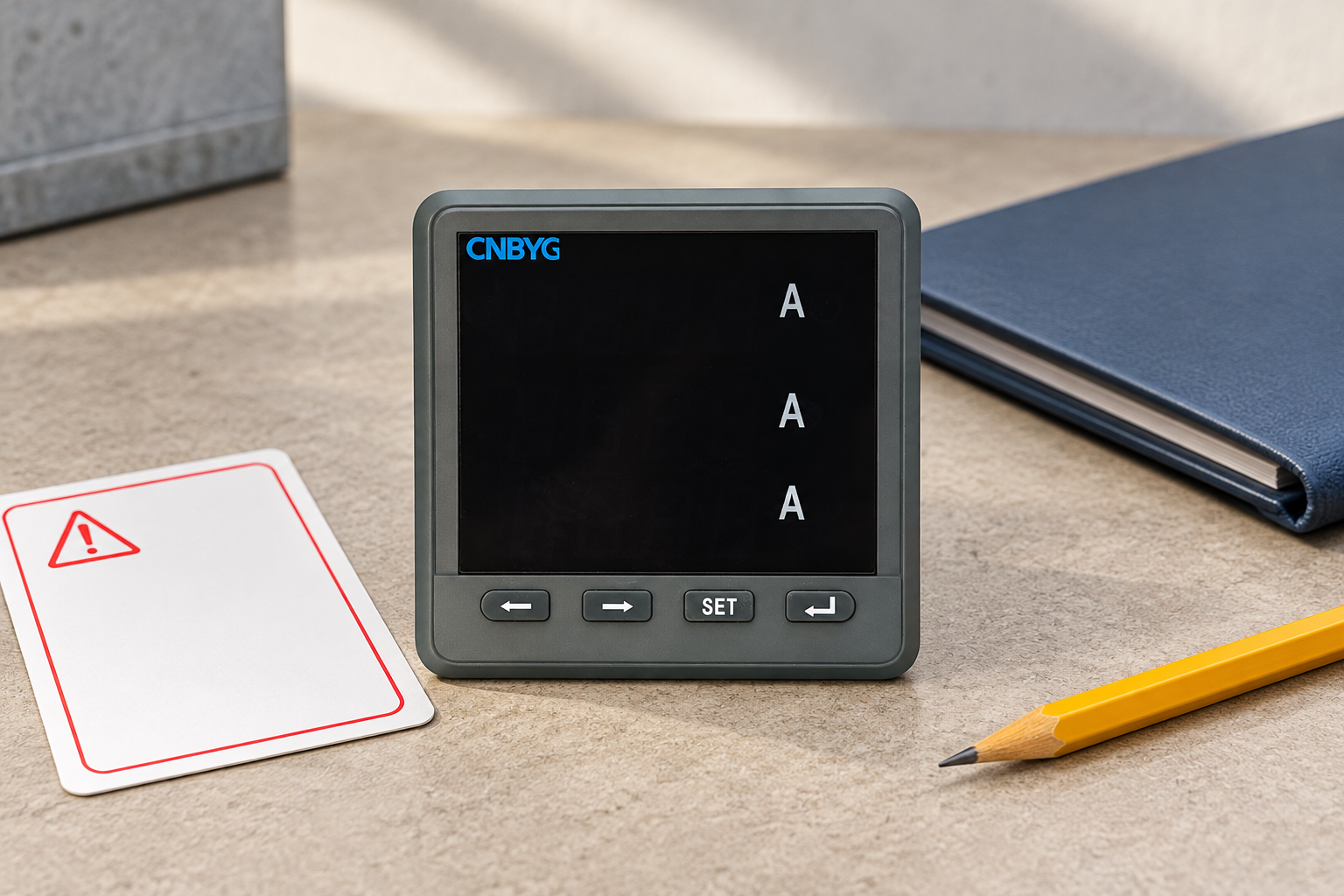
The CNBYG BY194 multifunctional instrument page lists optional RS485/MODBUS communication. It does not establish that every variant exposes IEEE floating-point registers, uses a particular sentinel, or reports unavailable measurements in a specific way. Obtain the ordered variant’s communication manual and confirm the installed option before implementing a decoder.
A useful supplier question names the exact field, manual revision, transmitted offset, raw response and expected meaning. Ask whether any status register or quality indicator must be evaluated with that field, and whether firmware changes affect representation. Request an authoritative explanation instead of inferring behavior from the product photograph or another installation’s configuration.
Before approval, test the ordinary valid path and an unavailable-data path using saved or simulated data in an isolated integration test. Check the dashboard, export and aggregation output. This verifies that invalidity remains visible throughout the pipeline without requiring unsafe manipulation of a live electrical installation.
Further learning: floating-point representations
The university lecture below explains floating-point arithmetic and its limitations. It provides background for understanding representation, while the register manual remains the authority for how a particular instrument encodes a measurement or invalid condition.

Frequently asked questions
Does NaN always mean the meter is broken?
No. It may originate from documented device behavior, an incorrect decoder or an application calculation. Preserve raw bytes and trace where the nonfinite result first appeared before diagnosing hardware.
Should invalid readings be replaced with zero?
Only use a substitute when a documented application policy explicitly permits it and labels the result. Silent zero replacement can make missing information look like a real measurement and distort totals.
Can byte-order testing alone confirm the correct value?
No. Confirm the register location, type, width, scaling and units against the manual, then verify with controlled observations. A plausible number from one arrangement can occur by coincidence.
Does the BY194 product image prove floating-point support?
No. The front image establishes visible appearance. Register formats, quality flags and invalid-value conventions require documentation for the actual supplied configuration.