


Un AHF cable penetration firestop review should confirm that each affected fire-rated wall or floor opening has an approved system matching the actual construction and cable arrangement. Identify the barrier, the penetrating items, the opening and the specified firestop system before accepting the work. A neat seal around a cable does not by itself demonstrate compliance. Keep firestop acceptance separate from the filter’s electrical commissioning and from the enclosure’s own ingress-protection requirements.
This checklist is for electrical contractors, project engineers and buyers coordinating an active harmonic filter installation. It helps organize inspection evidence and trade responsibilities. The applicable building rules, approved system details and qualified project decisions govern the actual installation.
Define where the filter scope meets the building
A filter order may include a module, an assembled cabinet or an integrated switchboard section. The cable route from that equipment can cross a building fire compartment even when the equipment itself is supplied complete. Identify who owns that route and who is responsible for reinstating the affected barrier. A supplier’s equipment test report does not establish acceptance of site-installed building penetrations.
Start with the approved cable routing drawings and the building’s fire strategy or rated-assembly schedule. Mark each opening serving the installation. Do not assume that every ordinary partition is fire-rated, or that an existing seal has been approved for additional cables. Confirm the barrier requirements with the responsible design professional before assigning a system.
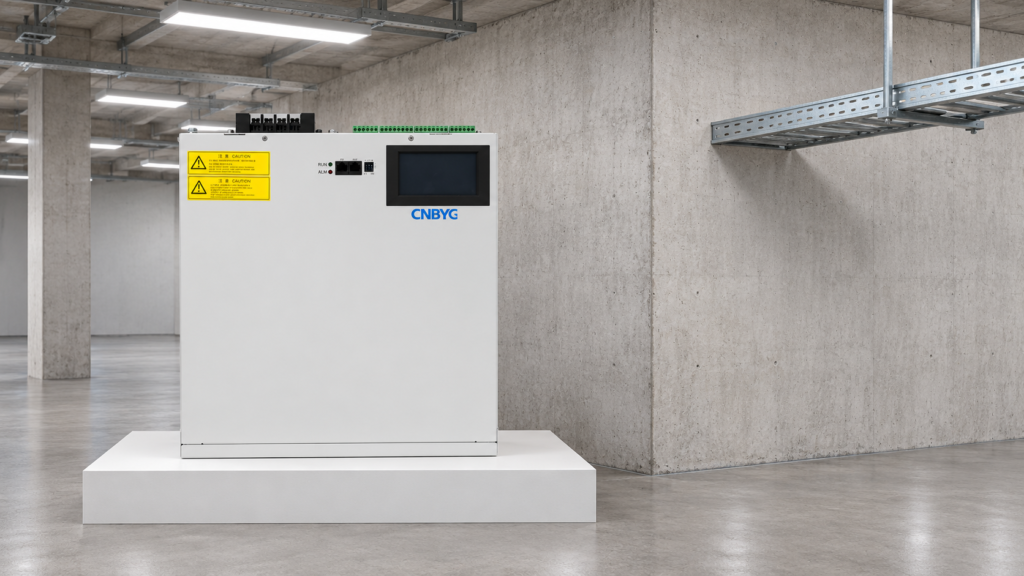
El CNBYG active harmonic filter product provides the equipment connection point for this discussion. Nothing in a product photograph establishes a fire-resistance rating for a surrounding wall, cabinet or cable route. Request equipment cable-entry information separately from the building firestop package.
Review a system, rather than a sealant color
El UL firestop and joint application guide is a useful starting point for understanding the scope of certified systems and their applications. Use the actual approved system detail for the installation; do not choose materials because their appearance resembles another project’s work.
Record the system identifier and revision, the barrier construction and the type of penetrating items. The review must account for the actual arrangement, including any tray or sleeve where applicable. A document showing a different substrate or configuration cannot be treated as a match without the responsible technical review.
The important procurement question is therefore not simply which firestop product will be delivered. Ask which complete approved detail applies at each opening and who has checked the site conditions against it. Material availability should be resolved before the installation reaches a point where the opening will be concealed.
Give every penetration an identifiable record
Assign a unique location reference that can be found on the drawing and at the installation. A room name alone may be inadequate when several openings are located above a ceiling. Include the floor, wall or shaft identification and an accessible orientation reference. The next inspector should be able to find the opening without relying on the installer being present.
Create photographs before work begins, during the relevant inspection stages and after completion. Identify which view shows which side of the barrier. A final photograph documents visible condition but may not show concealed details. Plan the required evidence before installation rather than discovering at handover that the decisive features are hidden.
Use the following table to organize questions. It is a coordination checklist, not a substitute for the approved system or a specification of dimensions.
| Elemento de revisión | Evidence to associate with the opening | Action if evidence does not match |
|---|---|---|
| Rated barrier | Drawing reference and actual wall or floor construction | Refer discrepancy to the responsible designer |
| Penetrating items | Cable, conduit, sleeve or tray identification and arrangement | Reassess the approved detail before installation |
| Opening condition | Identifiable views and required measurements | Resolve limits through the system documentation |
| System selection | Approved identifier, complete detail and revision | Obtain the correct documented system |
| Installed materials | Product identity and relevant installation records | Stop unapproved substitutions and obtain disposition |
| Inspection stages | Required observations and access arrangements | Coordinate inspection before concealment |
| Defect closure | Original concern, corrective work and reinspection | Retain the open item until acceptance is documented |

cURL Too many subrequests by single Worker invocation. To configure this limit, refer to https://developers.cloudflare.com/workers/wrangler/configuration/#limits
El cURL Too many subrequests by single Worker invocation. To configure this limit, refer to https://developers.cloudflare.com/workers/wrangler/configuration/#limits cURL Too many subrequests by single Worker invocation. To configure this limit, refer to https://developers.cloudflare.com/workers/wrangler/configuration/#limits.
cURL Too many subrequests by single Worker invocation. To configure this limit, refer to https://developers.cloudflare.com/workers/wrangler/configuration/#limits.
cURL Too many subrequests by single Worker invocation. To configure this limit, refer to https://developers.cloudflare.com/workers/wrangler/configuration/#limits.
cURL Too many subrequests by single Worker invocation. To configure this limit, refer to https://developers.cloudflare.com/workers/wrangler/configuration/#limits
cURL Too many subrequests by single Worker invocation. To configure this limit, refer to https://developers.cloudflare.com/workers/wrangler/configuration/#limits.
cURL Too many subrequests by single Worker invocation. To configure this limit, refer to https://developers.cloudflare.com/workers/wrangler/configuration/#limits Lista de verificación para la instalación de AHF. cURL Too many subrequests by single Worker invocation. To configure this limit, refer to https://developers.cloudflare.com/workers/wrangler/configuration/#limits.
Where a route moves or connects to separately supported components, the responsible designers must address compatibility. This guide does not assign a movement capability to a seal or a flexibility requirement to a particular cable. It asks the project team to identify those requirements and retain the relevant approval.
Control substitutions and changes during construction
A different sealant, sleeve arrangement or cable population may require a revised review even when the opening looks similar. Record proposed changes before installation. Identify the affected penetration, the original approved detail, the proposed difference and the authority responsible for accepting the resolution. Keep the response with the location record.
Do not allow a general email saying “equivalent materials accepted” to replace a clear decision about the specific opening. The acceptance record should make its scope understandable to the installer and inspector. If a technical judgment is required, use the project’s approved process and retain the supporting document rather than treating a site preference as an engineering approval.
After installation, keep additional cable pulls under change control. A later modification can alter the recorded configuration. The maintenance team should know where the penetration register is kept, who authorizes changes and how the affected installation is reinspected. A completed initial handover does not cover every future alteration.
Close defects with evidence that addresses the original issue
Write inspection concerns as observable discrepancies. “System detail unavailable at location P-07” is more useful than “firestop poor.” A precise issue can be assigned to the correct owner and closed against a clear requirement. Include photographs and the document reference where they help the reviewer understand the concern.
A corrective-action photograph is only part of closure. Identify what changed, the requirement used and whether reinspection was required. Record the reviewer and date. If an opening cannot be accessed, retain that limitation explicitly and obtain the project’s decision; do not silently turn an unobserved condition into an accepted result.
Keep the final register consistent with the as-built drawings. Remove superseded detail references from the active package while retaining the revision history where required. The objective is a handover set that tells the owner which system is at each opening and how it was accepted, rather than a folder of unrelated material certificates.
Educational video: inspecting firestop work
The International Firestop Council’s educational material below supports the need to assess an installation against its approved system. It helps explain why appearance alone cannot establish acceptance. It does not certify the AHF equipment, select a site-specific firestop design or replace the appointed inspector’s work.

Connect the register to equipment handover
Reference the penetration records in the final electrical handover package, while keeping their status separate from AHF commissioning. A satisfactory harmonic test does not demonstrate a building barrier’s fire performance. Likewise, an accepted firestop does not establish correct current-transformer wiring or electrical protection settings.
Add the relevant access and modification responsibilities to the AHF maintenance planning information. The maintenance organization needs to know that changing the cable route may affect a separate approved system. This is especially useful where the building owner and equipment operator are different organizations.
For purchasing, request a clear scope split before placing the installation order. Identify who surveys existing openings, supplies firestop materials, arranges inspection and produces the final register. That scope clarity helps avoid a gap between the filter supplier’s delivery and the building contractor’s completion obligations without implying that every project needs the same system.
Preguntas frecuentes
Does an AHF cabinet rating cover cable penetrations through a fire-rated wall?
No. Equipment ratings and the acceptance of a building penetration address different scopes. Confirm the barrier requirements and the approved firestop system for the actual cable route.
Can an installer select a firestop by the color of the sealant?
No. Review the complete approved system and its match to the actual construction and penetrating items. Material appearance alone cannot establish that match.
What should happen if more cables are added later?
Record the proposed alteration and have the affected firestop arrangement reviewed through the project’s change process. Update the installation and inspection records after the approved work.
Which records should be available at handover?
Keep identifiable locations, approved system details, relevant installation evidence, inspection results and defect closures together, with clear responsibilities for future modifications.