Desplazamiento de la dirección del registro Modbus del contador de energía: guía de verificación de solo lectura
A power meter Modbus register address offset is the numeric address transmitted inside the protocol request. It can differ from the register reference printed in a manual or entered into monitoring software. Resolve the difference by identifying the register table, function code and numbering convention, then checking one documented read-only value against the actual request. Do not apply a universal “subtract one” rule to every driver. Some drivers already perform that conversion; others expect the transmitted offset directly. A correct response alone does not prove that the intended measurement was selected.
This guide concerns address interpretation. For serial settings and physical communication, start with the guía de configuración del medidor de energía Modbus. For interpreting the returned bytes, use the separate guía de orden de bytes y palabras.
Separate the three addresses on the commissioning sheet
A useful integration record has three different fields: the manual’s printed reference, the address entered into the client application, and the address actually transmitted. Calling all three “register number” creates avoidable confusion. Keep the notation and number base beside each value. A hexadecimal entry copied into a decimal field can select an entirely different location while still producing a legitimate reply.
El especificación del Protocolo de Aplicación Modbus distinguishes its data model from protocol addressing. Protocol data addresses start at zero. The relationship between application data and a device’s internal implementation is device dependent. Traditional references such as 40001 are a documentation convention; they are not necessarily the literal number that belongs in the two-byte starting-address field.
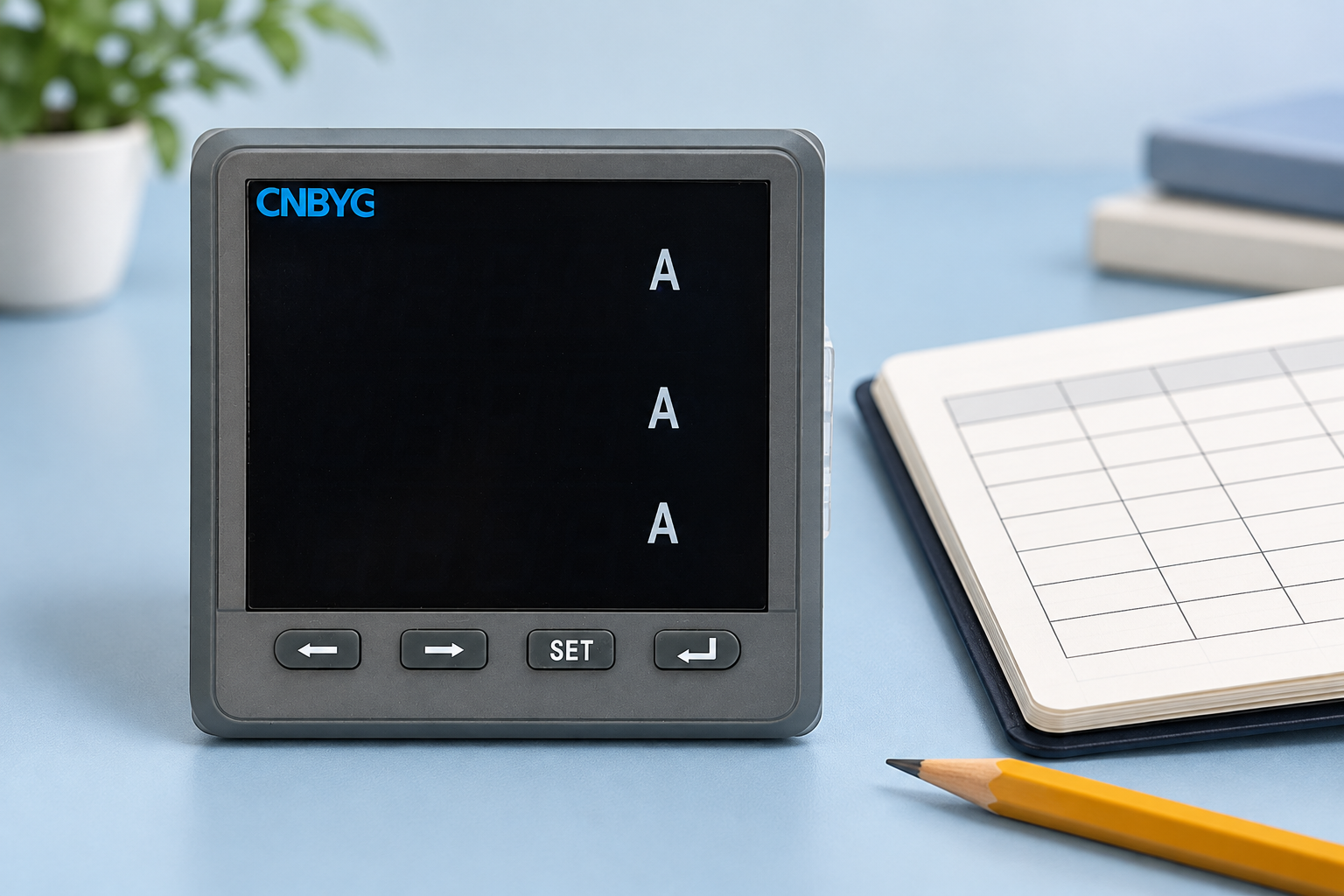
La familia de instrumentos CNBYG BY194 provides a relevant product context because its published description offers an optional RS485/MODBUS interface. The product image and family description do not establish the register map of every supplied variant. Obtain the exact model, firmware and communication manual before building tags. Do not copy a register from another manufacturer’s meter merely because both products use Modbus.
Read the table heading before entering a number
First identify whether the source describes holding registers, input registers, coils or discrete inputs. A number without its data table is incomplete. Function 03 and function 04 select different read operations in the standard protocol. A driver may combine table selection with a printed address prefix, or expose the function as a separate setting. Record both decisions.
Next find the manual’s explanation of addressing. Look for worked requests, hexadecimal columns, statements about base zero or base one, and examples supplied for the recommended client. A worked packet is often more decisive than a column simply labelled “address.” If two sections disagree, pause the affected tag and ask for clarification rather than changing every address in the project.
| Evidence in the documentation | Qué establecer | Commissioning record |
|---|---|---|
| A traditional register reference | Which table the prefix denotes | Reference and selected function |
| A zero-based address column | Whether the client expects that exact offset | Client entry and transmitted address |
| A one-based register number | Where the client applies conversion | Conversion rule with one worked example |
| A hexadecimal starting address | Whether the client field accepts hexadecimal | Both decimal and hexadecimal notation |
| A measurement spanning several words | First address and required word count | Start, length and representation |
This table is an interpretation checklist based on the protocol’s addressing model. It is not a BY194 register map. No addresses or supported functions for an individual CNBYG variant can be inferred from it.
Work through a hypothetical conversion
Suppose a hypothetical manual explicitly says that its holding-register reference 40001 corresponds to transmitted offset zero. Under that stated convention, reference 40010 corresponds to offset nine. A client configured to accept traditional references might therefore need 40010, while a client configured for raw offsets might need 9. These are two ways of selecting the same documented starting location, not interchangeable entries for the same input field.
Now suppose another hypothetical manual prints hexadecimal address 0010 and says the column already contains protocol offsets. The decimal equivalent is 16. Subtracting one would select offset 15 and introduce an error. The rule comes from the column definition and the client configuration, not from the appearance of the number.
A real project should attach the relevant manual page and a saved client configuration to this calculation. Include the register quantity as well. For a hypothetical two-register measurement starting at offset nine, requesting one register returns only part of the representation. Reading the correct start with the wrong length is a different fault from using the wrong base.
Verify with the smallest safe read
Begin on an approved maintenance connection with permission to access the instrument. Select a documented, read-only value that is available on the exact variant. Prefer a value with an independent comparison or recognizable identity. A measured current can be useful only when the relevant wiring, scaling and display interpretation are already understood. Zero under no load is weak evidence because many unrelated locations can also contain zero.
Disable automatic writes, time synchronization writes and configuration discovery that changes settings. Confirm the destination identity and unit identifier. Save the client mode, function, start address and count before transmitting. A read-only test should remain read-only even if a software wizard suggests fixing an unexpected response by writing a value.
Capture the request through a client log or an authorized protocol capture. Compare the transmitted starting address with the calculation on the commissioning sheet. For Modbus RTU, also retain the destination address and relevant serial parameters. The Modbus Serial Line guide explains the transport framing; it does not replace the product’s application register map.
Distinguish a valid reply from a valid measurement
A normal reply demonstrates that a request was accepted at some level. It does not demonstrate that the selected register is voltage, current, power or accumulated energy. A plausible number can result from an adjacent measurement, the wrong data type or a scaling coincidence. Validate meaning separately from transport success.
Compare the decoded value with a stable display reading or another approved reference. Record the time and operating condition so that a changing load does not look like an address fault. If there is a discrepancy, retain the raw returned words before changing decoding settings. Raw evidence lets the next engineer distinguish an offset error from word order, signedness, multiplier or CT-ratio problems.
cURL Too many subrequests by single Worker invocation. To configure this limit, refer to https://developers.cloudflare.com/workers/wrangler/configuration/#limits.
cURL Too many subrequests by single Worker invocation. To configure this limit, refer to https://developers.cloudflare.com/workers/wrangler/configuration/#limits
cURL Too many subrequests by single Worker invocation. To configure this limit, refer to https://developers.cloudflare.com/workers/wrangler/configuration/#limits.
cURL Too many subrequests by single Worker invocation. To configure this limit, refer to https://developers.cloudflare.com/workers/wrangler/configuration/#limits guía de intervalo de sondeo cURL Too many subrequests by single Worker invocation. To configure this limit, refer to https://developers.cloudflare.com/workers/wrangler/configuration/#limits.
cURL Too many subrequests by single Worker invocation. To configure this limit, refer to https://developers.cloudflare.com/workers/wrangler/configuration/#limits.
cURL Too many subrequests by single Worker invocation. To configure this limit, refer to https://developers.cloudflare.com/workers/wrangler/configuration/#limits
cURL Too many subrequests by single Worker invocation. To configure this limit, refer to https://developers.cloudflare.com/workers/wrangler/configuration/#limits.
cURL Too many subrequests by single Worker invocation. To configure this limit, refer to https://developers.cloudflare.com/workers/wrangler/configuration/#limits.
Acceptance and purchasing questions
Accept the integration only when the selected value, raw request and independent comparison agree within the limits of the comparison method. This is a communication mapping acceptance, not a calibration certificate. Keep measurement accuracy assessment in the separate meter accuracy verification procedure.
Before ordering, request the exact interface option, register-map revision, supported read functions, addressing examples and available configuration export. Ask whether firmware changes can alter the map. Require the supplier to identify any reserved ranges and restrictions on grouped reads. A sample request and expected reply for the ordered variant can prevent substantial commissioning work later.
Educational background: binary representation
The educational lesson below explains how computers interpret ordered bytes. It supports the distinction between selecting a register and interpreting its contents; it does not define meter addresses or substitute for a manufacturer’s register map. Address selection must be verified before changing representation settings.

Preguntas frecuentes
Should I always subtract one from a Modbus register number?
No. Establezca si el manual y el cliente utilizan referencias, números basados en uno o desplazamientos en bruto desde cero. Algunos clientes ya convierten la entrada. Verifique una lectura documentada a través de la solicitud transmitida antes de aplicar una regla a otras etiquetas.
¿El referencia 40001 siempre significa que debo ingresar 40001?
No. Según una convención tradicional de registros de retención, puede identificar el desplazamiento cero, pero el cliente puede esperar una referencia tradicional o un desplazamiento sin procesar. Utiliza la documentación exacta del controlador y el ejemplo de solicitud proporcionado por el medidor.
¿Puede el desplazamiento incorrecto aún devolver una lectura creíble?
Sí. Una dirección válida adyacente puede contener otra medición o un valor que se decodifique de forma plausible. Confirma el significado técnico mediante una comparación independiente y estable, y conserva las palabras sin procesar devueltas.
Can the BY194 product photograph establish its register map?
No. The photograph identifies the exterior reference only. Obtain the communication manual for the ordered model, interface option and firmware before assigning any measurement address, function, length or scaling rule.