


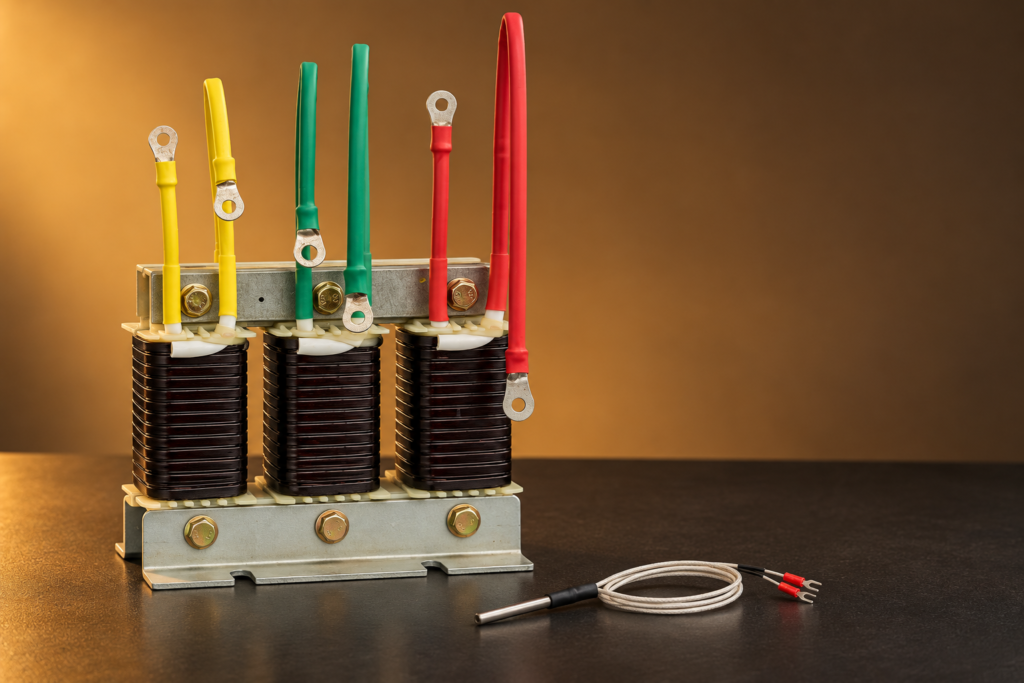
Reactor insulation class describes the thermal endurance classification of an insulation system; it is not a universal operating-temperature limit for the entire reactor. When selecting a low-voltage series reactor, check the insulation class together with the permitted winding temperature rise, reference ambient temperature, cooling arrangement, harmonic-current duty and protection settings. A higher insulation class does not automatically justify a hotter enclosure, a larger overload or a higher trip setting. The safe working temperature comes from the manufacturer’s documented design and the applicable project requirements.
This article helps panel builders and maintenance engineers distinguish terms that often become mixed together on quotations. It focuses on dry, iron-core reactors used with capacitor-compensation equipment. For the role of the reactor in the complete branch, see why use a reactor in a capacitor bank.
Insulation material and insulation system are different
A winding contains more than enamelled wire. Depending on construction, it includes interturn insulation, barriers, impregnation materials, sleeves, supports and other parts exposed to temperature and electrical stress. The thermal capability of one material does not by itself establish the thermal classification of the complete winding system. Compatibility between materials and the way the assembly ages matter.
L'officiel IEC 60085 publication description distinguishes electrical insulating materials from electrical insulation systems and addresses thermal evaluation and designation. This distinction is why an RFQ should ask about the reactor’s insulation system rather than merely asking whether one component is “high-temperature material.” A supplier’s claim about wire insulation alone leaves the rest of the assembly undefined.
Do not infer compliance from the appearance of a varnished coil. Color, gloss or a thick insulating sleeve does not demonstrate thermal endurance. Obtain the documented classification and the supporting information appropriate to the purchase specification. If the supplier describes a material rating without stating the system classification, clarify the scope before approving the reactor.
Keep five temperature terms separate
| Terme | What it describes | What it does not establish |
|---|---|---|
| Insulation-system thermal class | Thermal endurance designation of the insulation system | A universal permissible surface temperature |
| Winding temperature rise | Increase above the specified reference ambient under defined conditions | The final winding temperature without an ambient value |
| Température ambiante | Air temperature relevant to the installed reactor and test assumptions | Outdoor weather temperature if cabinet air is different |
| Hot-spot temperature | Temperature at a locally hottest region of the winding | A value reliably obtained from any convenient surface measurement |
| Protection threshold | The specified action point for a particular sensor and control scheme | A number that can be selected from insulation class alone |
The table is a terminology guide, not a list of operating limits. Request actual values, measurement methods and duty conditions for the quoted model. IEC 60076-6 covers reactor specification and testing categories; applicability to the particular equipment and contract should be confirmed rather than assumed.
Temperature rise must be paired with ambient temperature
A temperature-rise statement is incomplete when the reference ambient is missing. As an illustrative arithmetic example, a measured rise of 70 kelvin above an ambient of 35 degrees Celsius gives a corresponding measured temperature of 105 degrees Celsius. The temperature differences in kelvin and degrees Celsius have the same numerical increment. This example does not specify an acceptable rise or allowable temperature for a reactor.
The measurement method is equally important. A winding-resistance method estimates an average winding temperature under its prescribed conditions; a surface probe measures a particular accessible location. An infrared camera also depends on emissivity, viewing angle, reflective surfaces and the position being observed. These readings should not be treated as interchangeable representations of the winding hot spot.
For comparisons, record ambient and load at the same time as the reactor measurement. A reactor reading that appears unchanged may actually have a higher temperature rise if the enclosure air became cooler. Conversely, a higher absolute reading may reflect a hotter enclosure rather than a new electrical overload. Record both quantities so the conclusion can be tested.
Cabinet conditions can defeat an otherwise suitable rating
A supplier may have rated a reactor under a specified cooling arrangement, while the installed cabinet creates a different thermal environment. Restricted air paths, blocked filters, failed fans, high neighboring losses and cramped spacing can all affect the actual duty. Evaluate the air surrounding the reactor, not just the temperature outside the building.
Inspect whether vents and clearances match the panel design. Place temperature sensors where the approved arrangement specifies them. Moving a sensor to a cooler location may suppress nuisance trips while hiding the original problem. Adding acoustic foam or an enclosure around a noisy reactor can also change cooling and fire-performance assumptions. Mechanical and thermal modifications need engineering review.
The installation should preserve protective bonding, access and insulation clearances as well as ventilation. Cable routing should not obstruct airflow or place temperature-sensitive parts directly against a hot surface. A cabinet redesign needs a complete evaluation; choosing a higher thermal class cannot compensate for every installation defect.

Harmonic current changes thermal duty
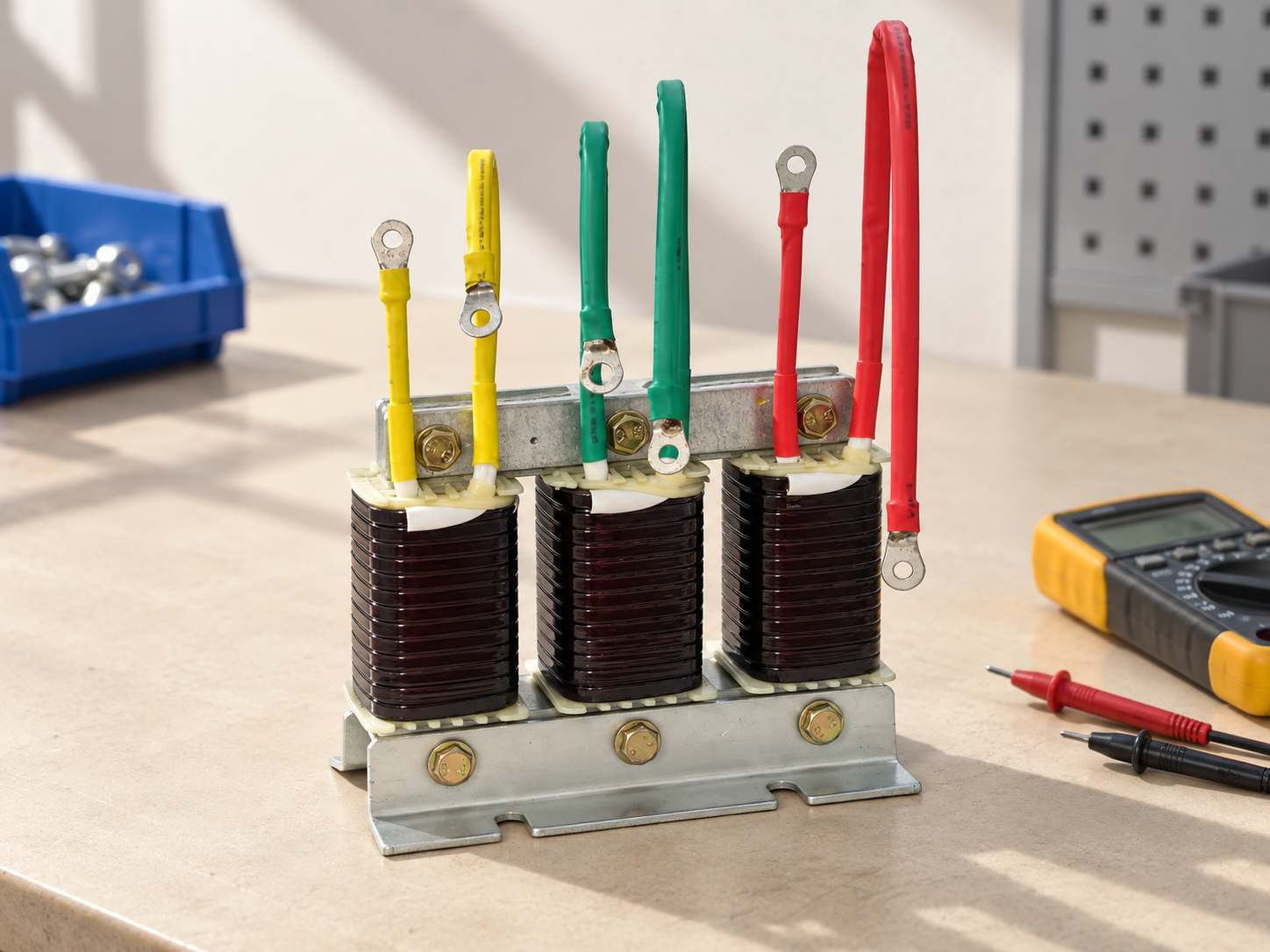
A reactor in a detuned branch carries more than the fundamental-frequency current when harmonics are present. The current spectrum affects winding and magnetic losses. Therefore, identical fundamental current does not guarantee identical heating in two plants. A panel serving predominantly linear loads may impose different duty from one with many variable-speed drives or rectifiers.
Obtain the total RMS current and harmonic spectrum at the relevant operating states. Compare them with the manufacturer’s stated duty. Do not apply a generic overload factor from an unrelated model. Review the capacitor and reactor as a matched branch because a component mismatch can change current and voltage stresses. Calcul des réacteurs détonnés provides the basic relationships, while the final thermal assessment requires the actual equipment data.
A reactor thermal class is not a harmonic-filtering specification. It does not state the inductance tolerance, saturation behavior, harmonic-current capability or detuning percentage. These are separate selection inputs. The RFQ should request them explicitly when the harmonic environment is important.
cURL Too many subrequests by single Worker invocation. To configure this limit, refer to https://developers.cloudflare.com/workers/wrangler/configuration/#limits
cURL Too many subrequests by single Worker invocation. To configure this limit, refer to https://developers.cloudflare.com/workers/wrangler/configuration/#limits.
cURL Too many subrequests by single Worker invocation. To configure this limit, refer to https://developers.cloudflare.com/workers/wrangler/configuration/#limits.
cURL Too many subrequests by single Worker invocation. To configure this limit, refer to https://developers.cloudflare.com/workers/wrangler/configuration/#limits cURL Too many subrequests by single Worker invocation. To configure this limit, refer to https://developers.cloudflare.com/workers/wrangler/configuration/#limits cURL Too many subrequests by single Worker invocation. To configure this limit, refer to https://developers.cloudflare.com/workers/wrangler/configuration/#limits.
cURL Too many subrequests by single Worker invocation. To configure this limit, refer to https://developers.cloudflare.com/workers/wrangler/configuration/#limits
cURL Too many subrequests by single Worker invocation. To configure this limit, refer to https://developers.cloudflare.com/workers/wrangler/configuration/#limits.
cURL Too many subrequests by single Worker invocation. To configure this limit, refer to https://developers.cloudflare.com/workers/wrangler/configuration/#limits.
If noise or vibration also changed, use reactor noise and vibration troubleshooting. A new thermal problem and a new sound may share an electrical cause, but neither symptom by itself proves an insulation-class mismatch.
What to include in a reactor RFQ
State the system voltage and frequency, required branch output, capacitor arrangement, harmonic survey, expected operating duty and enclosure conditions. Ask the supplier to specify the insulation-system class, permitted winding rise, reference ambient, test method, cooling conditions and integrated protection details. Request clarification of continuous and temporary duty rather than assuming an unspecified rating is continuous.
Where the project has a required standard, identify the edition and the applicable test evidence in the contract. A web article’s reference to an IEC publication does not certify a product. Obtain the relevant declaration, test report or other evidence required by the project. Distinguish a catalogue description from a documented test for the offered configuration.
Pour CNBYG CKSG low-voltage series reactors, submit the actual capacitor-stage data and enclosure conditions for selection. Ask for a matched electrical and thermal proposal. Do not specify a thermal class as the sole selection criterion or promise that a particular temperature will be safe without model-specific documentation.

Build a useful maintenance record
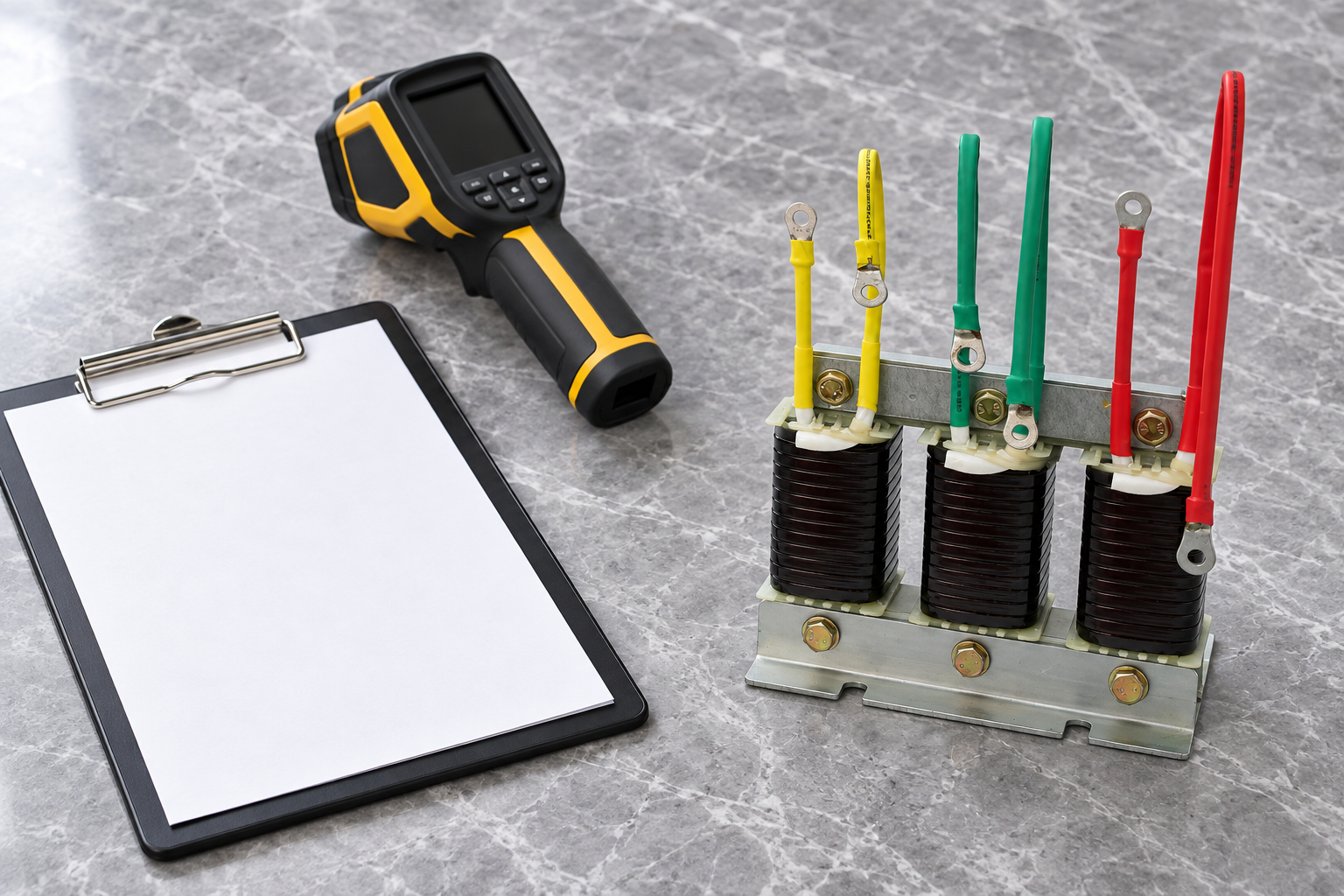
Record the reactor identification, sensor location, cabinet ambient, operating state, phase currents, harmonic measurements and temperature method. Include the time since energization and the time of any stage changes. This avoids comparing a short warm-up reading with a steady operating reading. Preserve photographs of the measurement locations so another technician can repeat the observation.
Trend the same quantities over time. A rising temperature under comparable conditions may justify investigation even if a protective trip has not occurred. Conversely, a single reading without ambient and load information is rarely sufficient to establish deterioration. Let the documented limits and repeatable evidence drive the decision.
Formation continue

This inductor lesson explains the magnetic component’s operation. It supplements the terminology above and does not replace model-specific thermal data or safe maintenance procedures.
Foire aux questions
Is insulation class the maximum permitted reactor surface temperature?
Non. La classification thermique concerne le système d’isolation. Les conditions admissibles pour les enroulements et la surface nécessitent de connaître les données de conception de la réactance, les hypothèses relatives à la température ambiante, la méthode de mesure et les exigences applicables à l’équipement.
Does a higher class allow a higher trip setting?
Not automatically. A protection setting depends on the sensor location and the complete thermal design. Investigate the cause of trips and obtain the manufacturer’s approved setting instead of deriving it from a class label.
Can an infrared image prove winding temperature rise?
It can support an investigation, but it measures visible surface radiation under instrument assumptions. It does not automatically give average winding temperature or the winding hot spot. Record the specified method and ambient.
What should be checked when replacing a reactor?
Confirm electrical matching, thermal class and rise data, ambient and cooling requirements, mounting, clearances, terminals and sensor integration. Keep the capacitor and reactor combination consistent with the approved branch design.