How to Review VFD Harmonics in a Cold Storage Plant
Cold stores often run compressors, evaporator fans and pumps at different speeds. That flexibility changes the load profile, but it does not by itself tell you whether the upstream complaint is harmonic current, voltage distortion, a control event or a motor-side PWM problem. The useful question is not “does a VFD create harmonics?” It is “which feeder and PCC record changes with which refrigeration state?”

Start with the refrigeration operating states
Build a simple event vocabulary that the refrigeration controller, meter and operator can share. A useful first pass is pull-down, steady hold, defrost transition, compressor restart and low-load operation. The exact names can follow the plant controls; the point is to preserve the state beside the electrical timestamp.
Danfoss describes compressors as constant-torque loads and fans as variable-torque loads. That distinction helps explain why a fan feeder may change quickly with speed while a compressor feeder follows pressure and capacity-control behavior. It does not prove a harmonic level.
Keep the electrical boundaries separate
Measure the drive feeder that contains the suspected compressor, fan or pump group, then measure the upstream bus or PCC in the same window. Record phase current, voltage waveform, harmonic spectrum, demand current, power factor and the active refrigeration state. A motor-side PWM symptom belongs in a separate record from line-side current distortion.
| Batas | What it can answer | What it cannot answer alone |
|---|---|---|
| Drive feeder | Which load group changes the current spectrum | Whether the utility-facing PCC is within a planning target |
| Main distribution bus | Whether several feeders combine or cancel | Which individual compressor or fan is responsible |
| PCC | What the upstream system sees | Whether a motor cable or shaft-current issue exists |
| Motor terminals | PWM, cable, bearing or insulation clues | The feeder’s utility-facing harmonic current |
Read a measurement by state, not by one average
For each state, keep the same meter setup and CT orientation. Note which compressors are enabled, fan speeds or staging, defrost heaters, and any restart or bypass command. If the PCC spectrum changes only during a particular sequence, investigate that sequence and its feeder before selecting a plant-wide filter.

Decide what evidence is still missing
A defensible review should have:
- A one-line diagram with transformer and feeder impedances noted.
- Drive input topology and any line reactor, DC choke, passive filter or AFE information.
- State-tagged records for pull-down, hold, defrost and restart.
- Separate line-side and motor-side observations.
- A before/after boundary if a mitigation trial is proposed.
If a complaint is “compressor trips when the cold room recovers,” do not jump from timing to causation. Check voltage events, current spectrum, protection logs and controller state in the same interval.
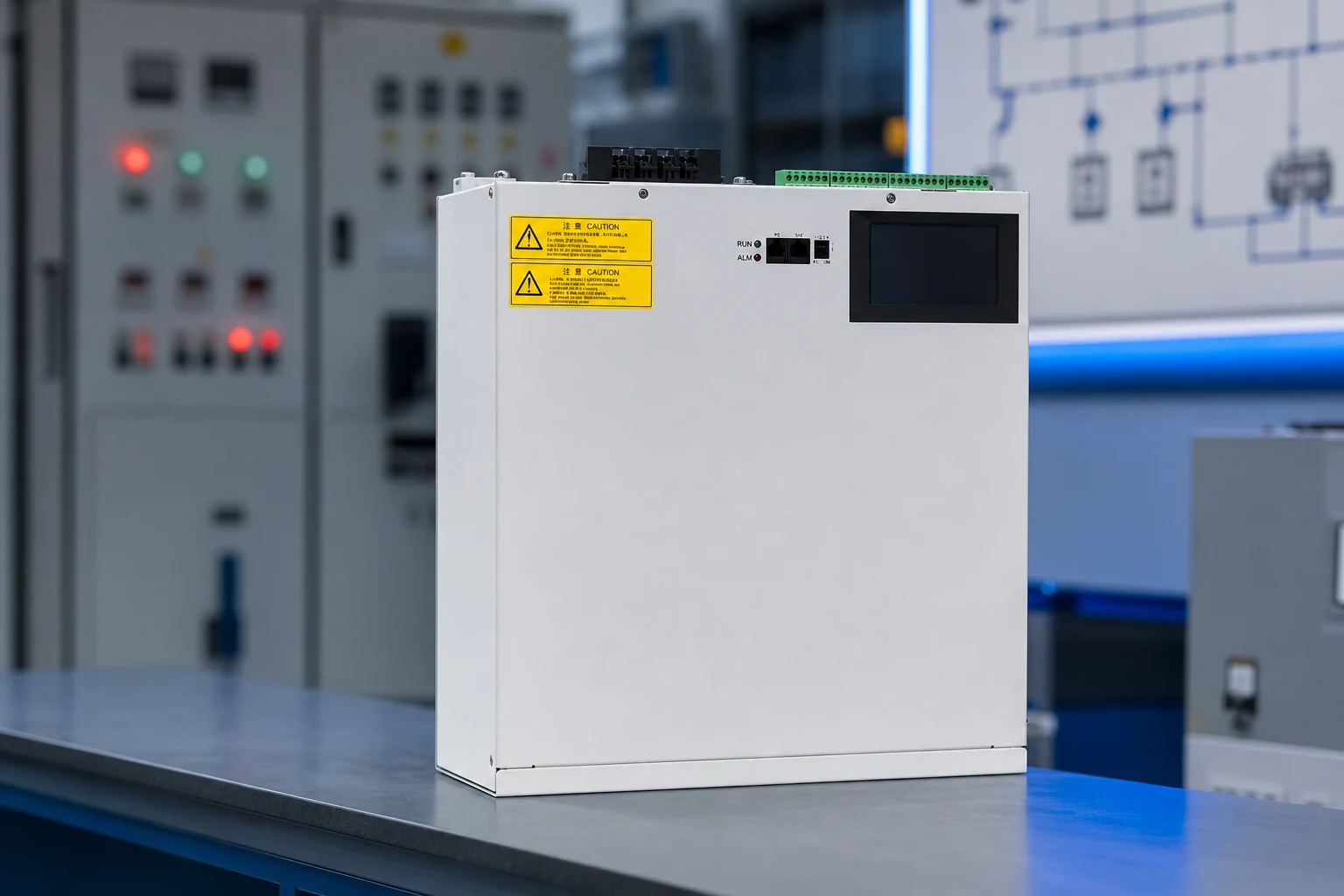
A cold-storage AHF path after state-tagged measurements
CNBYG’s AHF/APF product path is a reasonable next conversation when the feeder and PCC record shows a line-side harmonic problem that cannot be resolved by drive settings, grouping or source-side design. Ask for model-level current capacity, CT arrangement, environmental limits, bypass behavior and commissioning evidence. The link is a product path, not a claim that a specific CNBYG model fits this cold store.
For the broader system context, see the Power Quality System pillar and the related food-processing mixer review dan power-quality metering guide.