Why Power Capacitors Swell or Leak
Power capacitor swelling and leakage are stop-and-investigate signs, not normal maintenance conditions. A distorted enclosure can indicate internal pressure or thermal stress; material around a seal can come from the unit or from another source. Neither observation identifies the root cause by itself. Keep the affected stage out of service under the site’s approved procedure, preserve evidence and ask a qualified person to assess the unit and its circuit. This guide focuses on industrial low-voltage film capacitors rather than batteries, electronic electrolytics or motor-start capacitors.
Identify what is actually damaged
Record the complete model, serial number, voltage, frequency, kvar or capacitance, internal connection and construction from the installed unit’s documents. Similar cylindrical cases can contain different capacitor systems. Do not infer oil content, pressure-device operation or permissible case movement from appearance. A replacement catalogue description also cannot establish how the failed unit was manufactured. Obtain the applicable manual or written supplier clarification before making a disposal or replacement decision.
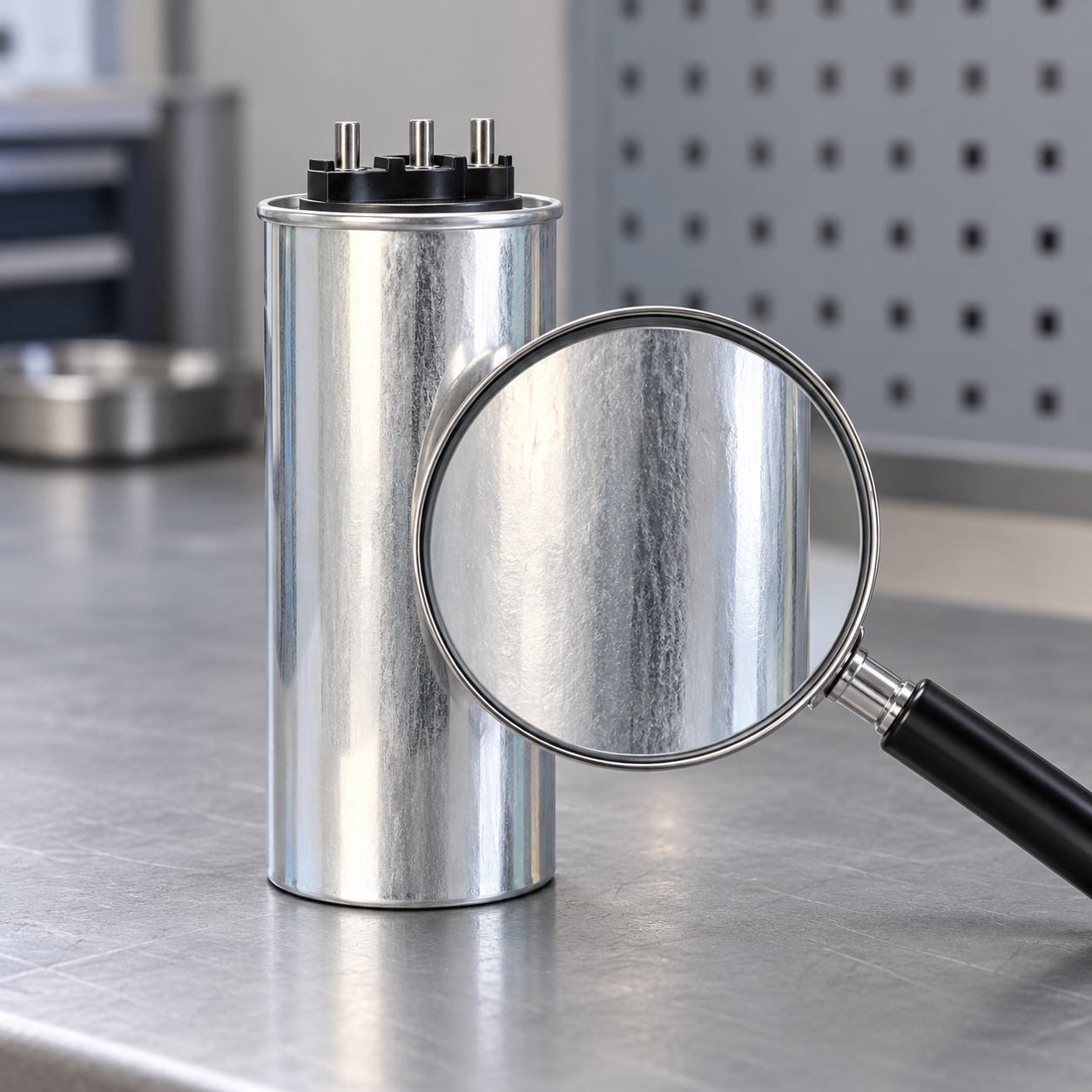
Itu CNBYG BSMJ cylindrical capacitor family is a relevant product starting point for a low-voltage compensation enquiry. Send the original identification and circuit details when requesting a matching replacement. The illustration below shows an intact product-reference exterior; it does not document a real failure or suggest that its particular construction contains liquid.
Record swelling before dismantling
Photograph the full case, top, terminals, mounting and surrounding equipment from safe access positions. Note whether the observed change is local to a dent, distributed around the enclosure or associated with a moved terminal assembly. Compare with commissioning photographs if available. Avoid pressing the case, tightening a seal, drilling, opening or attempting to flatten it. Physical manipulation can destroy evidence and create additional exposure.
A protective disconnection mechanism, when the specific product has one, may deliberately change the assembly as it operates. Its identity and inspection criteria come from the manufacturer. Do not bridge a disconnected element or try to restore terminal contact. Treat an apparently open unit as a failed component pending confirmation, and investigate why it reached that condition before installing another one.
Distinguish a leak from contamination
Trace the location and pattern of any residue without touching an unidentified substance. Nearby equipment, cleaning agents, condensation and environmental contamination can imitate a leaking capacitor. Record when the material was first observed, its route and whether adjacent units have a similar deposit. Use site environmental and handling procedures for sampling or cleanup. Visual resemblance is not a chemical identification.
If the unit is confirmed to contain an impregnant, obtain its safety and disposal information. Do not assume that every old capacitor contains the same material, or that a modern-looking enclosure proves its contents harmless. Keep identification with the removed unit so the waste contractor and maintenance team have a traceable record. A sealed product should not be opened simply to find out what is inside.
A decision table for the first investigation
This table organizes observations rather than setting a universal acceptance limit. Product-specific safety and inspection requirements take priority. IEC 60831-1 identifies the relevant standards family for self-healing low-voltage shunt capacitor units and banks; obtain the actual applicable documentation for acceptance testing.
| Pengamatan | Question to resolve | Evidence and next action |
|---|---|---|
| Changed case shape | Mechanical damage, heat or internal pressure? | Preserve photographs and isolate the affected stage for qualified assessment |
| Residue near a seal | Unit contents or external contamination? | Identify construction and substance through approved handling procedures |
| Moved terminal assembly | Has a documented protective feature operated? | Check product instructions; never bypass or mechanically reset it |
| Several affected units | Shared electrical or cooling stress? | Compare batch identity, operating records, harmonic duty and cabinet temperatures |
| One hot connection | Local connection resistance? | Investigate termination condition and specified installation method |
| Recurrence after replacement | Was only the symptom replaced? | Reopen the cause review before repeating the same replacement |
Stored energy still matters
An open supply switch does not establish that a capacitor is safe to handle. Stored charge, other sources and adjacent circuits must all be considered. OSHA’s electrical work-practice requirements address releasing hazardous stored energy and verifying deenergization. The precise isolation, discharge and grounding procedure depends on the installation and jurisdiction. This article does not provide an improvised discharge method or a universal waiting period.
Use qualified personnel, approved equipment and documented verification. A pressure-operated disconnect or blown fuse is not a substitute for proving safe access. The capacitor-bank safety guide connects component handling to the complete assembly. Keep visibly damaged units segregated, labelled and protected against accidental reconnection while the assessment remains open.
Check electrical stress using operating evidence
Review voltage and current records from before the event if available. A single reading after the failure may not represent the duty that caused it. Note operating modes, transformer changes, generator use, large drive starts and switching events. Distinguish fundamental current from total current when harmonics are present. The basic frequency dependence of capacitor reactance is explained in OpenStax’s AC-circuit lesson.
Capacitors are part of a network, and installing another unit can change that network again. Check the matching reactor, actual stage capacitance and original design assumptions. The guide to reactors in capacitor banks provides related context. Do not conclude that a reactor is adequate merely because one is fitted, or substitute a different capacitance without assessing the coordinated branch.
Separate cabinet heat from local heating
Review the cabinet cooling path, inlet conditions, filters, fans, spacing and neighbouring heat sources. Compare events with demanding production periods and ambient conditions. A unit may run hotter because the cabinet has changed, even though its own rating and controller setting remain unchanged. Record the actual surrounding temperature and operating duration rather than relying on the room’s nominal design temperature.
Local terminal heating deserves a separate work order. A loose or damaged connection, unsuitable conductor arrangement or incorrect installation can heat one region without explaining the temperature of the entire enclosure. Use manufacturer instructions for any termination work; there is no universal tightening value in this guide. Record the repair and its verification so later inspections can distinguish a recurring connection fault from component aging.
Review switching and protection history
Collect contactor or thyristor-switch commands, actual stage currents, fuse events and controller changes. Rapid stage operation can increase switching duty. A defective switch can leave a stage connected unexpectedly, while a failed contact prevents the intended correction. The controller display alone does not prove the physical switching state. Investigate the command and response together before attributing every alarm to the capacitor.
Repeated protection operation requires cause analysis. Replacing a fuse with a different type or greater rating can conceal a problem and alter coordination. Retain the original protective-device identity and event sequence. Ask whether the event occurred on connection, during sustained load or after another stage operated. Those distinctions help separate switching stress, sustained overload and an existing internal fault.
Approve a replacement as a coordinated change
Give the incident a clear boundary: the affected component, the stage and the operating period. Preserve the removed component where the agreed investigation requires it, with its identity and handling instructions. Record what evidence would change the current cause assessment. For example, damage concentrated across one cabinet may justify a shared cooling investigation, while repeated events on a single stage may direct attention to switching and connection history. Neither pattern alone proves the cause, but it helps the team choose a test that can distinguish alternatives instead of collecting unrelated readings.
An enquiry should include the old identification, internal connection, stage duty, reactor details, dimensions, mounting, discharge arrangement, switching device and protection. Attach the failure evidence and relevant operating measurements. The engineer should decide whether a like-for-like replacement is appropriate or whether a design change is needed. Physical fit and a similar catalogue kvar are insufficient on their own.
Define return-to-service evidence before installation. Confirm identification, installation, protection, discharge function and expected operational response under the approved procedure. A new intact enclosure does not prove that the original stress has disappeared. Schedule a targeted follow-up during a representative demanding operating state. Keep the result with the bank maintenance records rather than closing the incident only with an invoice.
Educational video: what capacitors store
The Engineering Mindset explains charge storage and basic capacitor behaviour. Small-component demonstrations provide conceptual background, not an industrial discharge or failure-handling procedure. Follow the installed equipment instructions and qualified personnel’s method for the actual bank.
Pertanyaan yang sering diajukan
Can a swollen capacitor be put back into service?
Keep it out of service pending qualified assessment against the product instructions. Do not press, open, reset or bypass a damaged unit to restore operation.
Does residue prove that a capacitor is oil-filled?
No. Identify the original construction and trace the source of the material. External contamination can resemble a leak, and different sealed products contain different materials.
Should every capacitor in the cabinet be replaced?
The evidence determines the scope. Compare shared electrical duty, cooling, batch identity and individual test results; neither automatic full replacement nor replacing only the visibly damaged unit is always justified.
What prevents the same damage recurring?
A documented cause review, a coordinated replacement and verification under representative operation. Replacing the case without addressing heat, switching or network stress can leave the original problem unresolved.