Compensação de Potência Reactiva para Cargas Portuárias
Port crane power factor correction should be selected from measured active and reactive power across complete crane duty cycles, including hoisting, travel, idle operation and any regenerative periods. Do not size compensation from the motor nameplate or a single power factor reading. Identify the drive topology, measurement convention, supply arrangement and harmonic conditions first. Then determine whether the remaining problem is fundamental reactive demand, distorted current, an active-energy recovery issue or a supply-voltage event. These require different engineering responses.
This guide addresses the information needed to specify reactive compensation for crane electrical supplies. It does not claim that an ordinary low-voltage compensator is suitable for every crane, marine environment, generator or medium-voltage supply. Product suitability, protection and installation require project-specific manufacturer approval and qualified engineering review.
Separate reactive compensation from the crane drive system
A crane contains several electrical operating conditions. Hoisting under load, lowering, trolley movement and standby do not impose the same power profile. Different drives may also exchange energy through a common DC arrangement. Obtain the actual electrical diagram before deciding where a compensation device could be connected.
Identify whether each major drive uses a diode rectifier, another controlled input stage or an active front end. Obtain its documented supply behavior rather than assuming every variable-speed drive has identical power factor. A modernized crane may combine equipment generations, auxiliary motors and lighting on the same incoming feeder.
O existente port RTG crane harmonic measurement guide focuses on locating harmonic contributions. Use those records as supporting evidence here. This article addresses the separate decision about fundamental reactive compensation and acceptance requirements, rather than repeating that harmonic measurement procedure.
Define the measurement boundary and commercial objective
State whether the objective concerns one crane’s incoming feeder, a terminal transformer, a generator or the utility connection. A satisfactory result at a crane feeder does not automatically establish the result at a terminal containing other loads. Likewise, a utility interval may conceal short duty-cycle behavior that affects a local supply.
Obtain the utility or port operator’s applicable billing and operating requirements. Confirm whether the concern is reactive energy, demand, displacement power factor, true power factor or a specific voltage complaint. Do not use a universal power factor target without checking the contract and measurement definition.
The utility explanation of power factor correction from Paulding Putnam Electric Cooperative provides general background. Apply the actual local tariff and supply agreement to the project. A general utility explanation is not evidence that a specific crane will achieve a promised saving.
Record the complete operating cycle
Use instruments and sampling methods capable of representing the relevant changes in operation. Synchronize electrical recordings with the crane’s operating log where practical. Retain active power, reactive power, voltage, current and the relevant harmonic quantities rather than storing only a derived power factor percentage.
Capture representative loaded and unloaded cycles, idle periods, overlapping movements and the operating combinations associated with the complaint. Record which conditions were absent during the survey. A light-duty demonstration should not be accepted as evidence for a heavily loaded production cycle.
For a terminal with several cranes, assess coincidence. The peak of one unit does not prove that every crane reaches its peak at the same time, but assuming diversity without records is equally weak. Use a time-aligned aggregate recording when specifying compensation at the common supply.
| Observed operating condition | É necessária evidência | Engineering question | Evitar concluir |
|---|---|---|---|
| Loaded hoisting | Signed active and reactive power over the movement | Is fundamental reactive demand material at this boundary? | Motor rated power equals compensation rating |
| Lowering or braking | Drive topology, signed power and energy-flow records | Is active power returning to the supply or handled locally? | Reactive compensation absorbs regenerative active energy |
| Idle operation | Low-load records and existing stage status | Could compensation become excessive? | A setting chosen at full load works at idle |
| Several cranes operating | Synchronized individual and common-feeder records | What demand actually coincides? | Either full coincidence or perfect diversity without evidence |
| Distorted current | Harmonic spectrum and relevant current quantities | Is distortion reducing true power factor? | More capacitance necessarily solves the problem |
| Generator supply | Generator controls, operating envelope and transient records | cURL Too many subrequests by single Worker invocation. To configure this limit, refer to https://developers.cloudflare.com/workers/wrangler/configuration/#limits | cURL Too many subrequests by single Worker invocation. To configure this limit, refer to https://developers.cloudflare.com/workers/wrangler/configuration/#limits |
| cURL Too many subrequests by single Worker invocation. To configure this limit, refer to https://developers.cloudflare.com/workers/wrangler/configuration/#limits | cURL Too many subrequests by single Worker invocation. To configure this limit, refer to https://developers.cloudflare.com/workers/wrangler/configuration/#limits | cURL Too many subrequests by single Worker invocation. To configure this limit, refer to https://developers.cloudflare.com/workers/wrangler/configuration/#limits | cURL Too many subrequests by single Worker invocation. To configure this limit, refer to https://developers.cloudflare.com/workers/wrangler/configuration/#limits |
cURL Too many subrequests by single Worker invocation. To configure this limit, refer to https://developers.cloudflare.com/workers/wrangler/configuration/#limits.
cURL Too many subrequests by single Worker invocation. To configure this limit, refer to https://developers.cloudflare.com/workers/wrangler/configuration/#limits
cURL Too many subrequests by single Worker invocation. To configure this limit, refer to https://developers.cloudflare.com/workers/wrangler/configuration/#limits.
Do not specify an SVG as a regenerative energy sink. Reactive current control and management of returned active energy are different functions. The crane drive supplier must establish how braking energy is handled and whether the supply is permitted to accept it. A compensation proposal cannot substitute for that review.
Where a power factor value becomes unstable around very low active power, inspect the underlying current and reactive quantities. A visually dramatic percentage can correspond to a limited absolute demand. Use engineering quantities and the relevant operating requirement to determine significance rather than reacting to the display alone.
Distinguish distortion from displacement
True power factor can be affected by waveform distortion as well as fundamental phase displacement. A capacitor bank changes reactive behavior but does not automatically remove harmonic current produced by a drive. Assess the harmonic profile before introducing capacitance into the network.
Review existing filters, capacitor stages, cable characteristics and transformer information. A proposed change can alter network interaction. The project engineer should determine whether a harmonic or resonance study is needed, particularly when equipment is added at an already distorted common supply.
O Publicação IEC 61000-4-7 is relevant to harmonic measurement methods. Select the applicable method, instrument capability and assessment boundary for the actual investigation. It does not provide a universal device capacity derived from a single measured distortion percentage.
Evaluate response across changing demand
Compare the measured reactive demand profile with the documented control capabilities of the proposed equipment. Include both inductive and capacitive requirements if the project needs them. Obtain the response conditions, limits and sensing arrangement from the manufacturer; do not assign a performance claim based on the device category alone.
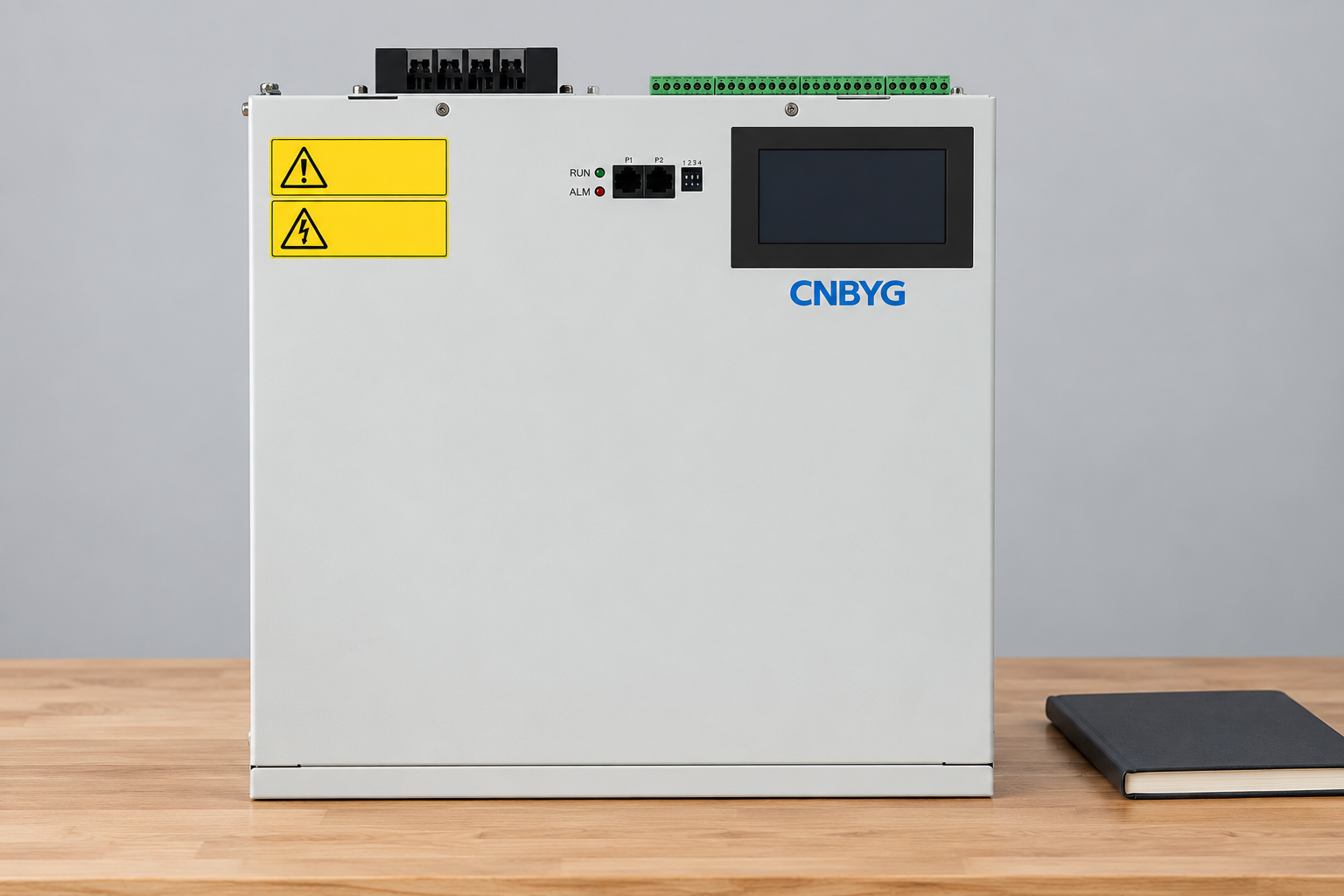
For an appropriate low-voltage application, the CNBYG SVG product can be considered within a manufacturer-reviewed compensation design. Confirm the voltage, frequency, connection arrangement, current capacity, ambient conditions, installation position and required controls for the exact supplied version.
O guia de dimensionamento SVG de carga dinâmica provides complementary sizing questions. Use actual time-aligned demand and project operating requirements. A large margin is not automatically a sound design if minimum-load behavior, control interaction or available supply capacity has not been assessed.
Assess existing capacitor compensation carefully
Inventory any fixed or automatically switched capacitor stages already connected to the crane or shared supply. Record stage ratings, controller settings, detuning provisions where fitted and the conditions under which stages operate. Compare the inventory with the as-built electrical diagram.
A steady inductive load may support a different approach from a rapidly changing crane cycle. Evaluate switching limitations, minimum demand and the interaction with drives. Do not add a fixed bank merely because a monthly bill suggests low power factor; it could be excessive during other operating states.
General correction principles do not establish a saving for a port crane. Retain the distinction between a proposed benefit and a site-specific verified outcome.
Review generator operation and environmental suitability
If a crane can operate from a generator or change supply modes, include those modes in the design review. Obtain the generator’s approved operating envelope, regulator information and supplier requirements. Compensation equipment and generator controls must be assessed together rather than treated as independent upgrades.
A port environment also requires attention to installation location, moisture, salt exposure, ventilation, vibration and access for maintenance. Do not infer environmental suitability from an exterior cabinet photograph. Obtain the actual enclosure and installation documentation for the selected location.
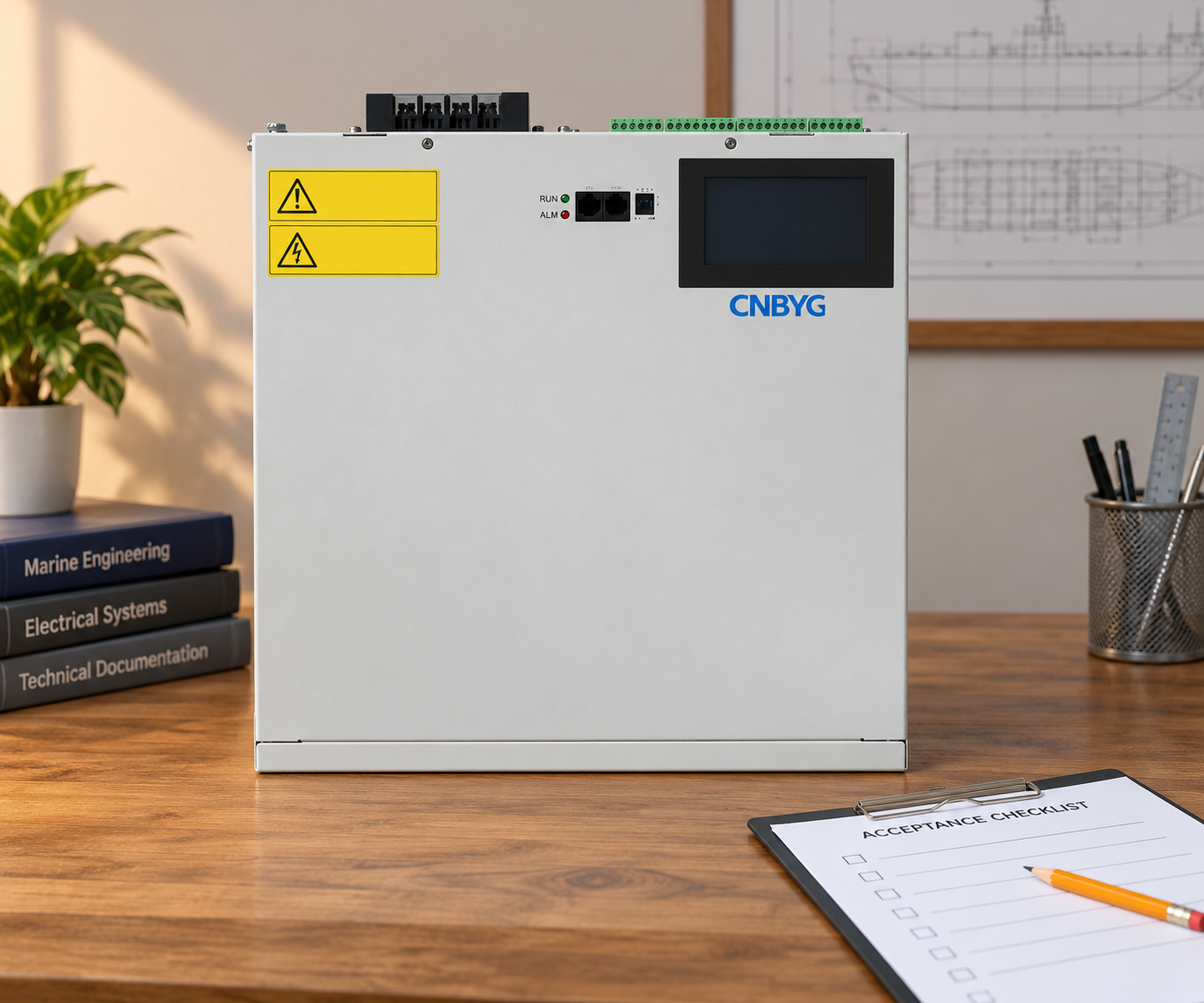
The illustration in this article shows a disconnected product exterior on an engineering workbench. It does not show a commissioned crane installation, a marine enclosure qualification or a wiring arrangement. Final equipment selection must follow documented project conditions and manufacturer application confirmation.
Write measurable acceptance conditions
Specify where the result will be measured, which methods and instruments will be used, and which operating cycles must be present. Include the tariff or operational requirement being assessed. Separate reactive performance from harmonic performance and any active-energy management requirement.
Compare before-and-after recordings under reasonably comparable conditions. Record crane loading, movement sequence, concurrent equipment and supply mode. If production conditions differ substantially, explain that limitation instead of attributing every numerical difference to the compensation change.
Include idle and transition checks as well as loaded operation. A system that achieves its objective during one hoist but causes excessive compensation or unstable behavior elsewhere is not demonstrated satisfactory. Define the response to failed acceptance conditions before procurement.
Retain a useful handover record
Keep the approved diagram, measurements, operating logs, equipment configuration, manufacturer suitability confirmation and acceptance results together. Record who may change control settings and how a later crane drive replacement will trigger review. Equipment changes can invalidate the assumptions behind the original compensation selection.
Utilize Guia de pesquisa sobre a qualidade da energia industrial for the wider evidence workflow. The location may be a port, but the same discipline applies: define the complaint, preserve synchronized measurements, distinguish causes and test the selected remedy under stated conditions.
Aprimoramento: padrões e monitoramento
The NPTEL lecture below explains general power quality standards and monitoring concepts. It supports the measurement-boundary discussion. It is not a crane-specific installation manual or evidence that the illustrated SVG is approved for a particular terminal.
Assista ao vídeo "Qualidade da Energia: Normas e Monitoramento"
Perguntas frequentes
Posso dimensionar a compensação da grua com base na potência nominal do motor de elevação?
Não. Obtenha dados representativos da procura de potência reativa ao longo dos ciclos de funcionamento, das condições de alimentação e das cargas simultâneas. A potência nominal do motor, por si só, não permite determinar a corrente de compensação necessária nem o comportamento do sistema de controlo.
Um SVG irá absorver a energia de travagem regenerativa?
Reactive compensation is not an active-energy sink. The drive and supply design must establish how returned active energy is managed, independently of the reactive compensation requirement.
Um fator de potência negativo comprova uma sobrecompensação capacitiva?
No. Check the meter's sign convention, signed active and reactive power, and the operating state. A change in active power direction must not be confused automatically with reactive power reversal.
Is a standard low-voltage cabinet suitable outdoors at a port?
Suitability must be established from the actual enclosure, environmental and installation documentation. A product photograph does not prove resistance to salt, moisture, vibration or the requirements of the selected location.