Correção do fator de potência para estações de carregamento de veículos elétricos
Correção do fator de potência para estações de carregamento de veículos elétricos
Power factor correction for EV charging stations must account for charger diversity, simultaneous plug-in events, harmonic current, idle periods and the utility meter boundary. A station can have a good average PF while creating a short current peak when many vehicles begin charging. It can also become leading overnight if fixed capacitors remain connected after vehicles leave. The correction plan should coordinate charger controls, transformer capacity, an SVG or APFC equipment and the station’s load-management strategy.
O Página do produto CNBYG SVG provides context for dynamic reactive-current support. Select the capacity and control priority from measured chargers, approved voltage limits and the site’s operating modes, not from the number of parking spaces alone.
Charging stations are variable electronic loads
AC chargers, DC fast chargers, payment systems, lighting, ventilation and battery storage may share the same transformer. Chargers can start in groups, ramp current, pause for vehicle limits or follow a site demand cap. Their input current waveform and power-factor definition may differ by model. Record the charger type, rated input, phase connection, duty cycle and load-management rule.
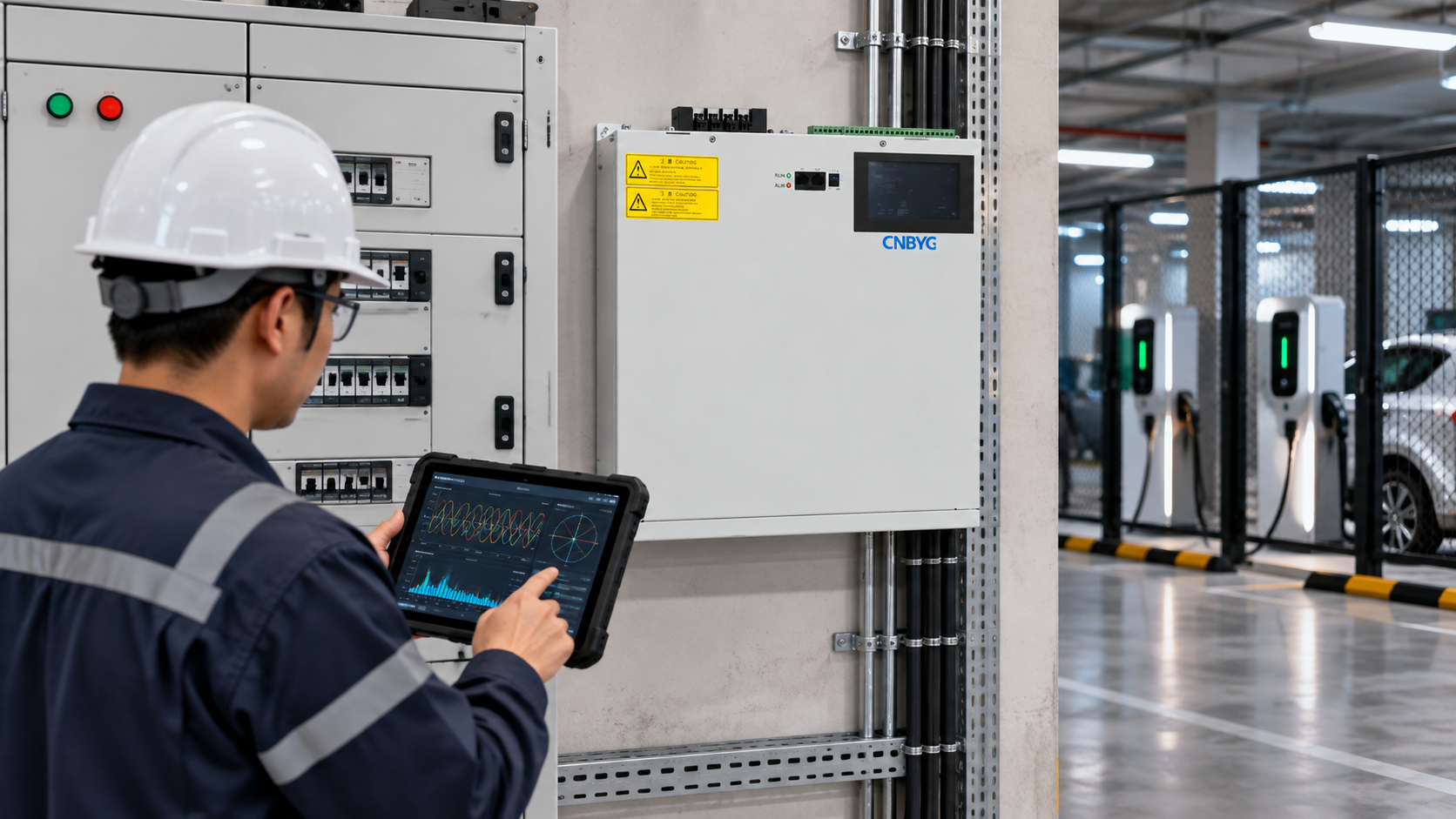
Map the charger distribution boards, transformer, main meter, capacitor bank, SVG, battery, solar system and utility connection. Capture idle, one charger, normal occupancy, maximum simultaneous charging, demand-limit transitions and overnight auxiliary load. Record kW, kvar, voltage, current, PF, THD and individual harmonic orders at the PCC and a representative charger group.
EV station correction decision table
| Observação | Área provável | Primeira verificação |
|---|---|---|
| PF falls when several chargers start | Simultaneous ramping or transformer current limit. | Use synchronized high-resolution traces and charger state. |
| True PF is worse than displacement PF | Harmonic current from charger rectifiers. | Check THD and the meter definition at the PCC. |
| PF becomes leading overnight | Fixed capacitors remain with only auxiliary load. | Apply an idle-load rule and check step status. |
| Demand cap causes PF oscillation | Charger load manager and compensator respond at similar speeds. | Assign priorities, deadband and delay. |
| Charger group PF differs from PCC PF | Different CT boundary or other site loads. | Synchronize meters and mark the correction boundary. |
| SVG current reaches a limit | Harmonic or unbalance duty uses shared current. | Review current priority and the voltage capability curve. |
Define the utility and charger boundaries
State whether the target is true PF, displacement PF, demand PF or a utility-specific value. Mark the point of common coupling and each charger distribution CT. A charger display may show a good PF while the PCC includes transformer magnetizing current, lighting and another feeder. Conversely, a charger-level correction may not improve the billed boundary.
Verify CT ratio, phase, polarity, burden and voltage reference. Compare the charger, switchboard and PCC meters with an independent analyzer during one charger and several simultaneous chargers. The Guia de compensação de corrente reativa SVG explains why an incorrect boundary can be mistaken for a capacity problem.
Select stepped or dynamic correction
Stepped capacitors can suit a predictable base load, but they need minimum on/off times, discharge and protection. EV stations can move from full load to idle quickly, so a stage that is appropriate during a charging wave may be excessive after vehicles leave. A night or idle rule is essential.
An SVG can follow changing reactive current and share current with harmonic or unbalance compensation. The Guia de tensão da grade e capacidade do SVG explains why the available kvar changes with voltage. Reserve current for harmonic filtering when charger distortion is significant, and coordinate the SVG with the station demand controller so both do not chase the same event.

Size from simultaneous charging scenarios
Measure net kW and kvar at the PCC for low occupancy, normal occupancy and maximum simultaneous charging. Estimate the reactive requirement with:
[
Q_c = P\left(\tan(\cos^{-1}PF_1)-\tan(\cos^{-1}PF_2)\right)
]
Use the PCC sign convention and then check current at the lowest voltage using (I_Q=Q/(\sqrt{3}V_{LL})). Add the harmonic and unbalance current that must be supported. Do not use the number of chargers as a direct kvar multiplier; charger power, phase balance, demand limits and occupancy determine the actual profile.
Include transformer inrush, charger ramping and a controlled demand-cap event. If the site has solar or battery support, test import, export and island modes separately. Document what happens when the SVG reaches its current limit: relax the PF target, reduce harmonic priority, alarm or hold the last safe value.
Coordinate charger controls and correction
Create a sequence for vehicle plug-in, charger ramp, demand-limit action, vehicle stop and overnight idle. State which controller owns the PCC target, which device handles harmonic current and which capacitor stages are blocked. Use deadband and delay so short charging pulses do not cause repeated switching.
If the site uses a generator, solar inverter or battery, coordinate their reactive controls with the EV station. The Guia de requisitos de instalação do SVG abrange a instalação de refrigeração, entrada do cabo e acesso ao serviço. Lista de verificação para a implementação do SVG can structure CT, interlock, trace and alarm evidence.
Testes de aceitação
Test one charger, several chargers starting together, maximum occupancy, demand-cap transitions, vehicle stops and overnight auxiliary load. Record synchronized kW, kvar, voltage, current, displacement PF, true PF, THD, harmonic orders, charger state, capacitor state, SVG current, temperature and alarms. Confirm the PCC meter sees the intended improvement without leading operation during idle.
cURL Too many subrequests by single Worker invocation. To configure this limit, refer to https://developers.cloudflare.com/workers/wrangler/configuration/#limits Item do catálogo IEC 61000-4-30 e siga a especificação do instrumento do projeto.
Erros comuns a evitar
cURL Too many subrequests by single Worker invocation. To configure this limit, refer to https://developers.cloudflare.com/workers/wrangler/configuration/#limits.
cURL Too many subrequests by single Worker invocation. To configure this limit, refer to https://developers.cloudflare.com/workers/wrangler/configuration/#limits.
cURL Too many subrequests by single Worker invocation. To configure this limit, refer to https://developers.cloudflare.com/workers/wrangler/configuration/#limits
cURL Too many subrequests by single Worker invocation. To configure this limit, refer to https://developers.cloudflare.com/workers/wrangler/configuration/#limits.
cURL Too many subrequests by single Worker invocation. To configure this limit, refer to https://developers.cloudflare.com/workers/wrangler/configuration/#limits.
cURL Too many subrequests by single Worker invocation. To configure this limit, refer to https://developers.cloudflare.com/workers/wrangler/configuration/#limits.
cURL Too many subrequests by single Worker invocation. To configure this limit, refer to https://developers.cloudflare.com/workers/wrangler/configuration/#limits.
cURL Too many subrequests by single Worker invocation. To configure this limit, refer to https://developers.cloudflare.com/workers/wrangler/configuration/#limits.
Record whether the charger group was under normal or emergency demand control. A reduced-current fallback can change both the active-power profile and the measured reactive requirement.
Keep the vehicle mix with the trace because different onboard chargers can respond differently.
Perguntas frequentes
Cada carregador de VE precisa de um capacitor local?
Não. A necessidade depende do design do carregador, verdadeiro FP, corrente harmónica, regra do PCC e carga combinada da estação. Capacitores locais podem ser arriscados se a comutação não estiver coordenada.
Why does PF change when the demand cap acts?
The charger group changes active power and current at the same time. The compensator may also be responding, so synchronized traces and explicit control priorities are required.
Can an SVG handle fast charger changes?
It can provide dynamic current when response, thermal duty, voltage capability and harmonic priority are validated. It must still be sized at the lowest voltage and hardest simultaneous event.
What should the acceptance test include?
Include one charger, simultaneous starts, demand-cap transitions, stops and overnight idle, with PCC and feeder readings, THD, controller state, alarms and capacitor/SVG status.
Conclusão
Power factor correction for EV charging stations is a variable electronic-load problem. Define the PCC, measure simultaneous charging and idle states, separate true and displacement PF, and coordinate capacitors, SVG and demand management. Validate the hardest charging wave and the quiet overnight period before accepting the target.
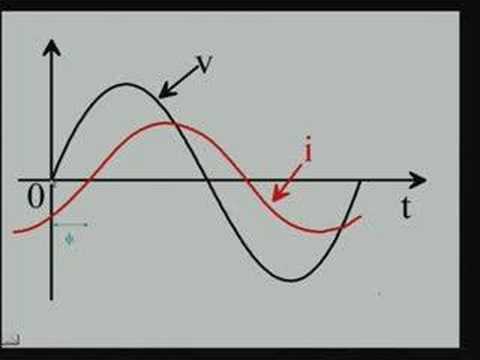
Vídeo neutro: fundo com fator de potência
A palestra do NPTEL abaixo fornece contexto educacional neutro sobre fator de potência e potência reactiva. Não se trata de uma recomendação de produto.