


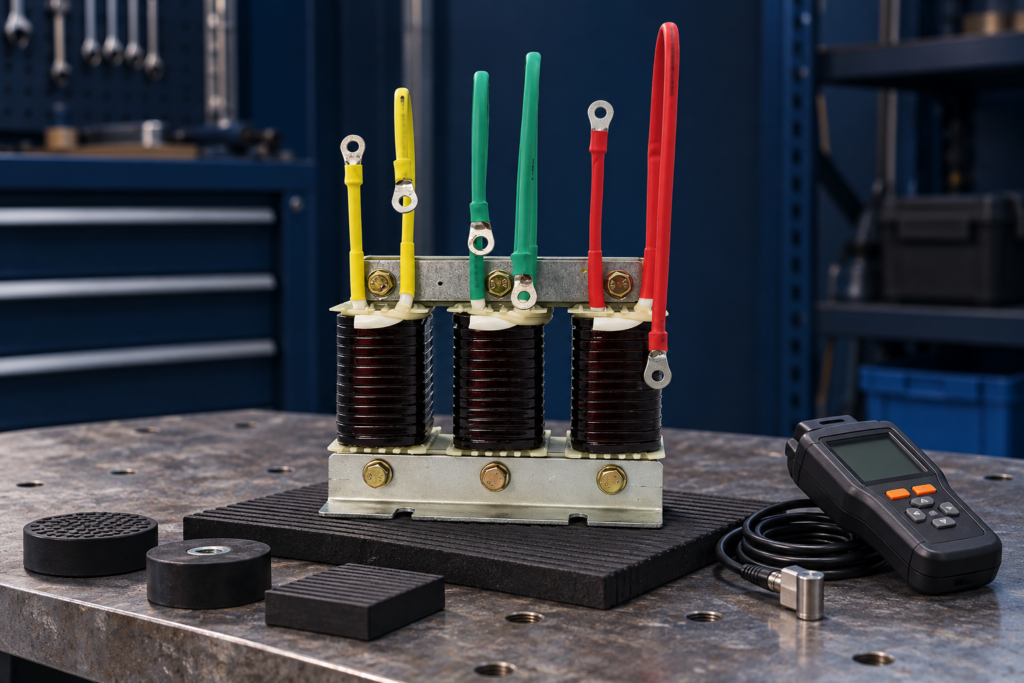
A humming reactor is not automatically a defective reactor. Reactor noise and vibration must be assessed against the equipment’s previous behavior, current loading, temperature, mounting condition and harmonic spectrum. A steady electromagnetic hum can be normal; a new rattle, intermittent impact, sharply increasing vibration or noise accompanied by overheating requires investigation. Start by recording when the sound occurs and which capacitor stage is connected. Then separate an electrical excitation problem from a loose mounting or enclosure resonance problem. Do not tighten components or touch the reactor while the panel is energized.
This guide addresses iron-core, low-voltage series reactors in industrial capacitor-compensation panels. It does not establish an acceptance limit for every reactor, prescribe internal core repair or replace the manufacturer’s test procedure. For the electrical purpose of the component, first review why a capacitor bank uses a reactor.
Why a series reactor makes sound
An alternating magnetic field produces forces in a reactor’s core and windings. Those forces change throughout the electrical cycle and can excite movement in laminations, winding supports and mounting surfaces. The mechanical assembly determines how much of that movement becomes audible sound. A sheet-metal panel may amplify a relatively small vibration, making a healthy component sound louder after installation than it did on a factory bench.
The familiar mains-related hum is therefore only one part of the diagnosis. Harmonic currents introduce additional excitation, and changing capacitor-stage operation changes the reactor’s load. A noise that appears only when one stage connects may identify that branch; a noise present with all stages disconnected may come from a transformer, fan or contactor elsewhere in the enclosure.
The connection between magnetic fields, energy and forces is discussed in MIT electromagnetic-fields course material. That material explains circuit behavior, not a permissible sound level for CNBYG equipment. Manufacturer data and the project specification remain the acceptance references.
Record the symptom before changing anything
A useful complaint is more specific than “the reactor is noisy.” Record the operating time, stage number, whether the sound is continuous or intermittent, approximate load, bus voltage and the measurement location. Include any recent maintenance, capacitor replacement, switching-setting change or new nonlinear load such as a drive. A sound that began immediately after a capacitor replacement deserves a different investigation from an unchanged hum noticed after a quieter production shift.
A short sound recording can help compare before and after conditions, but phone recordings have automatic gain and limited frequency response. They do not establish a calibrated noise limit. Keep the microphone position and background conditions consistent. When the project requires an acoustic acceptance measurement, use the specified instrument, distance and operating condition rather than comparing arbitrary smartphone decibel readings.
Photograph the exterior through an approved viewing position and retain the reactor nameplate, capacitor ratings and panel drawings. If no safe energized observation position exists, defer the internal inspection until the equipment is isolated. The California deenergized-equipment rule provides a reference for deenergization and stored-energy precautions; the site’s local requirements and qualified-person procedure also apply.
Separate electrical hum from mechanical rattling
| Observation | Possible explanation | Useful next check |
|---|---|---|
| Stable hum with stable current and temperature | Normal electromagnetic excitation | Compare with commissioning baseline and specified acceptance conditions |
| Metallic rattle from the enclosure | Loose panel hardware or a resonant sheet-metal surface | Inspect mounting and enclosure condition after isolation |
| Noise increases when a particular stage connects | Branch-specific current, capacitor mismatch or mounting issue | Compare that stage’s current, capacitance and reactor identification |
| Noise changes with VFD production cycles | Changing harmonic excitation | Correlate sound with harmonic-current measurements |
| Noise accompanied by discoloration or abnormal temperature | Possible overload, connection problem or damaged assembly | Remove affected equipment from service using the approved procedure |
| Repeated clicks rather than steady hum | Switching or stage-hunting problem | Review controller logs and switching frequency |
These are diagnostic hypotheses, not fault codes. More than one cause can coexist. A mounting issue may become obvious only when electrical loading excites its resonant frequency, so finding a loose panel does not eliminate the need to check current and temperature.
Inspect mounting, supports and ventilation safely
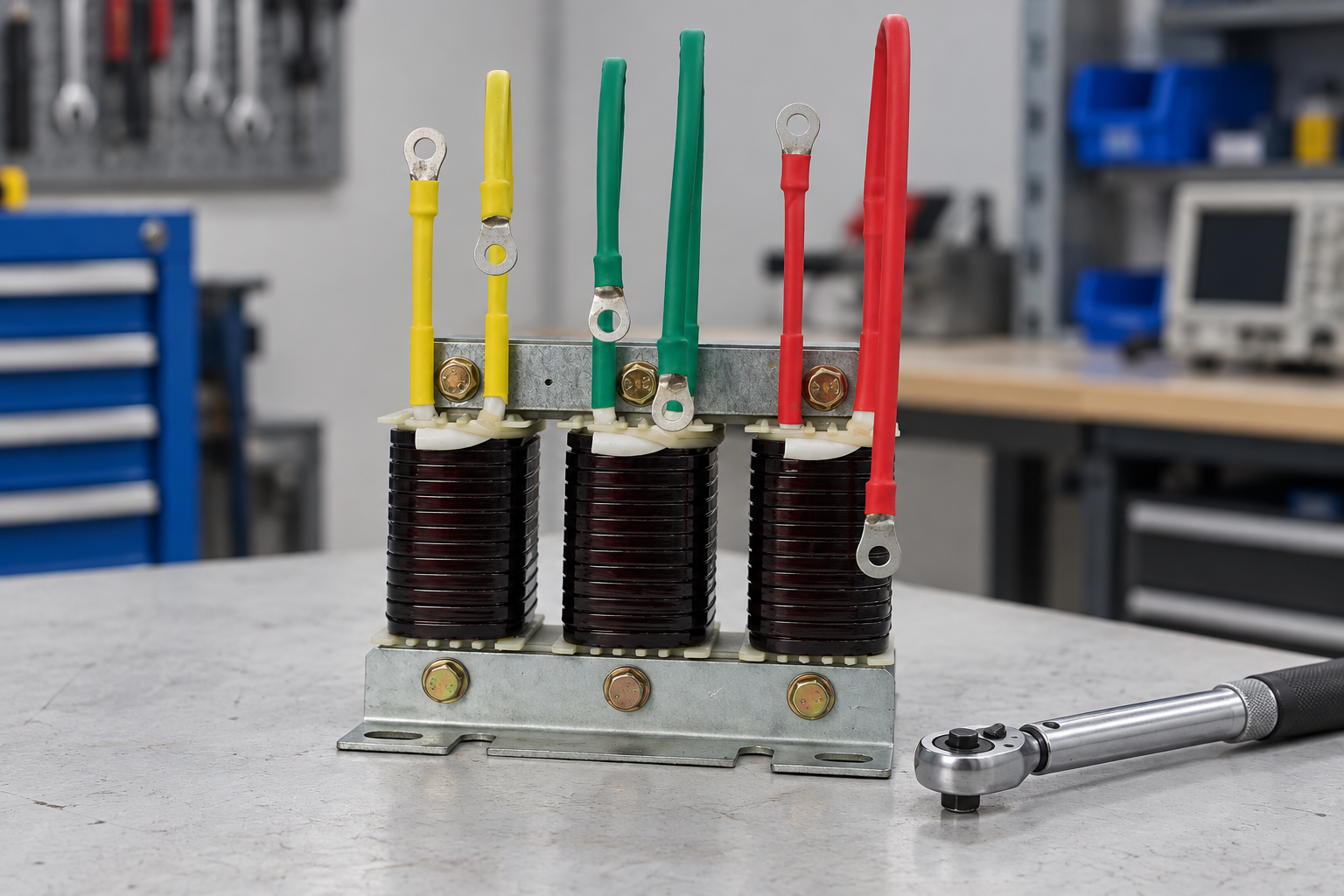
After shutdown, isolation and verification of the safe condition, inspect the base attachment, supports and nearby sheet-metal surfaces. Look for missing fasteners, fretting marks, cracked supports, displaced insulating parts and contact between the reactor and adjacent components. Confirm that installation matches the approved drawing. A reactor designed for a particular mounting arrangement should not be suspended or supported differently simply to reduce a sound complaint.
Do not assume that every accessible bolt is an ordinary fixing bolt. Core clamps, winding restraints and air-gap arrangements may be part of the factory magnetic design. Altering them can change inductance, insulation clearances or mechanical loading. Apply only the manufacturer’s approved torque and service procedure; request supplier review if the suspected movement is inside the assembly.
Check ventilation openings and fan operation as a separate issue. A hot enclosure can increase winding temperature even when the reactor’s own loading is unchanged. Adding an improvised cover or acoustic enclosure may reduce sound while restricting cooling. Any mounting pad or isolation element must also preserve load-bearing capacity, clearances, protective bonding and the intended heat path.

Check current, voltage and harmonic conditions
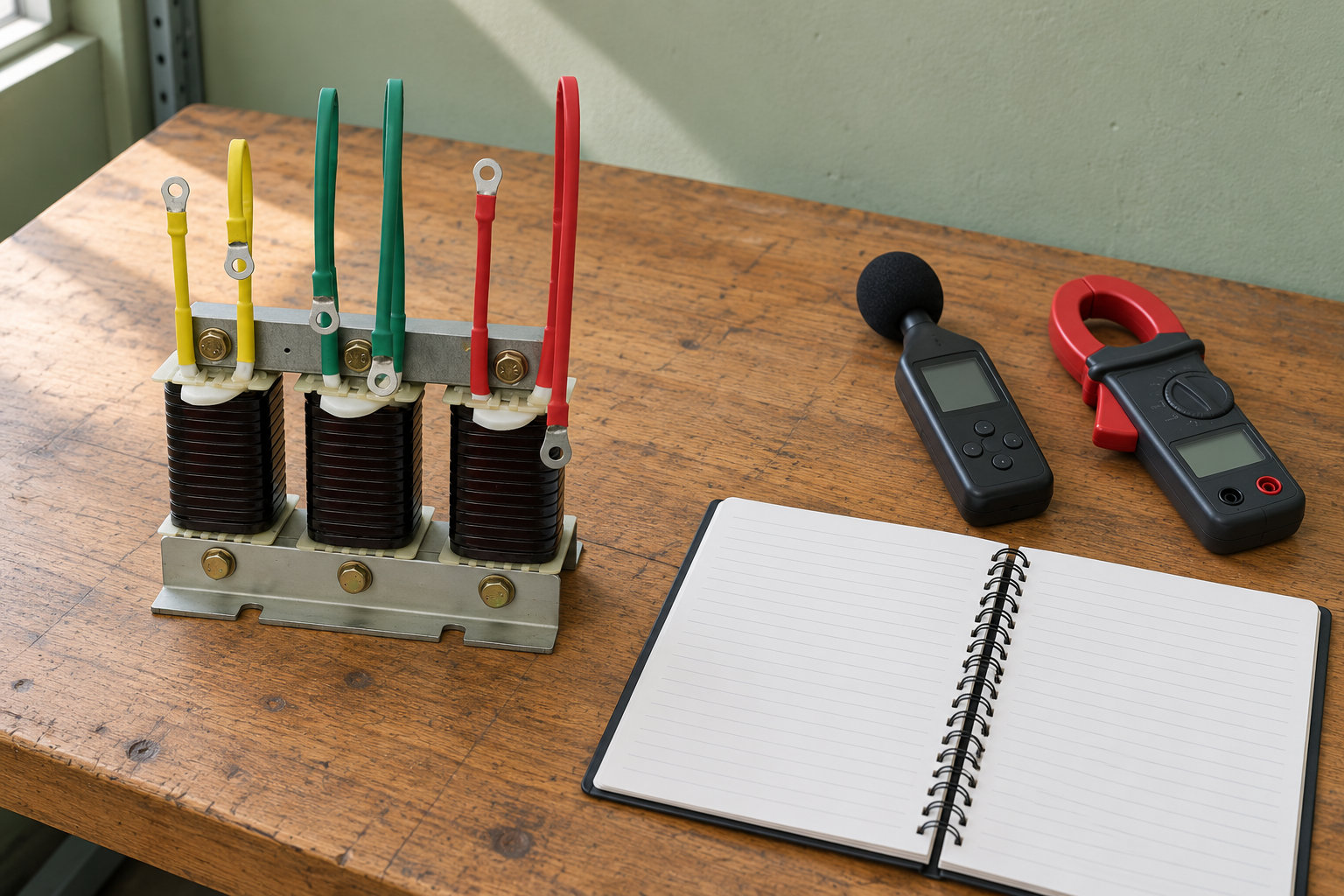
Compare phase currents with the complete branch’s design data, including the capacitor and reactor combination. A detuned reactor is not selected by fundamental current alone; harmonic loading and thermal conditions matter. Measurements must distinguish fundamental current, total RMS current and individual harmonic components. A single clamp-meter value cannot explain whether additional current comes from load variation, harmonics or a mismatch.
Use an appropriate power-quality instrument and an approved measurement procedure. Obtain the three-phase bus voltage, current spectrum, relevant operating states and any imbalance. Compare the affected branch with equivalent branches under similar conditions. If all branches changed after a new production line was connected, investigate the installation-level harmonic environment before replacing individual reactors.
Do not judge resonance from sound alone. Capacitors and inductors can produce frequency-sensitive behavior, but an audible tone does not uniquely identify the electrical resonant frequency. The OpenStax series-resonance explanation is useful background. A bank assessment needs the actual component values, source impedance and measured harmonic conditions. Refer to detuned-reactor calculation for the connection between the branch values and detuning.
Investigate changes after capacitor replacement
A replacement capacitor can fit physically while differing electrically. Check nominal capacitance, rated voltage, connection, frequency and intended reactor combination. Confirm whether the quoted stage capacity describes the capacitor alone or the assembled detuned branch at the operating voltage. Substituting a higher-voltage capacitor with the same nameplate kvar does not necessarily preserve the same capacitance.
Capacitance loss in an existing unit can also change the branch behavior. Compare phase capacitance using the appropriate isolated test arrangement and manufacturer’s method. Review capacitor capacitance loss before deciding that a noise increase proves the reactor itself has failed. If a branch contains several units, evaluate the arrangement as a complete stage rather than assuming one measured unit represents the whole branch.
Keep the original and replacement component records together. Ask the supplier to confirm compatibility using the reactor inductance, detuning percentage, frequency, operating voltage and capacitor capacitance. Do not experimentally combine spare components in an energized panel to see whether the sound improves.
Use a controlled comparison to isolate the cause
An engineer can compare approved operating states without bypassing protection. Establish a reference condition, then observe which scheduled or controller-commanded stage transitions correspond to the noise. Avoid unnecessary rapid manual switching: capacitors require the specified discharge and reconnection interval, and contactors have their own duty limits.
If the sound changes with one stage, inspect that branch during a planned safe shutdown. If it persists regardless of stage operation, locate other sources before commissioning a reactor replacement. Fans, contactors, transformers and enclosure doors can all produce misleading sounds. A vibration measurement on a panel surface may reflect transmitted motion from a neighboring component rather than local reactor movement.
Compare the same conditions after a verified repair. Record what changed, including torque correction, damaged support replacement, restored cooling or correction of a component mismatch. A reduction in audible noise is useful, but acceptance also requires normal electrical and thermal behavior. A quieter panel with a disabled capacitor stage has not demonstrated a successful repair.
When supplier review or shutdown is appropriate
Escalate a sudden change accompanied by overheating, damaged insulation, burning smell, repeated protective trips, visible movement or unexplained phase-current differences. Follow the plant procedure for removing affected equipment from service. Do not use a generic online temperature or sound threshold as permission to continue operation.
Provide the supplier with the model, nameplate photograph, installation drawing, capacitor ratings, measurement method, load state and before-and-after history. State whether the suspected sound is a hum, rattle, buzz or repeated switching click. Include any change to the branch components. This evidence makes remote assessment substantially more useful than an isolated audio clip.
For a new project, CNBYG CKSG series reactors should be specified as part of a matched compensation branch, with installation and thermal requirements confirmed for the actual panel. Request documented acoustic requirements when noise matters to the site; this article does not claim a particular model meets an unspecified noise limit.
Further learning

The video introduces inductor operation. Use it to understand magnetic energy storage and excitation; it is not a field-service instruction for an energized compensation panel.
Perguntas frequentes
Is some reactor humming normal?
Yes. Alternating magnetic forces can produce a steady hum. Whether a specific unit is acceptable depends on its documented requirements, baseline behavior, installation and electrical loading. A new or rapidly worsening sound deserves investigation.
Can I tighten core bolts to stop a buzz?
Do not alter core clamps or magnetic assembly parts without the manufacturer’s procedure. Their setting may affect inductance, insulation and mechanical support. Ordinary mounting checks also require safe isolation and the specified torque.
Does a noisy reactor prove harmonic resonance?
No. Sound can result from normal excitation, mounting resonance, switching or harmonic loading. Electrical measurements and the actual branch design are needed to evaluate resonance; an audio recording cannot establish it.
What information should accompany a reactor-noise complaint?
Provide component identification, capacitor and reactor ratings, stage number, operating conditions, current and voltage measurements, temperature observations, installation photographs and a history of recent changes. Keep measurement locations and methods consistent.