Portable vs Fixed Power Quality Monitoring
Portable vs fixed power quality monitoring is a choice about measurement purpose, location, duration and ownership, not simply instrument size. Portable equipment is useful for targeted investigations and measurements at changing locations. Fixed monitoring supports continuing visibility at defined boundaries. Either approach must have the documented capabilities, sensors and recording method needed for the question being asked.
Many plants benefit from both: permanent measurement identifies when or where behavior changes, while a portable analyzer gathers detailed evidence at the affected circuit. This guide explains how to choose the arrangement without assuming that every fixed meter is a full power-quality analyzer or every portable device provides standardized measurements.
Define what the plant needs to know
Start with the decision the monitoring must support. A recurring trip at one machine, a site-wide utility assessment, an equipment upgrade and continuous energy management are different tasks. List required quantities, relevant operating modes, measurement boundaries and the people who will review the results.
Distinguish a one-time investigation from ongoing observation. If a plant needs evidence about a specific process change, a temporary study may be enough. If it must detect future disturbances or maintain a baseline through changing production, a permanent arrangement may have a stronger practical case.
Do not let installed hardware dictate the question. A convenient fixed meter may not record the event that caused the problem. Equally, a portable instrument with detailed waveform functions may be unnecessary when the task is a stable long-term trend already available from a verified permanent system.
What portable monitoring does well
Portable equipment can be moved to the location most relevant to an investigation. It can compare feeders, assess a new load or record detailed evidence during a planned process run. Its flexibility is useful when the plant has not yet identified the affected electrical boundary.
Temporary deployment still requires a safe installation plan, suitable circuit ratings and qualified personnel. Portability does not make live connections routine or remove the need for approved access. Plan the responsible owner, data retrieval, removal date and restoration of the cabinet before installing the device.
A limitation is coverage. A portable analyzer measures only where and when it is installed. Moving it between locations can support steady comparisons, but may miss rare events or prevent time-aligned attribution. The report must identify which conditions were actually observed.
What fixed monitoring does well
Fixed instruments maintain a consistent observation point over time. They can reveal changes in loading, reactive-power demand or other confirmed functions without repeatedly arranging temporary installation. With suitable recording and communications, they support longer-term baselines and timely review.
Земля CNBYG BY194 multifunction power instrument is relevant to panel measurement. Check its exact variant and documentation before assigning harmonic recording, event capture or a measurement class. A fixed panel meter is not automatically a specialist power-quality analyzer.
Permanent monitoring also creates responsibilities: configuration control, sensor verification, communications, storage, clock accuracy and review of alarms. Data that accumulates without an owner may provide little operational value. Include these responsibilities in the design rather than treating installation as the end of the project.
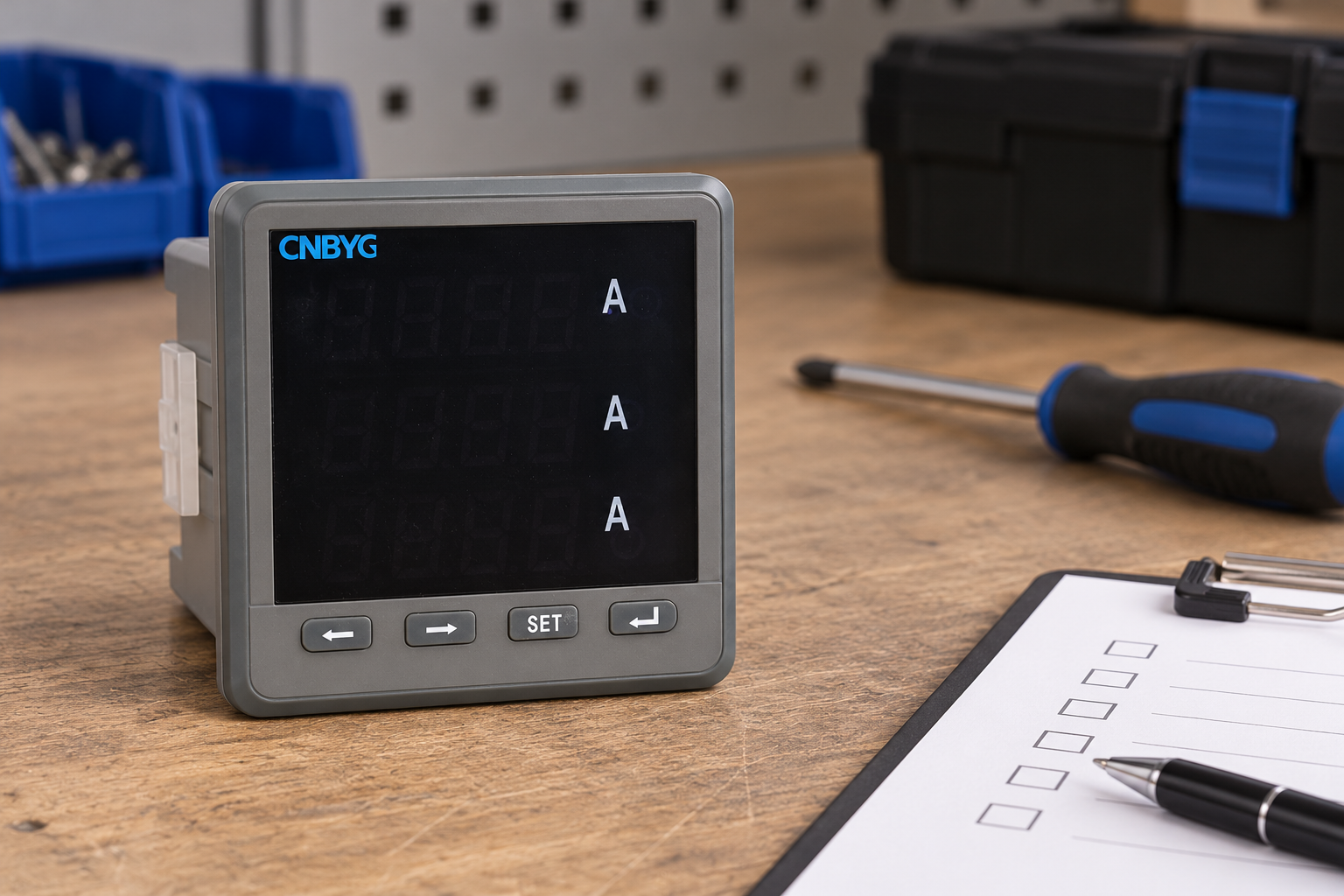
Reference-based illustration of a real panel product. It does not imply portable-analyzer functions or unconfirmed recording capabilities.
Compare the options against the task
| Consideration | Portable arrangement | Fixed arrangement |
|---|---|---|
| Changing measurement locations | Can move between defined investigation points | Remains at the installed boundary |
| Rare or unpredictable events | May require extended deployment at the right location | Can observe continuously if event capability is suitable |
| Detailed short-term investigation | Useful when the chosen analyzer has required functions | Depends on the installed instrument and data retention |
| Continuing baseline | Requires planned repeat studies or long deployment | Supports consistent observation with managed storage |
| Installation effort | Repeated safe installation and removal may be needed | Initial installation followed by maintenance and verification |
| Data ownership | Study team must preserve files and configuration | Plant must manage ongoing records, alarms and access |
These comparisons describe deployment characteristics. They do not establish accuracy or functionality from the category name. An unsuitable portable analyzer and an unsuitable fixed instrument can both fail the same study.
Check measurement methods and capabilities
Specify the required voltage and current quantities, harmonic information, event waveforms and aggregation. The IEC 61000-4-30 publication addresses power-quality measurement methods, and the IEC 61000-4-7 publication addresses spectral measurement instrumentation. Apply the appropriate full documents and project requirements.
Check the complete chain, including sensors and scaling. A permanently installed CT may suit operational metering but not a particular detailed spectral requirement. A portable probe may have the wrong range or bandwidth for the load. Instrument documentation should identify the supported combination rather than leaving the engineer to infer compatibility.
Measurement method and acceptance limit are separate. A declared measurement class does not by itself prove that the plant meets a utility agreement, and a familiar THD display does not establish that the required compliance quantity has been recorded.
Consider duration and event coverage
For a predictable production cycle, schedule portable monitoring to capture the relevant modes. For an unpredictable disturbance, a longer deployment or suitable fixed event recording may be needed. Calendar duration is only one input; usable data and operating coverage determine whether the result supports the decision.
Fixed monitoring can still miss events if triggers, memory or retention are unsuitable. Check whether detailed records are overwritten, whether alarms retain timestamps and whether the system was actually recording during the target interval. Continuous installation is not proof of continuous usable evidence.
Прочитайте event-triggered logging guide for intermittent processes and the power-quality recorder guide for recording context. Define a completion rule for a temporary study and a review rule for an ongoing system.
Plan multiple locations and synchronization
Some investigations need simultaneous measurements at an upstream and downstream boundary. Sequential portable recordings cannot prove that two separate events belong to the same disturbance. Multiple suitable instruments with a documented timing arrangement may be necessary.
A fixed upstream monitor can complement a portable downstream analyzer if their timestamps, measurement boundaries and quantities are compatible. Compare events with their uncertainty in mind. A graph with matching-looking shapes is not enough when the clocks or aggregation intervals differ.
Record phase mapping, CT ratios, source states and location identities consistently. These details allow engineers to interpret the relationship between points without guessing. Preserve the single-line diagram and configuration with the data so the comparison remains understandable after the survey team leaves.
Review data access before purchasing
Ask for sample raw files and reports from both arrangements. Confirm units, time zones, channel names and missing-data indicators. Determine whether the plant can export the evidence independently or depends on a particular license, service or software version.
For fixed monitoring, check communications and storage ownership. For portable monitoring, check how files and configurations will be handed over at the end of the rental or survey. Selected screenshots may illustrate a result, but they rarely provide enough evidence for later reanalysis.
Assess who receives alarms and what they should do. An alarm without a defined response can become background noise. Choose thresholds from the investigation or operating requirement, document them and periodically review whether the records are producing actionable information.
Compare the practical cost of the whole workflow
Consider instrument or rental cost, qualified installation, sensor needs, software, data review and repeated access. Portable equipment may be economical for occasional targeted studies, while frequent deployments can make permanent observation more attractive. The balance depends on the actual plant workload.
Do not present a fixed payback period without real cost and usage data. A permanent system also needs maintenance and responsible review. A portable survey can fail financially if it must be repeated because the first deployment missed a key operating mode or used inadequate export settings.
A staged approach can reduce uncertainty: begin with a focused survey, identify the boundaries worth observing, then design permanent monitoring from the evidence. This avoids installing instruments everywhere before the plant knows what decisions their data will support.
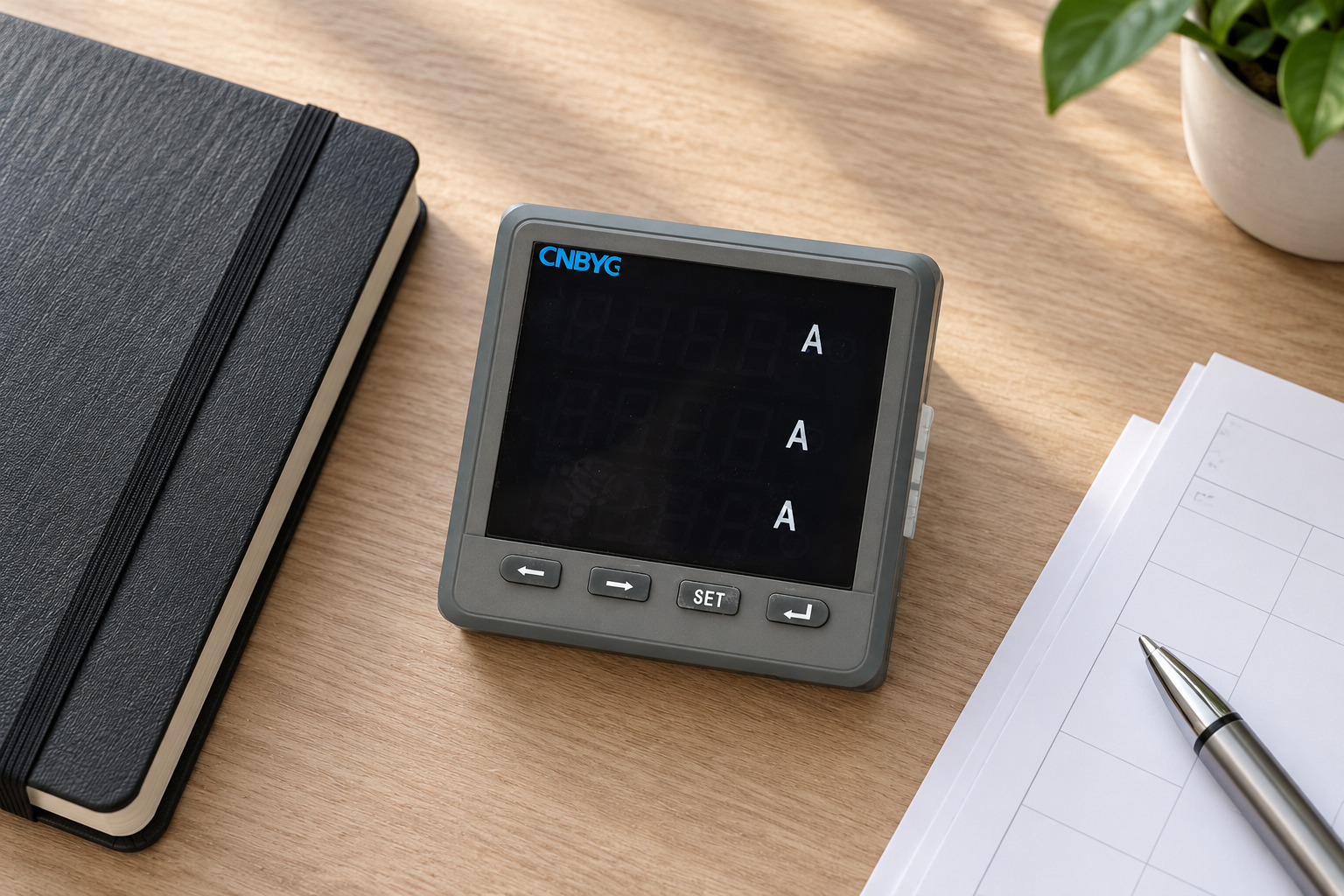
Reference-based illustration. Costs, capabilities and operating results must be supplied by the actual project.
Keep installation and maintenance safe
Qualified personnel must assess instrument ratings, accessories, isolation, access and the approved connection method. Follow local requirements and the site procedure. The OSHA electrical work-practice rules provide authoritative background on electrical work practices without substituting for a site-specific plan.
For fixed systems, document sensor circuits and safe maintenance arrangements. For portable deployments, inspect temporary leads and supports throughout the study and remove them through the approved process. Neither arrangement should depend on undocumented connections that later technicians cannot identify.
Connect monitoring to engineering action
Use the evidence to identify the mechanism before selecting correction equipment. Reactive-power demand, harmonic current and voltage events may require different responses. Monitoring provides the basis for that distinction, but does not automatically justify a filter or a larger capacitor bank.
Земля metering guide before an APF/SVG inquiry explains useful procurement evidence. The power-quality system overview provides broader context. Keep the inquiry tied to actual boundaries, operating states and verified measurements.
Further learning
Watch Power Quality: Standards and Monitoring
Часто задаваемые вопросы
Is fixed monitoring always more accurate?
No. Accuracy and suitability depend on the instrument, sensors, method and configuration. Deployment category does not establish measurement performance.
Can portable monitoring capture rare events?
Yes, if it is deployed at the right location for sufficient operating coverage with suitable triggers and storage. A short quiet study cannot rule out a rare disturbance.
Can existing panel meters support a specialist survey?
They can provide useful context within confirmed functions. Detailed evidence may still require a suitable analyzer, and comparisons need consistent boundaries and timing.
When is using both approaches worthwhile?
When a fixed baseline helps identify changes and a portable analyzer supplies detailed local evidence. Define how their records will be synchronized and interpreted before collecting them.