Why Use a Reactor in a Capacitor Bank? Harmonics and Matching
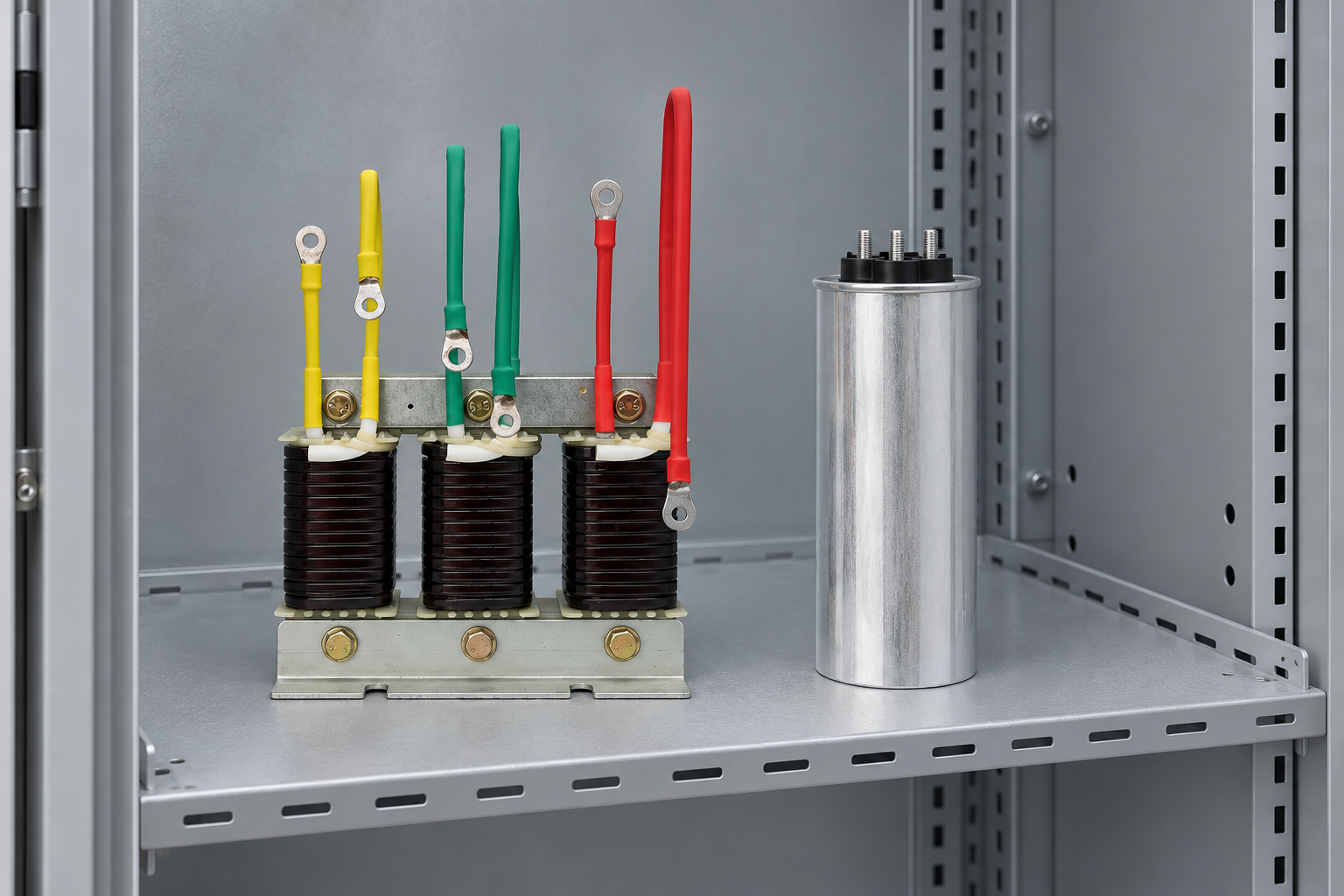
Why use a reactor in a capacitor bank? A properly selected series reactor changes the bank’s impedance to reduce resonance risk and limit specified switching stresses. It must be matched to capacitor capacitance, frequency, operating voltage, harmonic conditions and thermal duty. A reactor does not make every bank suitable for every network. This guide explains detuned compensation, its design boundaries and the checks needed for a matched low-voltage branch.
Why Capacitor Banks Use Series Reactors
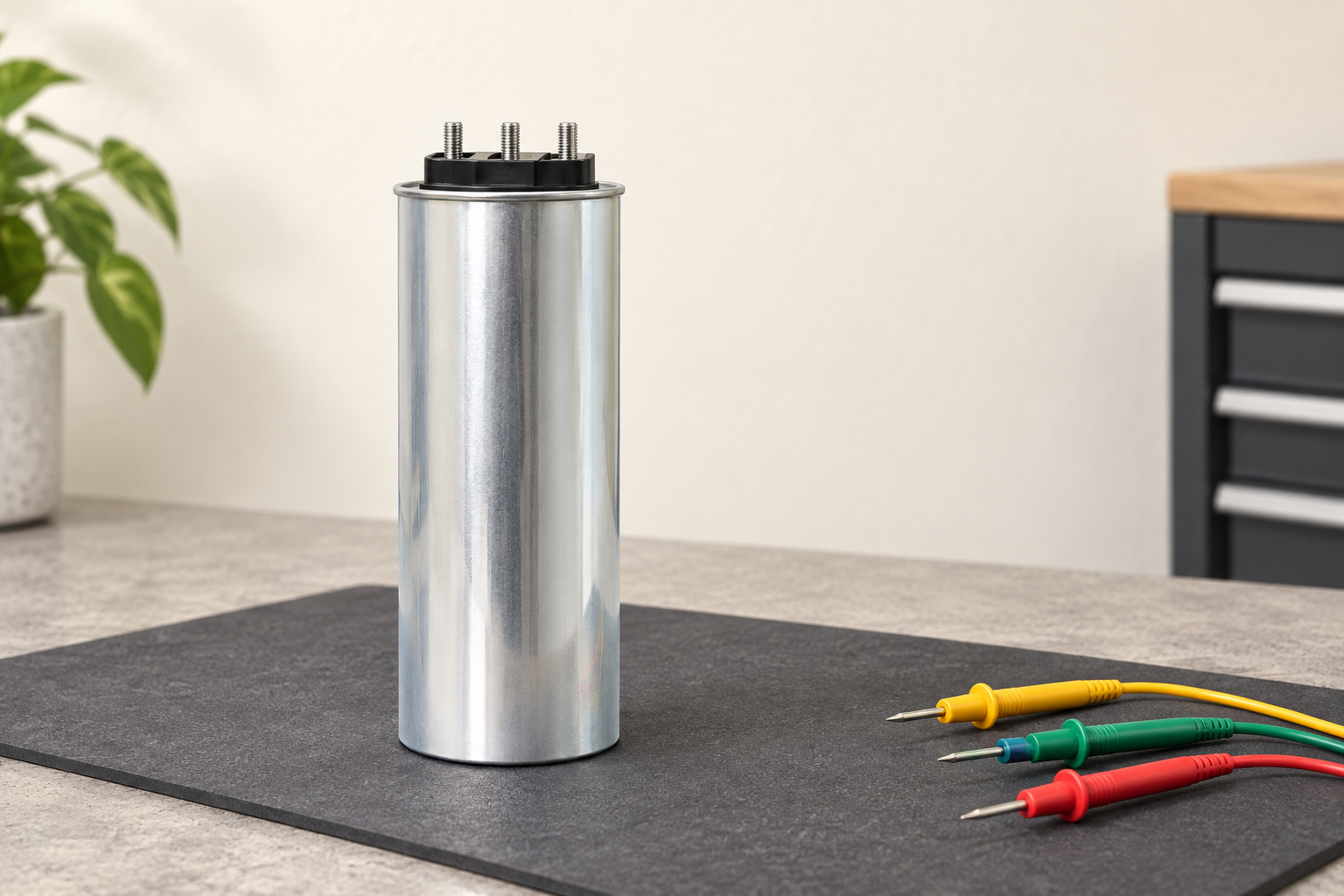
Series reactors are added so a capacitor bank can still correct power factor without becoming a preferential path for harmonic energy or an unprotected target for energization surge.
In a clean, lightly distorted network, shunt capacitors mostly see fundamental frequency. In modern plants, variable-frequency drives, UPS systems, and rectifiers inject harmonic currents into the same bus that hosts automatic power-factor stages.
Capacitive reactance falls as frequency rises, so those harmonics drive extra current and dielectric stress into unprotected capacitors. At the same time, the supply inductance and the bank capacitance can line up at a resonant frequency.
When that frequency sits near a harmonic that already exists, the bus can amplify voltage and current distortion instead of quietly fixing displacement power factor.
A series reactor for capacitor bank duty—often specified as a detuned reactor when the inductance is chosen for harmonic duty—changes that picture. The phrase “detuned reactor capacitor bank” is simply the procurement label for that paired assembly.
Inductive reactance rises with frequency, so the reactor–capacitor branch presents a higher impedance to harmonic currents. Industry education from Schneider Electric describes the same mechanism: detuned reactors prevent harmonic amplification caused by resonance and reduce the risk of overloading capacitors, while also helping with switching inrush.
Independent technical notes make the same point in procurement language: plain capacitor banks on harmonic-rich buses are the risky default; reactor-coupled banks are the safer PFC pattern.
The reactor is not a magic filter that erases every distortion problem. It is a purpose-built partner for the capacitor bank.
If your real job is active harmonic cancellation across a wide spectrum, that is a different tool. If your job is to keep PFC stages alive and non-amplifying, the series reactor is the part that belongs in the branch.
How Harmonics and Resonance Overload a Plain Capacitor Bank
Without a reactor, a plain bank can both overheat on harmonic current and participate in a resonant loop with the supply.
Think of harmonic resonance capacitor bank risk as a feedback loop between the transformer or feeder inductance and the capacitance you just added for power factor. The resonant frequency depends on those two reactances.
On many industrial buses, that frequency lands somewhere in the range where the 5th, 7th, 11th, or 13th harmonics already live—the same orders nonlinear loads commonly produce. When the loop lines up with a real harmonic, small distortion can become large voltage and current stress.
Capacitor fuses blow, stages trip, cables and transformers run hotter, and the “fix” for a utility power-factor penalty creates a new maintenance ticket.
Harmonic overload can happen even before a dramatic resonance event. Because capacitors draw more current as frequency rises, a modest voltage harmonic content can still push ampere and thermal stress beyond what a standard PFC cell was sized for at fundamental frequency.
That is why engineers talk about reactors as protection for the capacitor dielectric, not only as a theoretical impedance trick.
Важно: Adding a series reactor raises the voltage across the capacitors — Schneider Electric on detuned reactors. Detuned assemblies often need capacitor voltage ratings above the nominal system voltage.
Schneider’s educational example for 400/415 V networks cites cells such as 480 V or 525 V. Do not bolt a reactor onto existing low-voltage-rated capacitors and assume the nameplates still fit.
What a Detuned Series Reactor Changes in the Circuit
A detuned series reactor shifts the reactor–capacitor tuning below the dominant harmonic so the branch looks inductive at those higher frequencies instead of capacitive.
The practical design rule repeated in OEM and independent education is simple: choose inductance so the series resonance sits below about 90% of the dominant harmonic frequency. On many three-phase industrial systems the dominant order is the 5th.
For a 60 Hz plant that means keeping the tuning below roughly 270 Hz; for a 50 Hz plant, below roughly 225 Hz. Commercial detuned percentages such as about 5.67%, 6%, or 7% are common ways of landing in that safe zone when the 5th is the concern.
Higher percentages (around 12% to 14%) appear when stronger 3rd-harmonic content forces a lower tuning frequency.
In plain language: the reactor is sized so the bank does not “tune into” the harmonic the plant already has. Above the tuning point the branch behaves inductively, which is the opposite of a plain capacitor’s tendency to welcome high-frequency current.
That is the core answer to why the reactor exists in a harmonic environment.
Detuned does not mean tuned. A deliberately tuned filter aims at a specific harmonic order as a low-impedance trap.
A detuned bank intentionally avoids sitting on those orders so PFC can continue without becoming an amplifier. Confusing the two labels on a quotation is a common procurement mistake.
How Reactors Limit Capacitor Switching Inrush
Even when harmonics are mild, a series reactor limits the high-frequency surge that appears when capacitor stages energize.
An uncharged capacitor looks briefly like a near short to the applied voltage. The resulting inrush can be many times rated current for a few milliseconds, and back-to-back switching of another stage onto an already energized bank is worse.
Educational material on capacitor-bank reactors walks through that physics and notes that dedicated current-limiting reactors may be only about 0.1% to 0.5% of the capacitor reactance when inrush—not harmonic detuning—is the primary job.
Most modern automatic PFC stages in harmonic-aware plants combine both needs: enough inductance for detuning, which also cushions switching. The percentage on the nameplate should still be read against the site spectrum.
A tiny inrush reactor is not a substitute for a detuned percentage when VFDs dominate the bus.
| Duty | What the reactor changes | Typical reader signal |
|---|---|---|
| Harmonic / resonance protection | Raises high-frequency impedance; shifts tuning below dominant harmonics | Fuse blowing, rising THD after PFC steps, hot capacitors |
| Switching inrush limiting | Limits energization surge into capacitors and switchgear | Contactor wear, nuisance trips at stage close |
| Not an active filter | Does not inject anti-phase harmonic current | Persistent IEEE-style compliance gaps after PFC-only fixes |
A Plant Scenario: VFD Buses and Automatic PFC Stages
On a drive-rich bus, automatic plain capacitor stages are usually the wrong default.
Picture a packaging or materials plant that added VFDs over several years. Displacement power factor looked poor at the utility meter, so an automatic capacitor bank was quoted.
Stages close against a bus that already carries 5th and 7th energy from six-pulse drives. Within months, capacitor fuses open, maintenance replaces cells, and someone asks whether the bank was “undersized.”
The more useful question is whether the bank was unprotected.
Engineering forum discussions capture the same confusion from another angle: plants that already installed active harmonic filtering for utility limits still get told their remaining PFC capacitors must be detuned. The active filter and the detuned bank are solving adjacent problems.
The filter can cancel a measured harmonic current; the reactor keeps the PFC branch from resonating with whatever distortion remains—including imported distortion or operating cases the filter is not covering every minute.
If your site log shows power-factor stages coinciding with THD spikes, treat that as a resonance or overload clue before you only add more kvar. Measurement and a network look still matter; the reactor is the hardware pattern that makes kvar addition safer once you decide PFC is still required.
Detuned Banks vs Tuned Filters vs Active Harmonic Filters
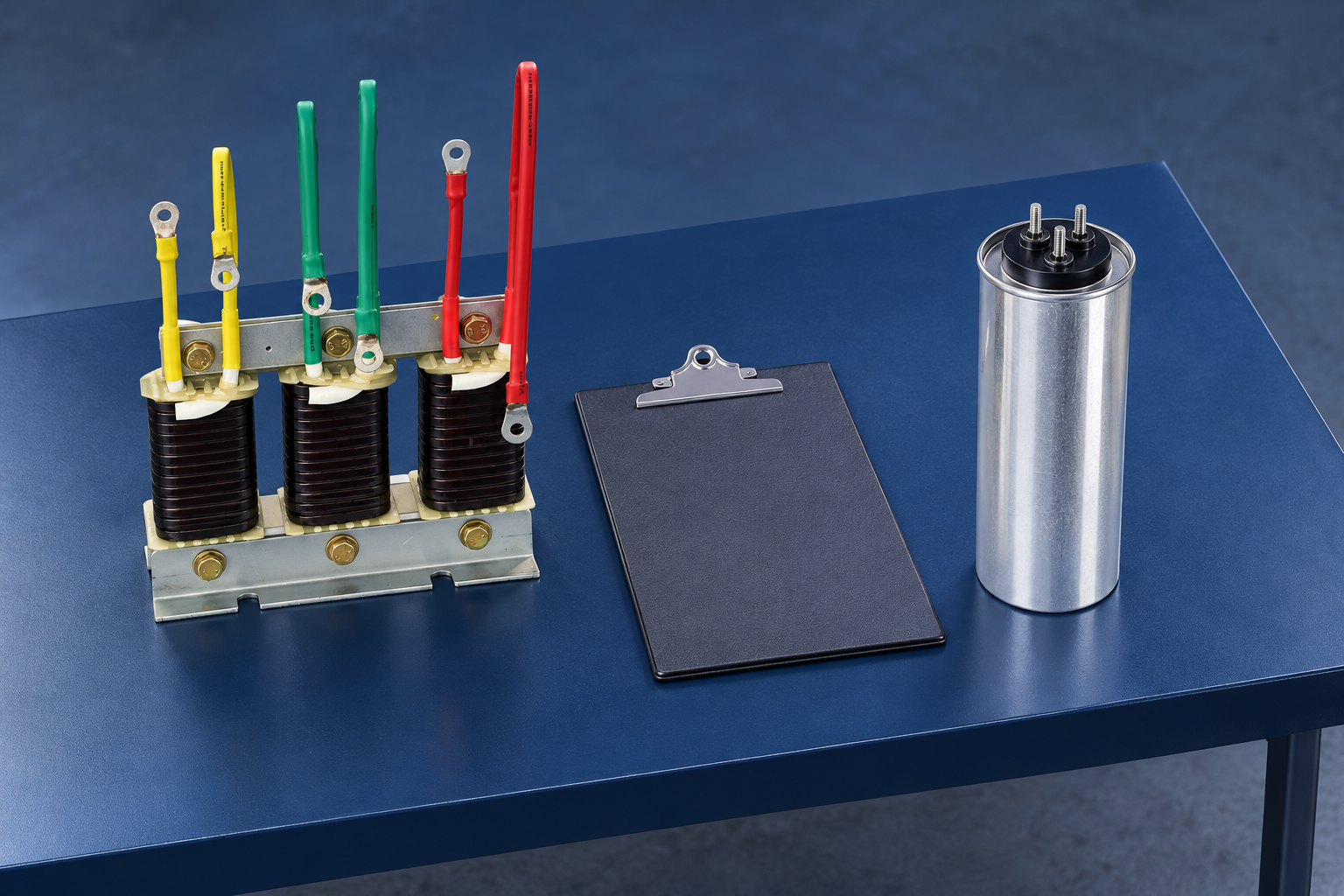
A detuned capacitor bank protects PFC; a tuned filter targets a harmonic order; an active harmonic filter cancels distortion with power electronics.
Keep the three jobs separate when you read a bill of materials:
- Detuned reactor + capacitor: Corrects fundamental reactive power while avoiding harmonic amplification. Best thought of as “safe PFC” in distorted networks.
- Tuned passive filter: Intentionally low impedance at a chosen order. Needs careful design so it does not turn into an unintended magnet for off-nominal conditions.
- Active harmonic filter (APF/AHF): Measures and injects compensating current. Use when harmonic compliance or process quality demands active cancellation, not only capacitor protection.
Schneider’s educational contrast is useful here: detuned reactors are passive and comparatively simple; active filters are dynamic; tuned filters are precise but less forgiving. Procurement language should not collapse all three into “harmonic reactor.”
If an RFQ only says “reactor,” ask whether the duty is inrush limiting, detuning for PFC, or a tuned trap.
Reactance Rate in Plain Language
Reactance rate is the reactor’s fundamental inductive reactance as a percentage of the capacitor reactance—and it is how builders land the tuning frequency.
You do not pick a percentage because it sounds premium. You pick it because of the harmonic spectrum and the resonance margin you need.
A purpose-level map is not a substitute for a site study.
| Reactance-rate class | Typical job | Reader caution |
|---|---|---|
| About 0.1%–1% | Mainly switching-inrush limiting | Not enough when 5th/7th energy is material |
| About 4.5%–7% | Common detuning below the 5th | Confirm with measured spectrum; expect higher capacitor voltage |
| About 12%–14% | Stronger detuning when 3rd-harmonic content matters | Still not an APF; voltage rise increases |
CNBYG’s published CKSG family lists multiple rates (including 1%, 4.5%, 5.6%, 6%, 7%, 12%, 13.8%, and 14%) for low-voltage grids from 0.4 kV to 1.14 kV. That breadth exists because sites differ.
The article’s job stops at purpose: match the rate to the spectrum and to capacitor voltage ratings, then validate on the project—not to pretend a blog table replaces a study.
When to Choose CNBYG CKSG Series Reactors
Need an LV series reactor matched to capacitor steps? Open the CNBYG Низковольтные серийные реакторы серии CKSG page next.
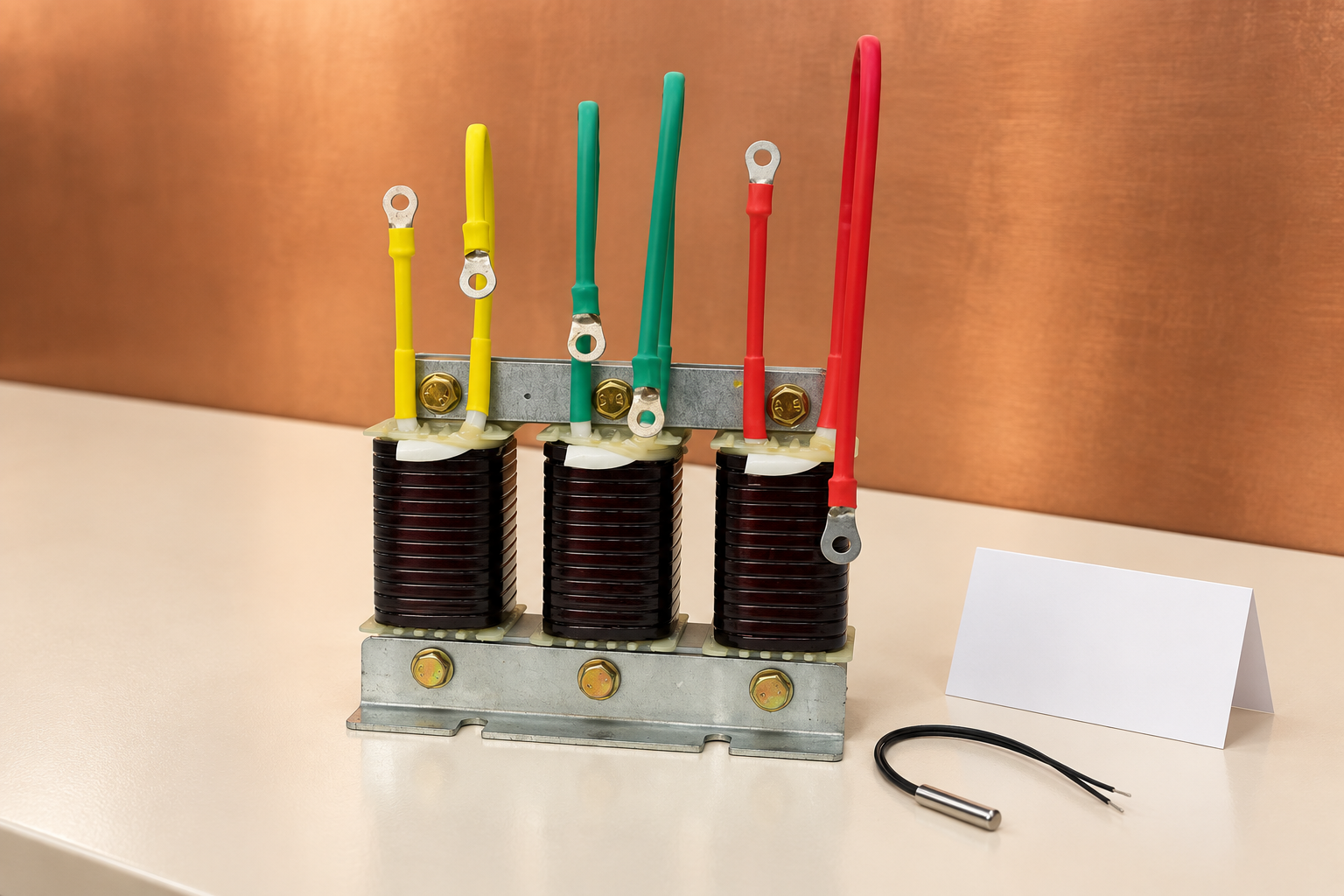
On the CKSG page, capacitors used for reactive compensation are described as vulnerable to harmonic currents, closing inrush, and operating voltages. Installing the series reactor ahead of the capacitor is how the family addresses that stress while supporting power factor and service life.
Single- and three-phase dry-type iron-core builds, thermal protection contacts, and cabinet-friendly dimensions keep the hardware panel-ready. The reactance-rate set listed above stays the matching lever for spectrum and capacitor voltage.
Published overload capability reaches continuous operation up to 1.35 times, with noise not exceeding 30 dB and a withstand level of 5 kV/min. Read those as nameplate-family facts, not as a promise about an unmeasured plant.
CKSG fits when you are building or refreshing LV detuned or series-reactor PFC stages and want a reactor family that sits with the rest of the компенсатор реактивной мощности accessories (capacitors, controllers, compound switches, capacitor-duty contactors).
Skip it when the primary need is active harmonic cancellation, medium-voltage substation reactor engineering outside the published LV scope, or a single-tuned filter study.
Check the matched branch and its operating condition
For procurement or replacement, use the capacitor and reactor matching worksheet to distinguish net stage output, capacitor capacitance and reactor ratings. The harmonic-voltage and capacitor-life guide explains why a voltage spectrum and actual branch current are more useful than an unsupported life estimate.
During maintenance, review insulation class, winding rise and ambient temperature separately. If sound changes, the reactor noise and vibration checklist helps separate magnetic excitation, mounting problems and branch-specific loading.
Further learning
Часто задаваемые вопросы
What happens if a capacitor bank runs without a reactor on a harmonic-rich bus?
It can amplify harmonic voltage and current through resonance and overload capacitor cells thermally. Fuse blowing and rising distortion after stages close are common field complaints.
What is the difference between a current-limiting reactor and a detuned reactor?
Current-limiting reactors are often a fraction of a percent of capacitor reactance and target energization surge. Detuned reactors use higher percentages so the LC tuning sits below the dominant harmonic. Many industrial stages combine both needs in one series inductor.
Why is detuning often set below the 5th harmonic?
Because the 5th is frequently the strongest characteristic harmonic on three-phase rectifier and VFD buses. Keeping series resonance below that order avoids parking the bank on the energy that already exists.
Does a detuned reactor remove harmonics the way an active filter does?
No. Detuning raises impedance and avoids amplification so PFC can operate more safely.
An active harmonic filter injects compensating current. They can coexist; they are not substitutes.
Why do detuned banks need higher capacitor voltage ratings?
The series reactor causes a voltage rise across the capacitors. Specifying cells only for nominal system voltage is a common mismatch on detuned assemblies.
If an active harmonic filter is already installed, why still use detuned capacitors?
Because remaining or imported distortion, plus the capacitor–network resonance mechanism, can still stress plain PFC stages. Forum engineers routinely separate “harmonics controlled by APF” from “PFC branches that must still be detuned.”
Are reactors required on every capacitor bank?
Not on every clean, low-distortion bus. On modern plants with material nonlinear load, reactor-coupled banks are the default prudent pattern.
How should a buyer use the CKSG family in this decision?
Treat CKSG as the LV series-reactor option for matching capacitor steps after the spectrum and capacitor voltage rating are clear. It covers the protection job described here; it is not a full harmonic-study substitute.
Ссылки
- Schneider Electric Blog — Decoding detuned reactors: What and why
- Capacitor Connect — What are detuned reactors and how are they used?
- Circuit Masterclass — Why Reactors are Used with Capacitor Banks
- MikeHolt Forum — Reactor calculation
- How to Store Electricity — Power Quality 2026: Harmonics, Voltage Sags, IEEE 519, BESS