Power Meter Instructions: Withdraw Superseded Revisions Safely
Power meter instruction revision control means identifying which approved document applies to the installed instrument and preventing superseded instructions from being used for new work. Keep a revision register that connects the exact device model and configuration to the current manual, relevant project instructions and withdrawal record. Preserve older documents when they explain historical work, but mark their permitted use clearly. A newer filename or download date alone does not prove compatibility. Before withdrawing a copy, check who holds it, what tasks depend on it and whether the replacement actually covers the installed equipment.
Begin with applicability, not the newest date
A product family can include several models, ordered options or document editions. The newest manual on a website may cover a different variant from the instrument in the panel. Confirm model identity and obtain the supplier’s applicability statement where the document scope is uncertain. Do not select an instruction solely because it looks similar to the front panel.
Record the installation’s asset reference, exact model, relevant firmware information if documented and the manual identifier used for the current approved work. Keep the manual revision separate from the device configuration revision. A document correction can occur without a device change, while a configuration change can occur under the same manual.
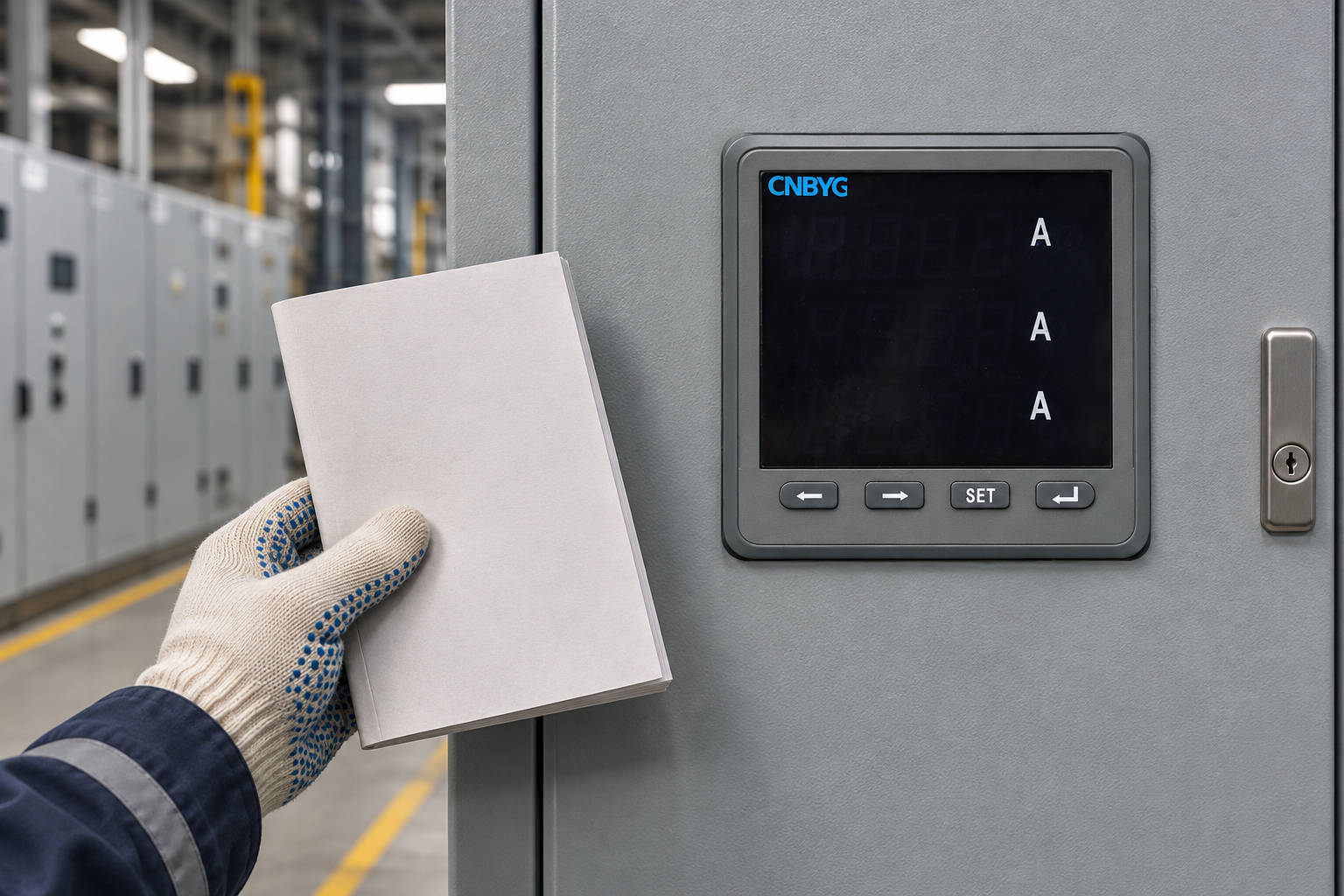
Start product identification with the BY194 series multifunctional instruments page. Confirm the actual ordered variant and applicable instructions with the supplier. The page and reference photograph do not establish every installed option, register-map version or site-specific setting.
Separate manufacturer instructions from project instructions
The manufacturer manual describes the product within its stated scope. A project work instruction may additionally identify feeder names, collector mapping, local access rules or a site approval sequence. Both can matter, but they have different owners. A site instruction should not silently override a device limitation or invent a terminal function absent from approved product documentation.
When a project document references a manual, record the specific revision or the approved method for determining applicability. A vague reference to “latest manual” can become ambiguous after a supplier releases a document for a later variant. Ask the document owner how future revisions will be reviewed before they become mandatory for the installed system.
เดอะ cURL Too many subrequests by single Worker invocation. To configure this limit, refer to https://developers.cloudflare.com/workers/wrangler/configuration/#limits provides background on maintaining controlled configurations and reviewing changes. The document register below is a practical engineering recommendation; it is not a quoted NIST form or an assertion that a particular document is legally required.
Build an instruction applicability register
Use stable document identifiers where available and store the approved file in a controlled location. Record external links as references, but do not assume that a supplier URL will always return identical content. The register should allow a reviewer to establish what instruction was used at the time of a particular job.
| Register field | สิ่งที่มันสร้างขึ้น | คำถามทบทวน |
|---|---|---|
| Installed equipment | Asset reference and exact ordered model | Does this instruction cover this device? |
| Document identity | Title, number, revision and issue date | Can the approved file be distinguished from other copies? |
| Scope | Applicable variants, options and tasks | Are any sections outside the installed configuration? |
| Approval | Owner and local acceptance state | Who authorized use for this installation? |
| Replacement | Superseding document and effective conditions | Has compatibility actually been checked? |
| Distribution | Controlled holders and working locations | Who could still use the old copy? |
| Historical use | Related completed jobs and retention basis | Why must a superseded copy remain available? |
This table deliberately contains no universal revision interval or electrical limits. Review frequency and acceptance authority depend on the site’s own process, supplier information and the consequences of using the wrong instruction.
Identify every working copy before withdrawal
Check the maintenance document system, shared drive, printed panel folder, contractor pack and locally downloaded support copy. A central revision register can be correct while an engineer still uses an old printed sheet kept inside a cabinet. Inventory actual working locations rather than assuming every user opens the central system each time.
Ask holders to confirm replacement or withdrawal through the site’s agreed process. For printed copies, make the permitted status clear and avoid leaving an unmarked obsolete sheet beside the current one. For retained electronic copies, separate historical records from the location used to start new jobs.
Do not delete all older instructions indiscriminately. They may be needed to explain a completed configuration or investigate an earlier fault. The aim is to prevent inappropriate current use while preserving the historical record that the owner is required to retain. Record both the withdrawn-use state and the retained-record state when they differ.
Review what changed before approving the replacement
Compare the sections relevant to the installed equipment and planned task. Determine whether the revision changes a description, corrects a value, adds a model or alters a required procedure. A replacement that only adds another product variant may have little effect on the existing job; a corrected setup instruction may require a focused review.
If the supplier has a change summary, use it as an aid and confirm the actual affected text. If there is no summary, record the comparison performed and the remaining uncertainty. Do not claim that an entire long manual is unchanged after checking only its cover page or revision table.
cURL Too many subrequests by single Worker invocation. To configure this limit, refer to https://developers.cloudflare.com/workers/wrangler/configuration/#limits cURL Too many subrequests by single Worker invocation. To configure this limit, refer to https://developers.cloudflare.com/workers/wrangler/configuration/#limits. cURL Too many subrequests by single Worker invocation. To configure this limit, refer to https://developers.cloudflare.com/workers/wrangler/configuration/#limits.
cURL Too many subrequests by single Worker invocation. To configure this limit, refer to https://developers.cloudflare.com/workers/wrangler/configuration/#limits
cURL Too many subrequests by single Worker invocation. To configure this limit, refer to https://developers.cloudflare.com/workers/wrangler/configuration/#limits.
cURL Too many subrequests by single Worker invocation. To configure this limit, refer to https://developers.cloudflare.com/workers/wrangler/configuration/#limits.
เดอะ คู่มือการโอนความรับผิดชอบด้านการตั้งค่า cURL Too many subrequests by single Worker invocation. To configure this limit, refer to https://developers.cloudflare.com/workers/wrangler/configuration/#limits cURL Too many subrequests by single Worker invocation. To configure this limit, refer to https://developers.cloudflare.com/workers/wrangler/configuration/#limits cURL Too many subrequests by single Worker invocation. To configure this limit, refer to https://developers.cloudflare.com/workers/wrangler/configuration/#limits.
Worked example: an old quick-reference sheet remains in use
Consider a hypothetical panel with a current approved manual in the central document system and an older quick-reference sheet in a contractor folder. A technician prepares a job using the sheet. The document owner discovers that the sheet references a superseded project mapping. This example illustrates document control and does not identify a real customer incident or product defect.
The owner stops use of that sheet for new work, checks whether the planned task has begun and assesses any affected completed jobs. The replacement pack identifies the applicable manual and approved project mapping separately. The old sheet is retained with the historical job record if required, clearly marked with its withdrawn-use status.
The withdrawal register records the holders contacted and the confirmation received. If one contractor has not acknowledged the replacement, that distribution item stays open. The owner does not mark the entire withdrawal complete simply because the central file has been updated.

Verify withdrawal by testing the user’s route
Check how a technician actually finds instructions for a new job. Follow the approved document link or job-pack reference and confirm that it resolves to the correct file and revision. Inspect the printed-copy locations identified in the register through the site’s normal process. A search result showing the right title is not enough if the linked attachment is older.
Retain evidence of the applicability review, approval and distribution results. If a later change is needed, this record provides a baseline for the next comparison. The คู่มือเทคโนโลยีปฏิบัติการของ NIST supplies broader OT context for coordinating changes with operational constraints; it does not establish the device-specific instruction content.
The following educational video illustrates problems caused by uncoordinated shared actions. It supports the reason for assigning one approved current instruction during a handover, rather than demonstrating any document-management feature in the meter.

คำถามที่มักถูกถาม
Is the newest manual always correct for the installed meter?
No. Confirm the exact model, options and stated document applicability. A newer manual can cover a different variant or scope, and its issue date alone does not establish compatibility.
Must superseded instructions always be deleted?
No. They may need to remain as historical records. Withdraw them from current use, mark their permitted status clearly and retain or dispose of them under the applicable owner-approved policy.
Does accepting a revised manual authorize a settings change?
No. Document approval and device modification are separate decisions. Any required settings change needs its own authorized scope, impact review and verification according to the site’s process.
When is withdrawal complete?
When the applicability and replacement decisions are recorded and the identified working-copy holders or locations have been addressed. Unconfirmed recipients or remaining uncontrolled copies should stay visible as open items.