Capacitor Voltage Rating Selection for 400 V Systems
Select a capacitor voltage rating for a 400 V system from the actual line voltage, tolerance, harmonics, switching duty, reactor arrangement, temperature and applicable capacitor standard. Do not choose a voltage rating from the nominal label alone. A capacitor exposed to harmonic voltage, detuned-reactor behavior, transients or a higher system voltage can experience more electrical stress than the 400 V nameplate suggests.
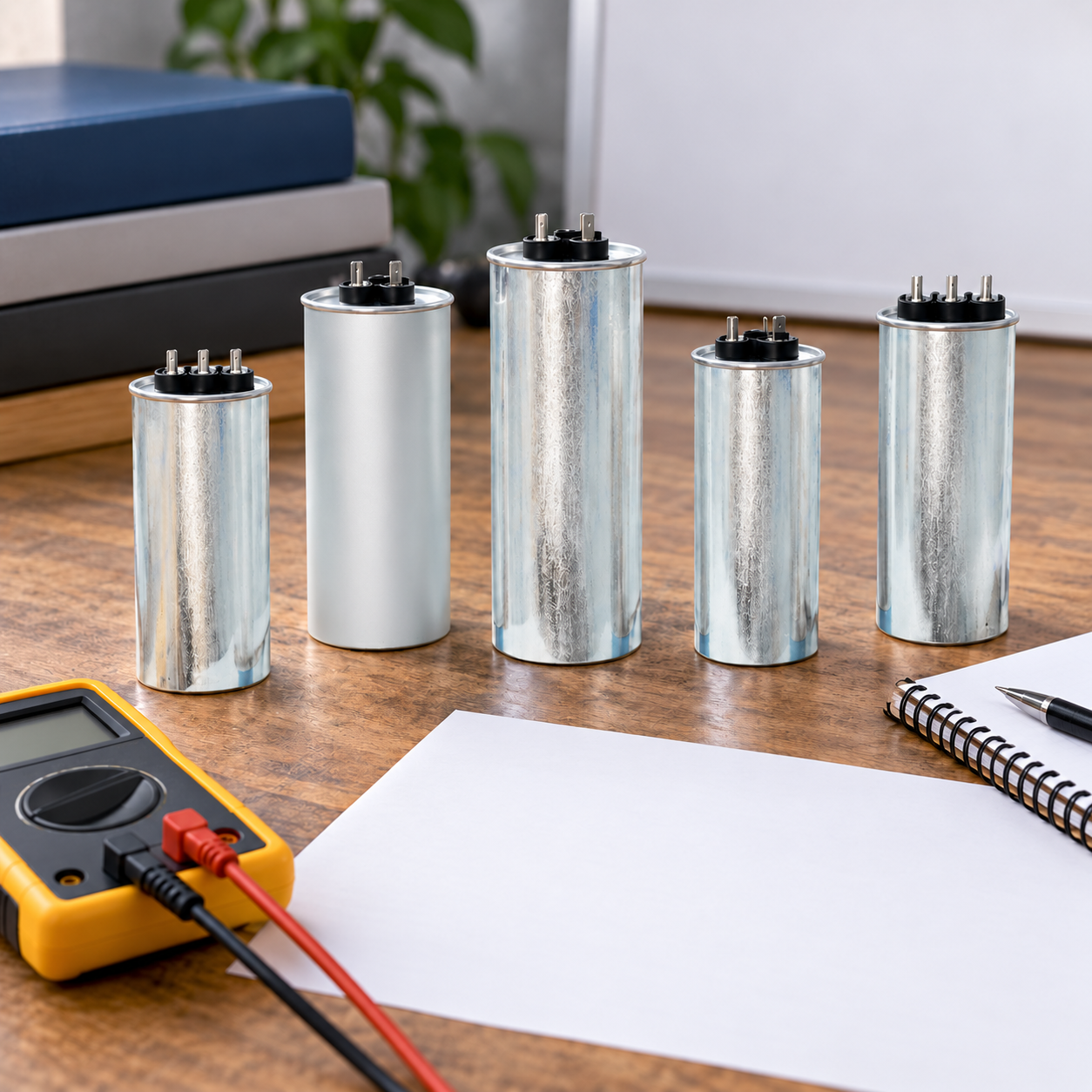
เดอะ CNBYG cylindrical BSMJ power capacitor family provides context for dynamic compensation, while this article focuses on capacitor-bank voltage selection. Use the capacitor manufacturer’s data, the project voltage study and the applicable standard for the final rating.
What the rating means
The capacitor voltage rating is a design limit under stated frequency, temperature, duty and waveform conditions. A 400 V three-phase system may have a line-to-line nominal voltage of 400 V, but actual voltage includes tolerance, transformer tap, imbalance, transients and harmonic components. The capacitor bank also interacts with reactors, switching devices, fuses and discharge components.
Record whether the 400 V value is line-to-line, the frequency, connection arrangement, expected tolerance, short-circuit level, harmonic spectrum and detuned-reactor design. Do not compare a capacitor’s voltage rating to a line-to-neutral value without checking the connection.
Selection table
| Selection factor | คำถาม | Evidence |
|---|---|---|
| Nominal system voltage | Is 400 V line-to-line and is the connection correct? | Single-line diagram and transformer data. |
| Voltage tolerance | What maximum continuous voltage can appear? | Utility range, tap study and site measurements. |
| ฮาร์มอนิกส์ | What harmonic voltage and current are present? | Measured spectrum and load study. |
| Reactor arrangement | Is a detuned or tuned reactor installed? | Reactor design, tuning and temperature data. |
| Switching duty | How often do stages switch and what transients occur? | Controller settings, contactor and inrush design. |
| อุณหภูมิ | What ambient and enclosure temperature applies? | Layout, ventilation and manufacturer limits. |
| Standards | Which capacitor, assembly and safety references apply? | Supplier declaration and project matrix. |
Do not select from nominal voltage alone
Start with the highest expected continuous voltage, not just 400 V. Check transformer tap positions, utility tolerance and whether the bank can remain connected during a lightly loaded condition. A higher voltage increases capacitor reactive output and electrical stress. The capacitor-bank safety requirements helps explain why voltage changes affect reactive-current equipment, even though an SVG is not a substitute for capacitor-bank selection.
Check the connection. In a delta bank, each capacitor sees the line-to-line voltage. In a star arrangement, the per-unit voltage depends on the connection and neutral. The drawing, manufacturer data and protection design must agree.
Harmonics and reactors
Power-electronic loads can create harmonic current and voltage. A capacitor can participate in a resonance with transformer and system inductance, so the bank requires a harmonic and resonance study. A detuned reactor changes the capacitor branch voltage and thermal behavior; its tuning and continuous current must be matched to the intended system.
Measure fundamental voltage, total harmonic voltage, harmonic orders, current, temperature and stage state. The the purpose of reactors in capacitor banks provides a related measurement-boundary approach. Do not infer harmonic safety from a single PF reading.

Switching, protection and temperature
Check contactor or thyristor switching, inrush, discharge time, fuses, breaker coordination, overvoltage protection and enclosure ventilation. A stage that switches often can have a different thermal and mechanical duty from a base stage. Include the minimum-load state so a capacitor does not remain connected when inductive demand falls.
เดอะ คู่มือข้อกำหนดการติดตั้ง SVG covers cooling and service access. The รายการตรวจสอบการใช้งาน SVG และ capacitor-bank maintenance checklist show how to retain settings, alarms and inspection evidence for a broader power-quality installation.
Practical selection sequence
- Confirm 400 V line-to-line, frequency and connection.
- Record maximum continuous voltage, tolerance and tap range.
- Measure imbalance, harmonics, current, temperature and transients.
- List reactors, tuning, capacitors, contactors, fuses and discharge devices.
- Check capacitor manufacturer voltage, kvar, temperature and duty limits.
- Review resonance and short-circuit studies.
- Verify the stage kvar and voltage at the actual connection.
- Test minimum, normal, peak and switching conditions.
- Record protection, alarms, temperature and as-left settings.
- Recheck after a new VFD, rectifier, transformer or tariff change.
Common mistakes
Do not use a 400 V label without checking tolerance. Do not ignore the connection arrangement. Do not assume a reactor automatically makes every capacitor safe. Do not omit harmonic voltage, switching transients, temperature or discharge. Do not select kvar and voltage separately from the same design study.
Verify the chosen rating at the bank boundary
Use the highest expected continuous line-to-line voltage and the actual capacitor connection when checking stress. Include transformer tap range, utility tolerance, imbalance, harmonic voltage and the voltage rise produced by any series reactor. Confirm the manufacturer’s continuous and short-duration limits at the project ambient and frequency. If the bank operates in stages, check each stage and the worst combination.
Record the measured voltage before switching, during inrush and after the stage settles. Compare current, temperature, harmonic spectrum and stage status with the design values. If the bank is frequently blocked or reaches a temperature alarm, investigate the system conditions instead of simply increasing the voltage rating. A higher rating changes kvar and may change protection, tuning and control behavior.
Review the design after a new rectifier, VFD, UPS, solar inverter or EV charger is added. A new harmonic source can change resonance and capacitor current even when the nominal bus remains 400 V. Keep the one-line, reactor data, protection settings, discharge test and as-left voltage record together so maintenance can repeat the same checks.
Validate kvar, voltage and protection together
Voltage rating cannot be selected independently from kvar. A higher-rated capacitor at the same physical bank can produce a different reactive output, so confirm the stage kvar at the system voltage and frequency. Check the branch current, fuse or breaker, reactor current, discharge device and controller setpoint as one design. If the bank is detuned, use the approved tuning and current limits rather than copying a nominal percentage from another project.
At commissioning, measure each stage before switching, during inrush and after it settles. Record line voltage, capacitor current, reactor temperature, harmonic spectrum, alarms and the stage state. Test a light-load condition to confirm the bank does not remain connected when leading kvar is possible. Test the highest expected load to confirm the stage provides the intended reactive support without exceeding thermal or current limits.
Keep the voltage study with the maintenance record. A tap change, new transformer, VFD, rectifier, solar inverter or EV charger can change the voltage and harmonic environment. Recalculate or remeasure before changing the rating. The safest replacement is not always the one with the largest printed voltage; it is the one that matches the complete system study and manufacturer’s limits.
Record the final selection, rejected alternatives and the reason for the chosen rating.
Include the system voltage range, frequency, connection, reactor tuning, harmonic evidence, temperature, protection and the manufacturer data used. If any value is estimated, mark it as an assumption and schedule a site measurement before final energization.
The maintenance file should also show the stage sequence, discharge check, fuse or breaker settings, thermal inspection points and the conditions that require a new harmonic study. That record is more useful than a replacement label alone because it explains why the selected rating was safe for the complete 400 V installation.
Keep the final inspection signed and dated.
Store the measurement files with the equipment record. If the voltage, harmonic spectrum, transformer tap or connected load changes, reopen the selection rather than treating the old rating as permanently valid. This is especially important when a 400 V board gains more rectifiers, drives, solar inverters or EV chargers.
Keep the rejected options and assumptions beside the final selection so a later replacement does not repeat the study from memory.
This record should travel with the panel drawings.
Keep it available for commissioning and service.
Note the inspection interval.
Record the responsible person.
Keep the signed record.
Attach the final voltage trace.
Record the test instrument.
Keep the calibration record.
Store the final report.
Voltage calculations and applicable evidence
For an ideal series capacitor-reactor branch, define p = X_L/X_C at the fundamental frequency. Neglecting resistance, capacitor fundamental voltage relative to the corresponding branch supply is 1/(1-p). A 7% matched branch therefore gives about 1.075 and a 14% branch about 1.163. These calculated factors are not automatic capacitor ratings: harmonic voltage, tolerances, connection and actual duty still require assessment. OpenStax explains the series AC-circuit relationships.
IEC 60831-1 identifies the relevant self-healing low-voltage shunt capacitor standards family. Obtain product-specific voltage and duty criteria rather than inferring an allowable range from its public catalogue description. แนวปฏิบัติงานด้านไฟฟ้าของ OSHA address stored energy and qualified verification in their jurisdiction; the site procedure governs actual bank access.
คำถามที่มักถูกถาม
Is a 400 V capacitor always correct on a 400 V system?
Not automatically. Check maximum voltage, connection, harmonics, reactor arrangement, switching, temperature and manufacturer requirements.
Why can a reactor change capacitor voltage stress?
The reactor and capacitor form a branch whose voltage and current depend on frequency, tuning and system conditions. Use the approved design and measurements.
What harmonics should be checked?
Measure the fundamental and relevant harmonic voltage and current at the bank boundary, then compare with the applicable design and manufacturer limits.
What records should be retained?
Keep the one-line, voltage study, harmonic study, capacitor and reactor data, protection settings, temperature, switching tests and as-left inspection.
บทสรุป
Capacitor voltage selection for a 400 V system is a system-design decision. Verify voltage tolerance, connection, harmonics, reactors, switching, temperature, protection and standards before choosing the rating. Test the real operating modes and keep the evidence with the bank settings.
Educational video: capacitor fundamentals
The Engineering Mindset explains capacitor charge storage and basic behaviour. Small-component demonstrations are conceptual background, not an industrial testing or discharge procedure.