


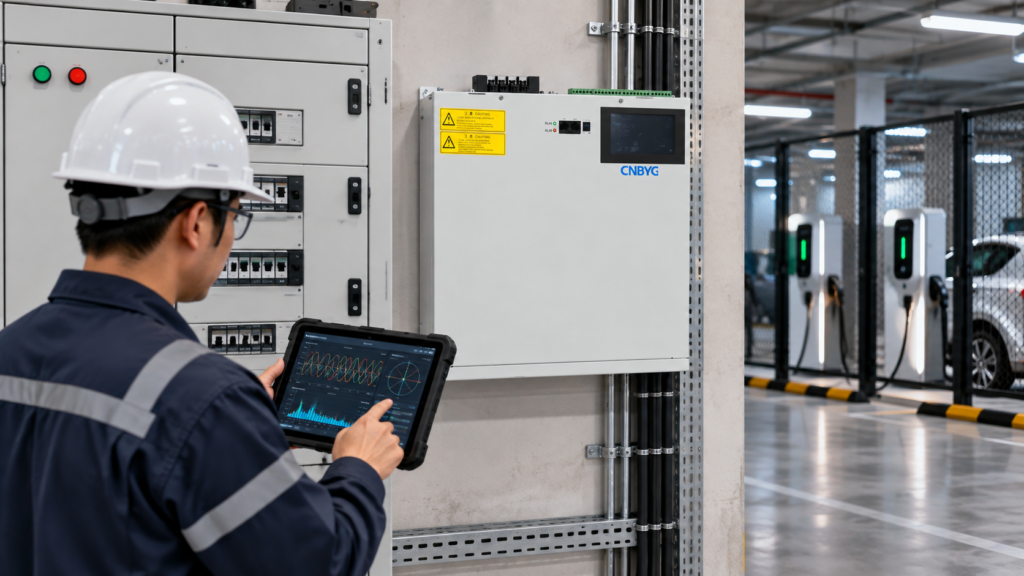
การแก้ไขค่ากำลังไฟฟ้าสำหรับสถานีชาร์จรถยนต์ไฟฟ้า
Power factor correction for EV charging stations must account for charger diversity, simultaneous plug-in events, harmonic current, idle periods and the utility meter boundary. A station can have a good average PF while creating a short current peak when many vehicles begin charging. It can also become leading overnight if fixed capacitors remain connected after vehicles leave. The correction plan should coordinate charger controls, transformer capacity, an SVG or APFC equipment and the station’s load-management strategy.
เดอะ หน้าผลิตภัณฑ์ CNBYG SVG provides context for dynamic reactive-current support. Select the capacity and control priority from measured chargers, approved voltage limits and the site’s operating modes, not from the number of parking spaces alone.
Charging stations are variable electronic loads
AC chargers, DC fast chargers, payment systems, lighting, ventilation and battery storage may share the same transformer. Chargers can start in groups, ramp current, pause for vehicle limits or follow a site demand cap. Their input current waveform and power-factor definition may differ by model. Record the charger type, rated input, phase connection, duty cycle and load-management rule.
Map the charger distribution boards, transformer, main meter, capacitor bank, SVG, battery, solar system and utility connection. Capture idle, one charger, normal occupancy, maximum simultaneous charging, demand-limit transitions and overnight auxiliary load. Record kW, kvar, voltage, current, PF, THD and individual harmonic orders at the PCC and a representative charger group.
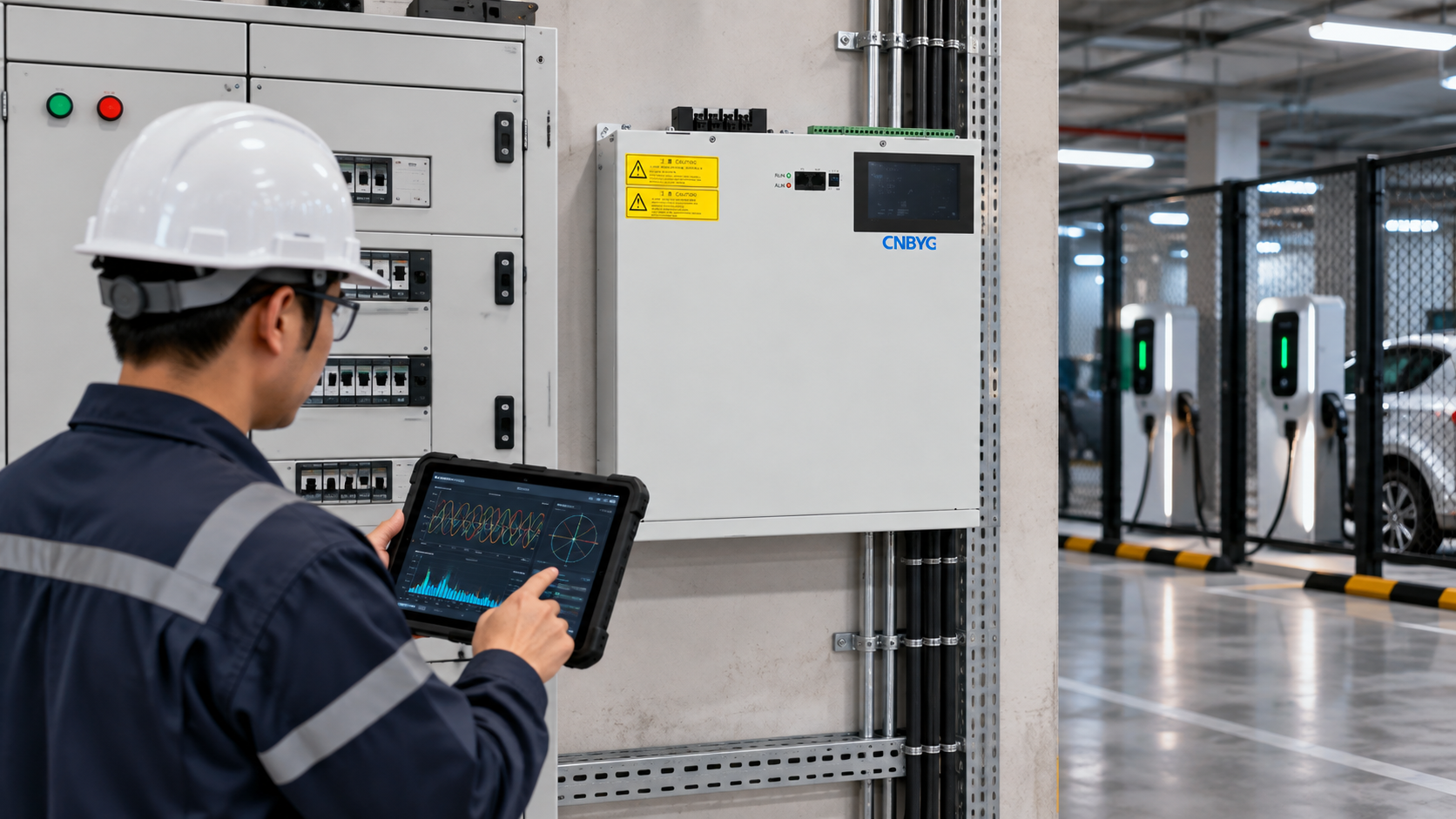

EV station correction decision table
| การสังเกต | พื้นที่ที่น่าจะเป็น | ตรวจสอบครั้งแรก |
|---|---|---|
| PF falls when several chargers start | Simultaneous ramping or transformer current limit. | Use synchronized high-resolution traces and charger state. |
| True PF is worse than displacement PF | Harmonic current from charger rectifiers. | Check THD and the meter definition at the PCC. |
| PF becomes leading overnight | Fixed capacitors remain with only auxiliary load. | Apply an idle-load rule and check step status. |
| Demand cap causes PF oscillation | Charger load manager and compensator respond at similar speeds. | Assign priorities, deadband and delay. |
| Charger group PF differs from PCC PF | Different CT boundary or other site loads. | Synchronize meters and mark the correction boundary. |
| SVG current reaches a limit | Harmonic or unbalance duty uses shared current. | Review current priority and the voltage capability curve. |
Define the utility and charger boundaries
State whether the target is true PF, displacement PF, demand PF or a utility-specific value. Mark the point of common coupling and each charger distribution CT. A charger display may show a good PF while the PCC includes transformer magnetizing current, lighting and another feeder. Conversely, a charger-level correction may not improve the billed boundary.
Verify CT ratio, phase, polarity, burden and voltage reference. Compare the charger, switchboard and PCC meters with an independent analyzer during one charger and several simultaneous chargers. The คู่มือการชดเชยกระแสไฟฟ้าแบบตอบสนองได้ของ SVG explains why an incorrect boundary can be mistaken for a capacity problem.
Select stepped or dynamic correction
Stepped capacitors can suit a predictable base load, but they need minimum on/off times, discharge and protection. EV stations can move from full load to idle quickly, so a stage that is appropriate during a charging wave may be excessive after vehicles leave. A night or idle rule is essential.
An SVG can follow changing reactive current and share current with harmonic or unbalance compensation. The คู่มือการคำนวณแรงดันไฟฟ้าและกำลังไฟของกริด explains why the available kvar changes with voltage. Reserve current for harmonic filtering when charger distortion is significant, and coordinate the SVG with the station demand controller so both do not chase the same event.
Size from simultaneous charging scenarios
Measure net kW and kvar at the PCC for low occupancy, normal occupancy and maximum simultaneous charging. Estimate the reactive requirement with:
[
Q_c = P\left(\tan(\cos^{-1}PF_1)-\tan(\cos^{-1}PF_2)\right)
]
Use the PCC sign convention and then check current at the lowest voltage using (I_Q=Q/(\sqrt{3}V_{LL})). Add the harmonic and unbalance current that must be supported. Do not use the number of chargers as a direct kvar multiplier; charger power, phase balance, demand limits and occupancy determine the actual profile.
Include transformer inrush, charger ramping and a controlled demand-cap event. If the site has solar or battery support, test import, export and island modes separately. Document what happens when the SVG reaches its current limit: relax the PF target, reduce harmonic priority, alarm or hold the last safe value.
Coordinate charger controls and correction
Create a sequence for vehicle plug-in, charger ramp, demand-limit action, vehicle stop and overnight idle. State which controller owns the PCC target, which device handles harmonic current and which capacitor stages are blocked. Use deadband and delay so short charging pulses do not cause repeated switching.
If the site uses a generator, solar inverter or battery, coordinate their reactive controls with the EV station. The คู่มือข้อกำหนดการติดตั้ง SVG ครอบคลุมการระบายความร้อน การติดตั้งสายไฟ และการเข้าถึงการบริการ รายการตรวจสอบการใช้งาน SVG can structure CT, interlock, trace and alarm evidence.
การทดสอบการยอมรับ
Test one charger, several chargers starting together, maximum occupancy, demand-cap transitions, vehicle stops and overnight auxiliary load. Record synchronized kW, kvar, voltage, current, displacement PF, true PF, THD, harmonic orders, charger state, capacitor state, SVG current, temperature and alarms. Confirm the PCC meter sees the intended improvement without leading operation during idle.
Repeat after a charger firmware update, a new charger model or a changed demand-limit rule. For measurement method context, consult the รายการในแคตตาล็อก IEC 61000-4-30 และปฏิบัติตามข้อกำหนดของเครื่องมือโครงการ.
ข้อผิดพลาดทั่วไปที่ควรหลีกเลี่ยง
Do not size correction from the station’s connector count. Do not use an average PF that excludes the charging start event. Do not leave capacitors connected overnight without checking the auxiliary load. Do not allow a demand manager, charger controller and SVG to use different boundaries or response priorities.
Another mistake is ignoring phase balance and harmonic current. The station may show a reasonable displacement PF while transformer RMS current remains high. Save the old settings, a rollback value and the maximum simultaneous charging trace before changing the target.
Keep a charger operating record
Record the charger model, firmware, rated input, phase connection, vehicle state, demand-limit value and occupancy for each test. Store synchronized PCC and feeder traces with kW, kvar, true PF, displacement PF, THD, voltage, current, capacitor state and SVG output. Label the start and end of every charging wave and the quiet interval after vehicles unplug.
Review the record after a new charger model, a site demand-policy change, a transformer tap change or a communication update. A station that is stable with six chargers may behave differently when twelve begin together. If the SVG reaches a current limit, document the priority decision and the resulting PF and THD instead of hiding the limit behind a more aggressive target.
Use a staged test. First validate the PCC boundary with compensation disabled. Then test one charger, several chargers, the demand cap and idle operation. Change only one controller setting at a time and keep the previous value for rollback. This creates evidence that can be repeated by another shift and prevents an average daily PF from masking a short but important charging event.
The final record should state the charger combinations tested, the occupancy and demand-cap range, the voltage range, the active controller, blocked stages and the exact acceptance decision. If the maximum simultaneous event was not available, record the missing scenario and do not present a normal-occupancy trace as the station’s worst case.
Keep the analyzer time base, averaging interval and charger telemetry with the record. A station-level demand average can hide a short charging ramp. Recheck the plan whenever the utility demand rule, charger firmware or load-management schedule changes.
Record whether the charger group was under normal or emergency demand control. A reduced-current fallback can change both the active-power profile and the measured reactive requirement.
Keep the vehicle mix with the trace because different onboard chargers can respond differently.
คำถามที่มักถูกถาม
Does every EV charger need a local capacitor?
No. The need depends on charger design, true PF, harmonic current, the PCC rule and the station’s combined load. Local capacitors can be risky if switching is not coordinated.
Why does PF change when the demand cap acts?
The charger group changes active power and current at the same time. The compensator may also be responding, so synchronized traces and explicit control priorities are required.
Can an SVG handle fast charger changes?
It can provide dynamic current when response, thermal duty, voltage capability and harmonic priority are validated. It must still be sized at the lowest voltage and hardest simultaneous event.
What should the acceptance test include?
Include one charger, simultaneous starts, demand-cap transitions, stops and overnight idle, with PCC and feeder readings, THD, controller state, alarms and capacitor/SVG status.
บทสรุป
Power factor correction for EV charging stations is a variable electronic-load problem. Define the PCC, measure simultaneous charging and idle states, separate true and displacement PF, and coordinate capacitors, SVG and demand management. Validate the hardest charging wave and the quiet overnight period before accepting the target.
วิดีโอแบบกลางๆ:พื้นหลังค่ากำลังไฟ
บทความบรรยาย NPTEL ด้านล่างนี้ให้ข้อมูลด้านการศึกษาที่เป็นกลางเกี่ยวกับค่ากำลังไฟฟ้าและกำลังไฟฟ้าสะท้อน ไม่ได้เป็นคำแนะนำในการเลือกซื้อผลิตภัณฑ์.
