AHF Cabinet Ventilation and Heat Dissipation: An Engineering Checklist
AHF Cabinet Ventilation and Heat Dissipation: An Engineering Checklist
An active harmonic filter (AHF) is a power-electronic device that produces heat while it operates. Cabinet cooling must therefore be treated as part of the electrical design, not an afterthought. Start with the specific unit’s documented heat loss, airflow direction, ambient-temperature range and required clearances. Then consider the complete installation: other heat-producing equipment, enclosure protection, room temperature, dust, filters, cable routing and access for maintenance. The result to verify is that the installed AHF can operate through representative peak-load and warm-weather conditions without blocked airflow, thermal alarms or undocumented derating. A generic clearance number or fan size cannot safely be prescribed for every AHF model.
This article is a planning and verification guide for wall-mounted and rack-mounted arrangements. It does not claim a particular CNBYG product’s watt loss, airflow rate, temperature limit or enclosure rating. Obtain those details for the exact model and cabinet from the supplier and assembly designer before approving the installation.
Treat the AHF, cabinet and room as one heat path
The power module loses energy as heat. That heat must move from internal components to the product enclosure, through its intended ventilation path, into the surrounding cabinet or room and finally away from the site. A free-looking slot on the front is not enough if the cabinet exhausts hot air back toward an intake or the room itself is too warm. Wall units and rack modules can have different access and airflow geometries even within one product family.
The IEC 61439-1:2020 publication sets general service-condition and verification rules for low-voltage switchgear and controlgear assemblies, including attention to temperature-rise verification. The relevant assembly standard and approved design must be applied to the full panel; a component datasheet alone does not verify the completed assembly. For the room, the ASHRAE Handbook’s power-plant guidance describes relating ventilation design and room temperature to electrical-equipment ratings. Its general principle is useful here, but a plant-wide ventilation formula is not a substitute for model-specific AHF data.
Make an inventory of heat sources: the AHF, reactors, transformers, other power-electronic modules, UPS equipment, control power supplies and nearby switchgear. Note which are simultaneously loaded during the hottest expected operating period. A cabinet that passed a cool-day acceptance test may perform differently when production and ambient temperature both peak.
Confirm the actual product’s airflow and access requirements
Do not assume that the front grille of a rack module is always an intake or that a wall unit exhausts through its top. Airflow direction and required clearances must come from the exact manual. Record the model, mounting orientation, equipment spacing, permitted ambient range, any altitude derating, and the minimum space needed to remove or inspect filters and fans. Design space for service as well as heat flow; an AHF squeezed behind a fixed cable tray may be impossible to maintain without a shutdown.
Use the approved product drawing and cabinet layout. Check what would block flow after installation, not only on an empty panel: door bracing, bundled control cables, a neighboring drive, a decorative cover, dust screen or a row of modules can change the path. If an enclosure is modified with openings or fans, the resulting ingress protection and certification basis may change. IEC 60529 classifies degrees of protection provided by enclosures. Its IP classification is about ingress and access protection; it does not promise adequate cooling by itself.
The CNBYG AHF product page shows the relevant wall and rack product forms. Use the model documentation, not the product photograph, to establish actual airflow arrows and dimensions.
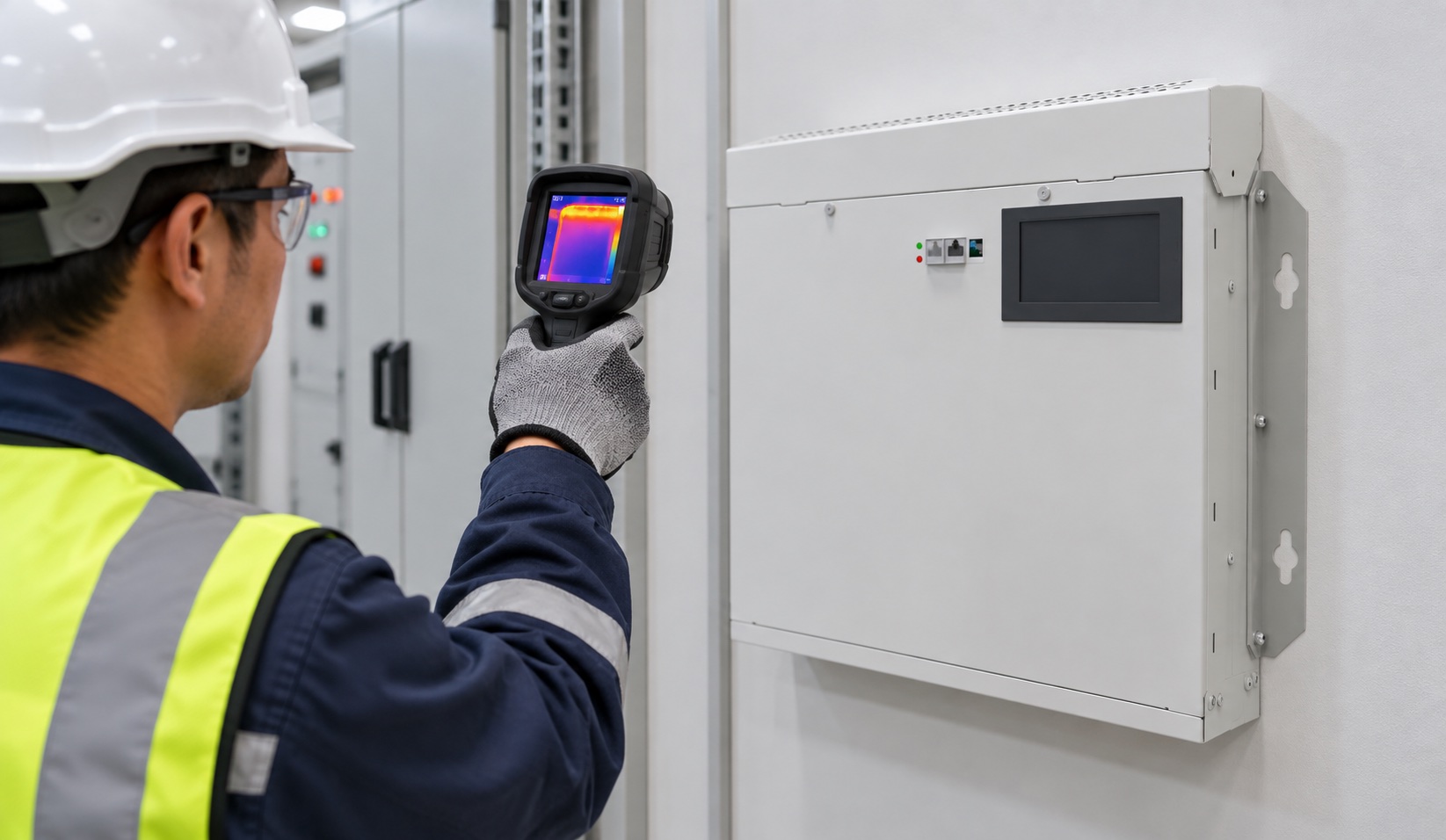
Image: illustrative external inspection of a closed AHF; no temperature or clearance shown is a product specification.
Build the cooling decision from measured and documented inputs
The table is a checklist for a design review. Where the exact value is unknown, request it; do not substitute an arbitrary industry rule.
| Input to confirm | Neden önemli | Saklanacak kanıt |
|---|---|---|
| AHF loss or heat-dissipation data for the proposed operating mode | Determines how much heat the cabinet and room must reject | Model-specific datasheet or supplier calculation with duty conditions |
| Airflow direction and mounting clearances | Prevents intake obstruction and exhaust recirculation | Installation drawing, cabinet layout and as-built photos |
| Maximum design ambient at the equipment location | Sets the temperature difference available for heat transfer | Room trend, HVAC design basis and summer operating record |
| Heat from neighboring devices | Can make local air hotter than the room average | Panel heat inventory and simultaneous-load assumptions |
| Enclosure dust/water protection and filtration | Extra openings may conflict with the environmental requirement | Required IP or NEMA class, filter maintenance plan, approved enclosure design |
| Fan, filter and alarm access | Determines whether cooling remains effective over time | Service clearance check and maintenance ownership |
For a forced-ventilation design, a heat balance can be estimated from heat load, airflow, air density, heat capacity and allowed temperature rise. But the calculation is only as good as the heat-loss and inlet-air assumptions; it also does not prove that air reaches the specific hot components. Cabinet designers should validate flow paths and temperature rise under the applicable assembly rules. Avoid publishing a single fan-flow number without a documented load and environmental basis.
Compare wall-mounted and rack-mounted arrangements carefully
A wall-mounted unit needs a location where its specified inlet and outlet regions remain open, where surrounding air is within its allowable range, and where staff can reach it safely. Mounting it high near a hot ceiling or directly over another exhaust can defeat an otherwise adequate room temperature. An external wall can create condensation or solar-heating issues depending on the site. Verify structural support and cable routing separately from cooling.
A rack-mounted module adds cabinet-level interactions. Neighboring modules can exhaust toward each other; blanking panels or partitions may affect airflow; cable bundles at the rear can reduce outlet area; and a closed door can alter the pressure drop. Preserve the module’s service path. The empty space visible in a cabinet photo is not a clearance specification—measure and document the actual required distance from the manual.
The AHF installation checklist covers broader mounting and electrical requirements, while the three-wire versus four-wire AHF guide addresses the circuit configuration. Neither topic should be confused with thermal adequacy. A valid electrical connection can still be thermally poor.
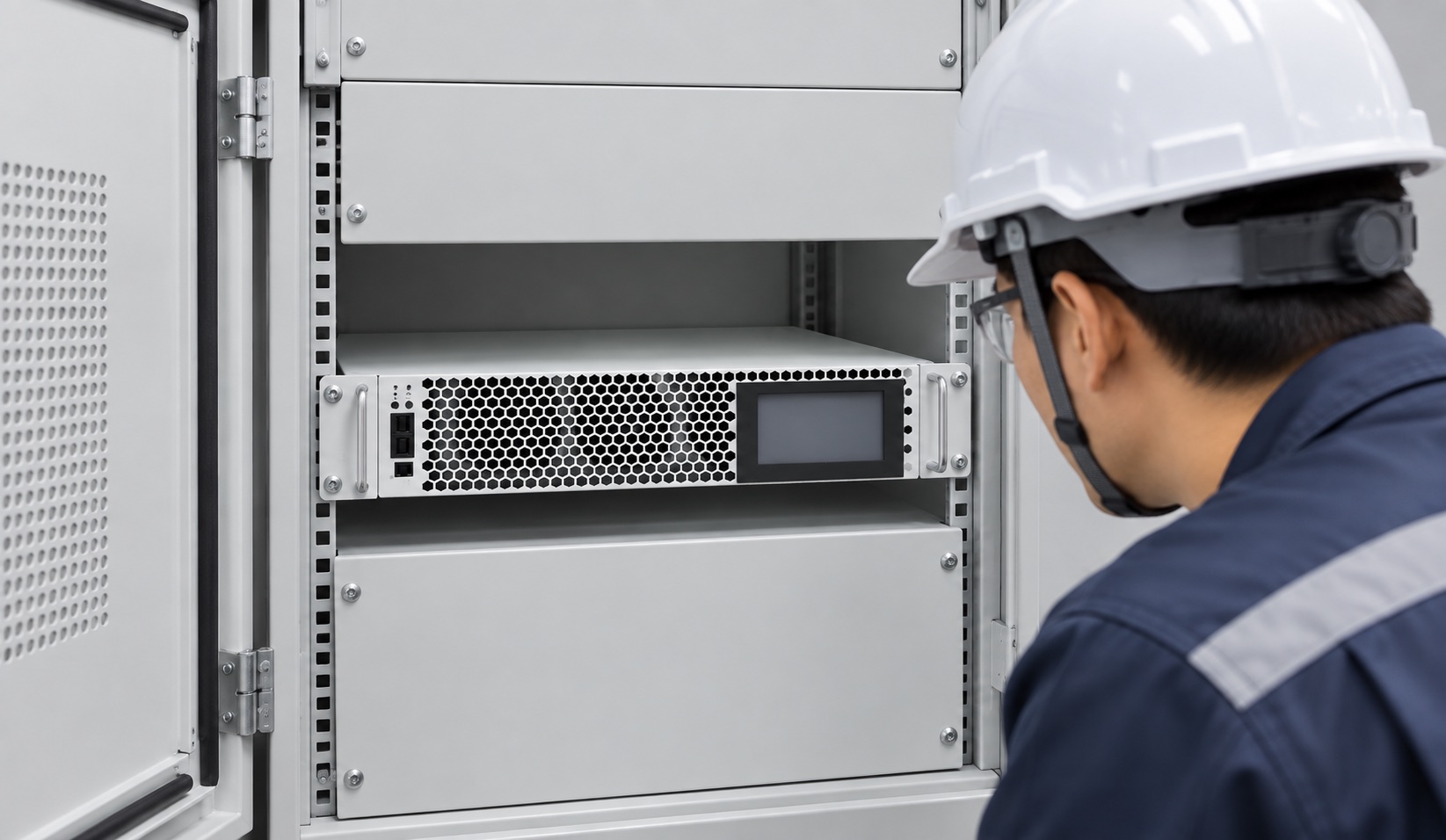
Image: close inspection of a rack AHF based on the site’s real product image; no airflow direction is asserted.
Keep environmental protection while providing cooling
Dusty, humid, wash-down and outdoor sites may require a more protective enclosure. Simply cutting more vents can lower protection against contamination. A filter, heat exchanger or air-conditioning arrangement may be needed, but its suitability depends on site conditions, energy use, maintenance and the required enclosure class. Condensation risk deserves its own review where cooling surfaces may fall below the dew point.
The NEMA 250 scope statement notes that enclosure classification does not in itself cover every internal condition, including thermal damage. Likewise, an IP code under IEC 60529 is not a thermal rating. The assembly and AHF manufacturer must agree on the chosen arrangement. Do not promise a particular enclosure rating after changing vents, fans or door seals without re-verification.
Where several AHF modules operate in parallel, count simultaneous losses and the effect of a failed fan or clogged filter. A spare bay left empty today may be populated later, changing airflow. Include future expansion in the thermal review rather than assuming initial acceptance will remain valid forever.
Commission and trend the thermal behavior
At commissioning, record room ambient, cabinet air at a suitable inlet and exhaust location, relevant AHF temperature or alarm indicators, output current, operating mode and production load. Observe several stable load states, including a representative high-duty condition where feasible. A brief no-load run cannot establish peak-load cooling. The AHF commissioning guide provides the broader startup sequence.
Compare readings with the exact manual’s limits and derating instructions. An infrared camera may help locate unusual external hot spots, but it cannot reveal internal component temperatures through an opaque cover. Do not infer a safe internal temperature from a cool-looking exterior. If a thermal alarm or unexplained derating occurs, inspect the airflow path, fans, filters, ambient and loading before changing protection settings. Disabling an alarm is not a cooling solution.
Keep a maintenance record for filter condition, fan status and seasonal ambient trends. Cleaning or replacing parts should follow the manufacturer’s instructions and site isolation procedure. Only qualified personnel should access electrical enclosures; the article’s images depict closed or covered equipment.
Watch a neutral explanation of electronics cooling
NPTEL IIT Bombay’s Introduction to Electronics Cooling lecture explains the heat-transfer concepts behind a cabinet airflow review. It is general engineering education, not a CNBYG mounting instruction.
Sık sorulan sorular
How much clearance does an AHF need?
Use the exact model’s installation drawing. Required clearance depends on the product, mounting orientation, airflow path and service needs. A generic distance copied from another unit could be wrong.
Can a cabinet fan solve any AHF overheating problem?
No. A fan helps only if the heat load, inlet air, outlet path, pressure drop, environmental protection and control are suitable. A blocked or recirculating path can remain hot despite a larger fan.
Does an IP-rated cabinet guarantee adequate cooling?
No. An IP code classifies ingress and access protection, not internal heat rejection. Cooling must be designed and verified while maintaining the required environmental protection.
What should be recorded after installation?
Keep the model and manual revision, cabinet layout, heat-loss basis, ambient assumptions, inlet/exhaust observations, load state, alarm and derating history, and fan/filter service plan. Retest after expansion or a significant process change.
Handover decision
Approval should be based on documented equipment data, a reviewed cabinet and room heat path, installation photos and representative operating observations. If the supplier cannot provide the information needed to assess losses or clearances, mark the thermal design unresolved rather than inventing values. That preserves both AHF reliability and the integrity of the site’s electrical design.