Delta SM70-45D 70V 45A 380V DC Power Supply: Specs and Replacement Guide
The Delta SM70-45D 70V 45A 380V DC power supply query usually comes from engineers trying to identify, replace, or safely commission a legacy Delta Elektronika unit. The verified model is the SM70-45D in the SM3000 family: a programmable DC source with a nominal 0–70 V and 0–45 A output range. “380V” in marketplace titles should be treated as an input-side clue, not as a DC output rating. Because this model is discontinued, the correct next step is to check the unit nameplate and serial-specific manual, confirm the required operating point and interfaces, then compare those requirements with an officially supported replacement.
| Search phrase element | What it should mean | What to verify |
|---|---|---|
| SM70-45D | Legacy model in the SM3000 series | Exact model suffix, options, serial number, and condition |
| 70 V | Maximum nominal DC output voltage | Required load voltage, OVP setting, cable drop, and safety boundary |
| 45 A | Maximum nominal DC output current | Continuous current, connector condition, cable ampacity, and cooling |
| 380 V | Often a reseller shorthand for the three-phase AC supply environment | Actual input rating on the nameplate and manual; never infer from the listing title alone |
What the SM70-45D actually is
The SM70-45D is a regulated, programmable DC power supply rather than a general-purpose 380 V DC source. Delta Elektronika’s official SM3000 product manual lists the model alongside other voltage/current variants and describes constant-voltage operation with current limiting and constant-current operation with voltage limiting. The supply changes between CV and CC behavior according to the load and the settings.
The model name provides a useful first reading: approximately 70 V maximum output and 45 A maximum output. However, multiplying 70 V by 45 A gives 3.15 kW only as a mathematical corner. It does not prove that every voltage-current combination is continuously available. For any real test plan, use the manufacturer’s output-range graph, thermal conditions, line-input conditions, and the individual unit’s documentation.
The manual also describes analog voltage and current programming, monitor outputs, remote shutdown, protection behavior, and interface options. Those features matter when the supply is part of automated test equipment rather than used as a stand-alone bench source. A replacement that matches only voltage and current can still fail the project if its control polarity, analog scaling, connector pinout, response time, or remote interlock behavior differs.
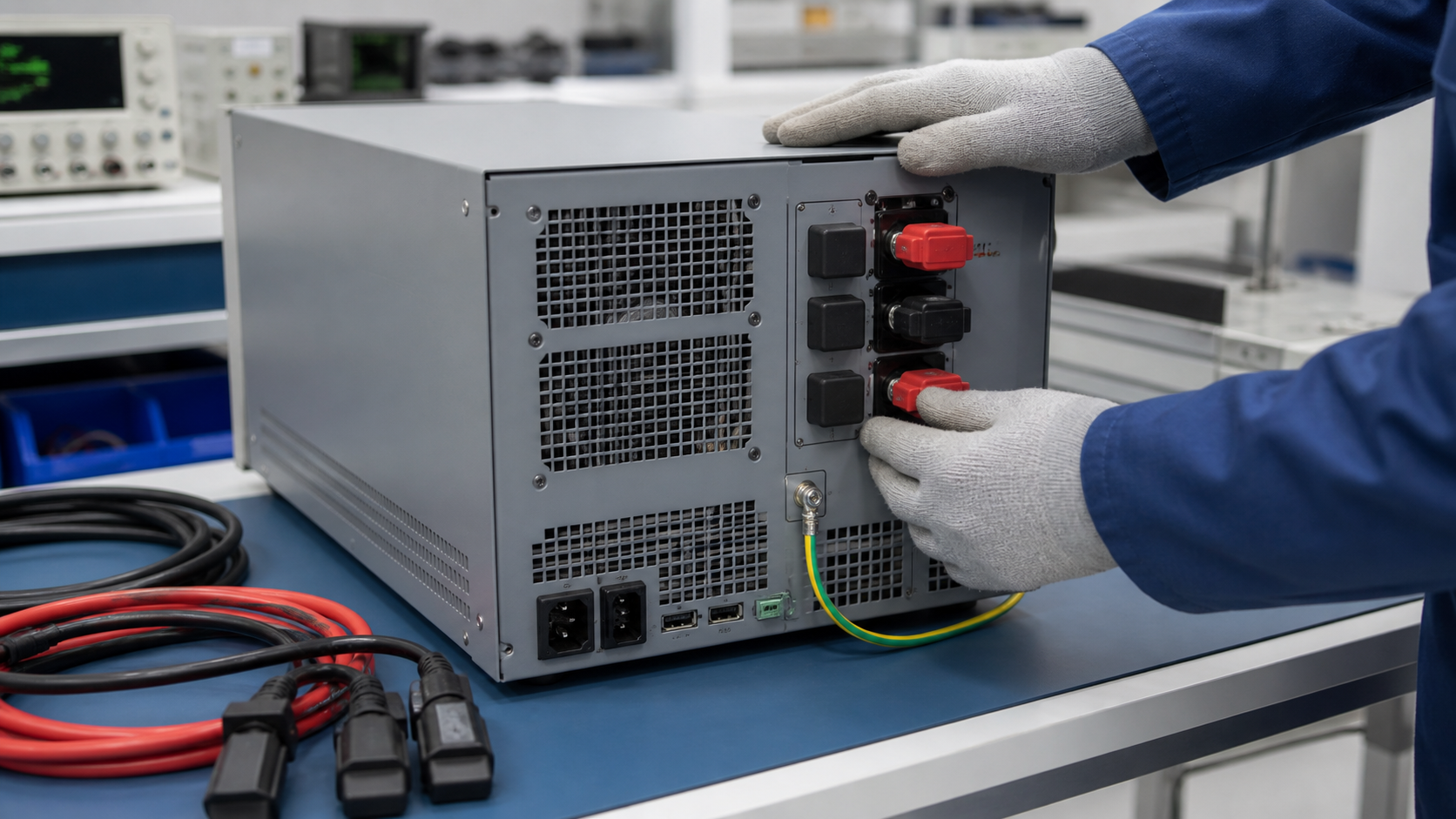
Does “380V” describe the input or output?
For this model, 70 V and 45 A describe the DC output. The “380V” phrase frequently seen in resale listings should not be interpreted as a 380 V DC output. The SM3000 manual states that the series uses a three-phase input without a neutral connection and that operation changes when a non-standard line input or single-phase input is used. It also instructs the user to follow the AC input voltage and frequency rating stated for the unit.
That is why the nameplate is decisive. Before purchase or installation, request a clear photograph of the full rear label and verify:
- rated AC input voltage range and frequency;
- required number of phases and protective-earth connection;
- model suffix and installed options;
- serial number and service history;
- DC output voltage and current rating;
- connector, fuse, cooling, and rack requirements.
If the seller cannot provide the nameplate, treat the electrical compatibility as unverified. A listing title is not an installation document. This distinction is especially important when the supply is moved between countries with different nominal mains systems.
Confirmed operating functions that matter in practice
Constant-voltage and constant-current operation
In CV mode, the supply regulates voltage while limiting current at the selected threshold. In CC mode, it regulates current while limiting voltage. The transition occurs when the load requires more current than the selected limit at the requested voltage. This behavior protects the load and is central to battery charging, component testing, motor experiments, and other controlled DC applications.
The basic relationship is P = V × I. Khan Academy’s neutral DC circuit and electrical power review explains the relationship between voltage, current, resistance, and power. For procurement, calculate the complete operating envelope—not just one nominal point—and include startup current, transient demand, duty cycle, and allowable ripple.
Programming and monitoring
The official manual describes 0–5 V analog programming and monitor signals for voltage and current. It also covers remote shutdown and optional computer interfaces. When integrating a used unit, check the actual installed interface hardware and do not assume that an option mentioned in a family manual is present in every device.
Cooling, temperature, and protection
Ventilation is not optional. The manual states a full-power operating range from −20 °C to +50 °C and requires derating above that range, with unobstructed side ventilation. It also describes overload, short-circuit, thermal, and overvoltage-related protection. These protections reduce risk, but they do not replace correct conductor sizing, overcurrent protection, grounding, enclosure design, or a safe commissioning procedure.
How to evaluate a used SM70-45D before purchase
Search results for this exact phrase are dominated by marketplace listings, calibration services, discontinued-product pages, manuals, and newer Delta power-supply families. That SERP pattern indicates a replacement and verification intent rather than a need for a generic definition. A useful inspection therefore needs to go beyond “powers on.”
| Check | Evidence to request | Neden önemli |
|---|---|---|
| Identity | Readable front and rear photos, nameplate, serial number | Prevents confusion with similarly named SM70 models |
| Basic output | No-load and loaded voltage/current test records | Confirms regulation under a meaningful load |
| CV/CC transition | Electronic-load sweep or documented current-limit test | Verifies the main control behavior |
| Ripple and transient response | Oscilloscope captures with stated bandwidth and probe method | Poor measurement technique can hide or invent noise |
| Terminals and cooling | Close photos of connectors, fans, vents, and discoloration | High-current heating damage may not appear in a front photo |
| Remote functions | Interface inventory and functional test | Automation may depend on options and connector behavior |
| Calibration | Recent certificate with traceability and uncertainty | A calibration label alone does not define measurement quality |
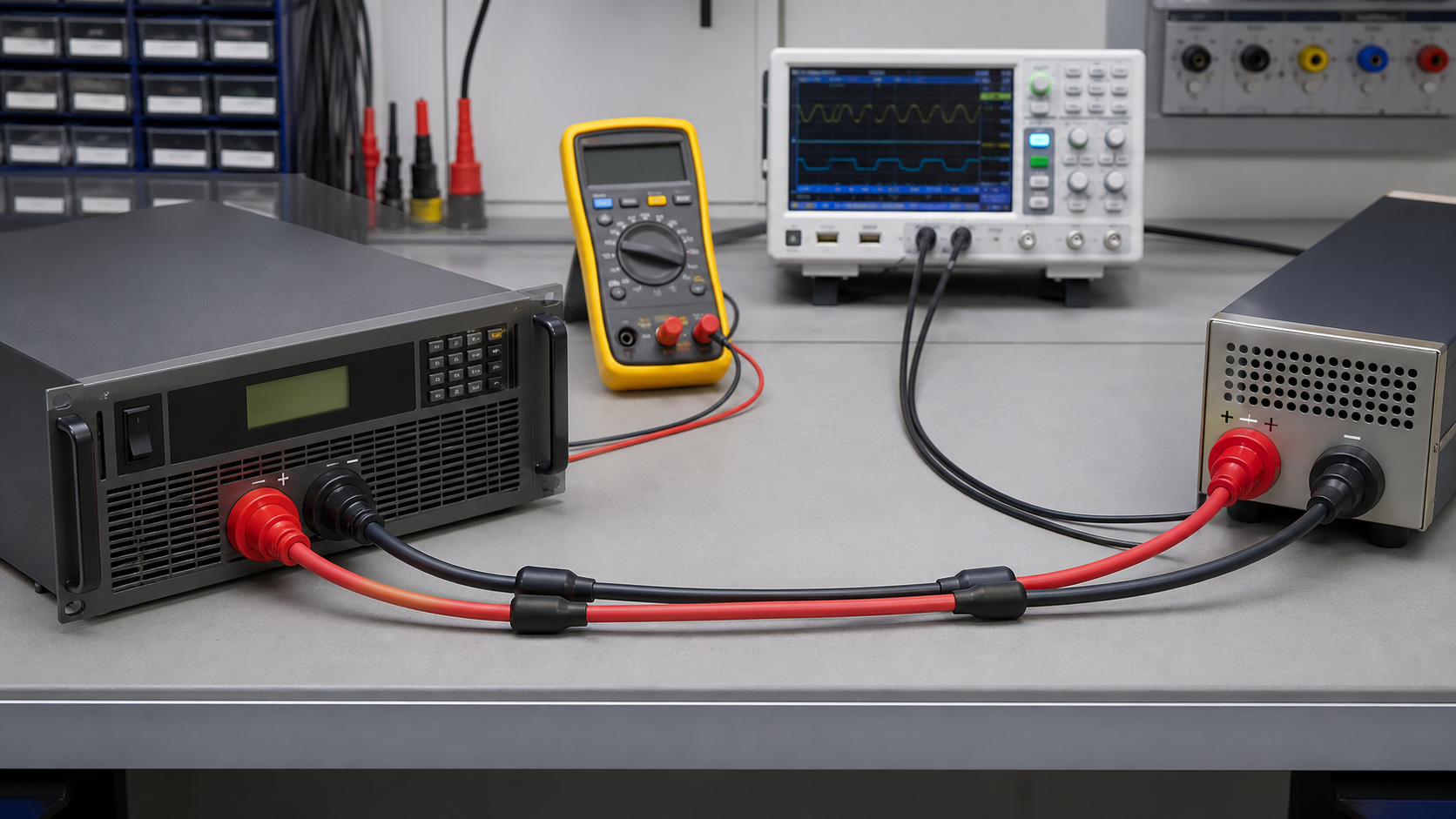
Replacement planning for a discontinued model
Delta Elektronika’s official discontinued-products list identifies the SM70-45D as discontinued and points to the SM100-AR-75 as the manufacturer’s listed replacement. That reference is a starting point, not an automatic drop-in approval. The newer unit’s output curve, physical dimensions, input requirements, interfaces, control response, terminals, and safety integration must be reviewed against the original application.
Build a replacement requirement sheet before requesting quotes. Record minimum and maximum output voltage, continuous and peak current, required power at each operating point, allowable ripple, transient behavior, programming speed, analog and digital interfaces, isolation, remote sensing, polarity requirements, rack dimensions, airflow direction, ambient temperature, compliance requirements, calibration scope, and local service availability.
Also decide whether the system needs source-only operation or bidirectional source/sink behavior. The legacy SM70-45D should not be casually replaced with a regenerative bidirectional supply merely because the headline voltage appears similar. Regeneration affects protection, grid connection, system controls, and risk assessment.
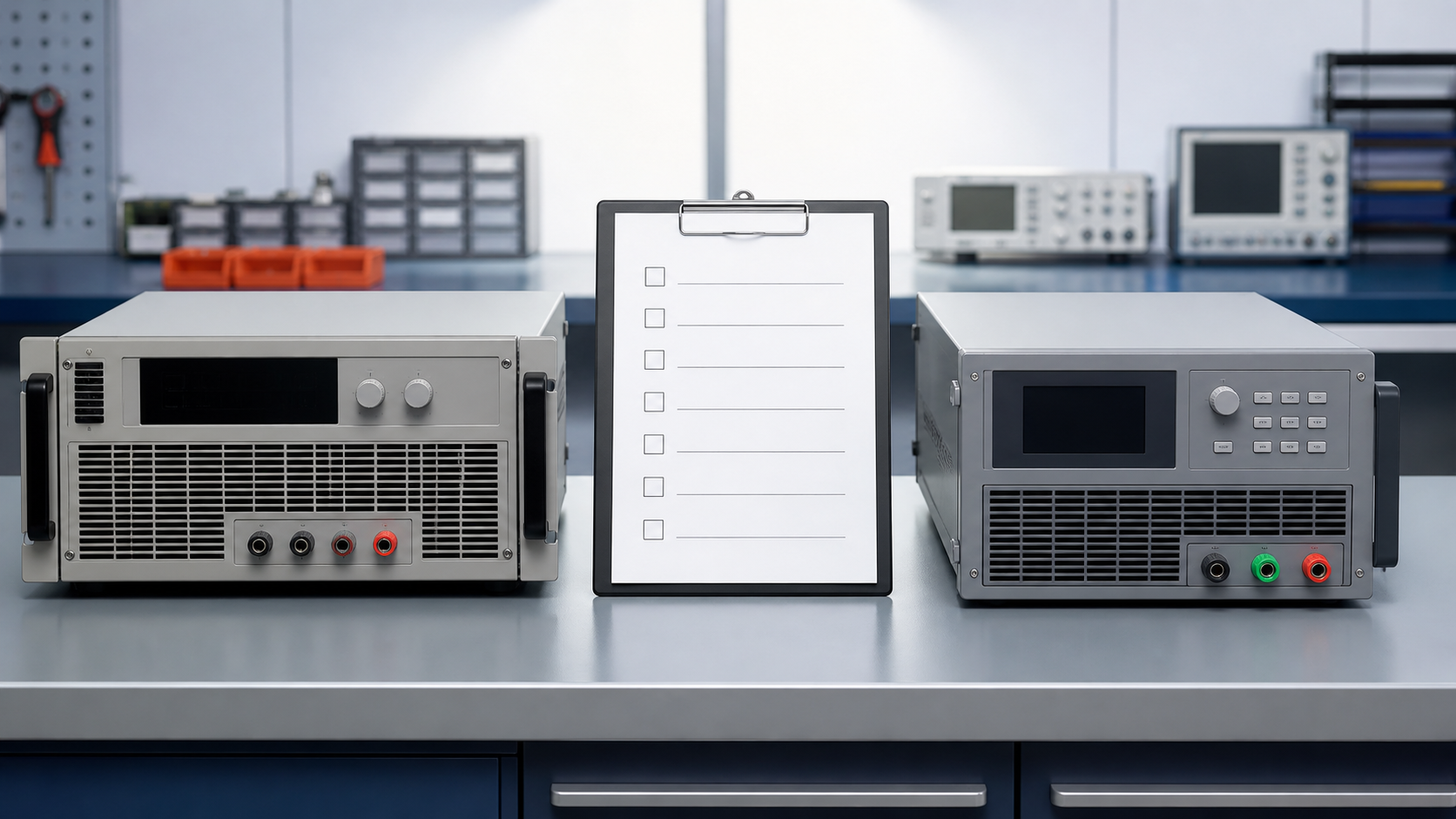
Safe installation and commissioning sequence
- Confirm documentation. Match the model, suffix, serial number, nameplate, manual revision, and installed options.
- Review the supply environment. Verify input voltage, phases, frequency, protective earth, disconnecting means, overcurrent protection, and local rules.
- Inspect mechanically. Check rack support, ventilation clearance, fan condition, terminal covers, and evidence of overheating or impact.
- Size the DC conductors. Use the expected current, conductor temperature rating, installation method, voltage drop, connector rating, and applicable code—not a generic online chart.
- Start de-energized. Follow the site’s electrical safety and lockout procedure. OSHA’s electrical safety resources provide a general safety reference; the responsible qualified person must apply the rules relevant to the installation.
- Test in stages. Begin with no load or a controlled low-risk load, verify polarity and metering, then increase load while monitoring temperature, voltage, current, ripple, and CV/CC operation.
- Validate protection and controls. Check current limit, remote shutdown, interlocks, monitoring, and automation at safe test levels.
- Record acceptance data. Save settings, instrument IDs, calibration status, load points, waveforms, environmental conditions, and results.
Where plant-side power quality fits
A programmable DC supply is the load-facing test source; plant power-quality equipment operates on the upstream AC distribution system. They are different product categories. If several high-power supplies, drives, rectifiers, or electronic loads operate in one facility, it can be useful to monitor the feeder separately from the DC output.
CNBYG’s BY194 multifunctional power instrument is relevant to AC-side feeder monitoring, not as a replacement for the Delta supply. For practical panel measurement context, see our guide to multifunction power meter wiring. The articles on active versus reactive power ve Endüstriyel tesislerde VFD harmonikleri explain other upstream measurements that may matter in facilities with concentrated electronic loads.
Educational video: voltage, current, and resistance
This Khan Academy lesson provides a neutral refresher on voltage, current, resistance, and basic circuit behavior. It supports the concepts used in a programmable supply test plan but does not replace the manufacturer manual or site-specific electrical procedure.

Watch on YouTube: Introduction to circuits and Ohm’s law — Khan Academy
Sık sorulan sorular
Delta SM70-45D bir 380 V DC güç kaynağı mıdır?
No. The verified model designation describes a nominal 0–70 V, 0–45 A DC output. “380V” in resale search phrases usually refers to the AC input environment. Confirm the exact input rating from the physical nameplate and correct manual before connection.
SM70-45D hala üretiliyor mu?
The manufacturer lists the SM70-45D as discontinued. Its discontinued-products page identifies SM100-AR-75 as a replacement reference, but engineering review is still required before substitution.
70 V ve 45 A her zaman aynı anda kullanılabilir mi?
Do not assume that from the model name. Use the official output-range curve and applicable derating conditions to confirm the allowable voltage-current operating point.
En çok kullanılan birim testi hangisidir?
There is no single sufficient test. At minimum, verify identity, nameplate input, loaded CV and CC operation, current limiting, ripple with a documented measurement method, protection behavior, thermal condition, and any required remote interfaces.
Does CNBYG sell the Delta SM70-45D?
This article is an identification and engineering guide, not a claim that CNBYG manufactures or sells that Delta model. CNBYG’s related role is in AC-side power monitoring, power factor correction, and power-quality solutions for industrial facilities.