Active Harmonic Filter Maintenance Schedule: What to Check and When
Active Harmonic Filter Maintenance Schedule: What to Check and When
An active harmonic filter (AHF) maintenance schedule should combine routine observation, trend review and planned qualified inspection—not a single fixed interval copied from another site. Start with the exact model’s manual, the site’s electrical maintenance program and the equipment’s operating history. At every review, confirm whether the AHF remains available, free of unresolved alarms, within its thermal and current limits, and still effective at the defined measurement point. Increase attention after an overload, repeated alarm, dusty season, cabinet modification or major load change. Schedule intrusive work only under the approved isolation and safety procedure. This approach protects both equipment reliability and the credibility of harmonic-performance claims.
The suggested cadence below is a planning example, not a CNBYG-prescribed service interval. No fan life, filter replacement date, capacitor life or inspection period can be inferred from a product photograph. The supplier’s model-specific documentation and the facility’s adopted standards control the final plan.
Start with an asset record and a baseline
Each AHF in a plant needs a unique asset identifier linked to its location, one-line diagram, model and firmware, commissioning date, CT arrangement, protective settings and current operating mode. If the site has parallel units, track them separately. A single “AHF healthy” line in a plant log can hide a disabled module. Keep the approved settings export or dated screenshots so later changes can be traced.
The baseline should include representative load states, AHF output current, alarms, temperatures or thermal indicators available to operators, and harmonic measurements at the relevant feeder and, where required, the point of common coupling (PCC). Store raw measurement files when possible. Without a baseline, a maintenance team can see a green status light yet miss a gradual loss of effectiveness. The AHF commissioning procedure describes establishing a startup record; maintenance should preserve and revisit it.
The NFPA 70B 2026 publication is an authoritative framework for electrical equipment maintenance. Application depends on the adopted edition, equipment type and local jurisdiction. It should inform a site program; this article does not substitute for the standard or invent an AHF-specific interval from it. In the United States, OSHA electrical work-practice rules also govern safe work around energized and deenergized circuits.
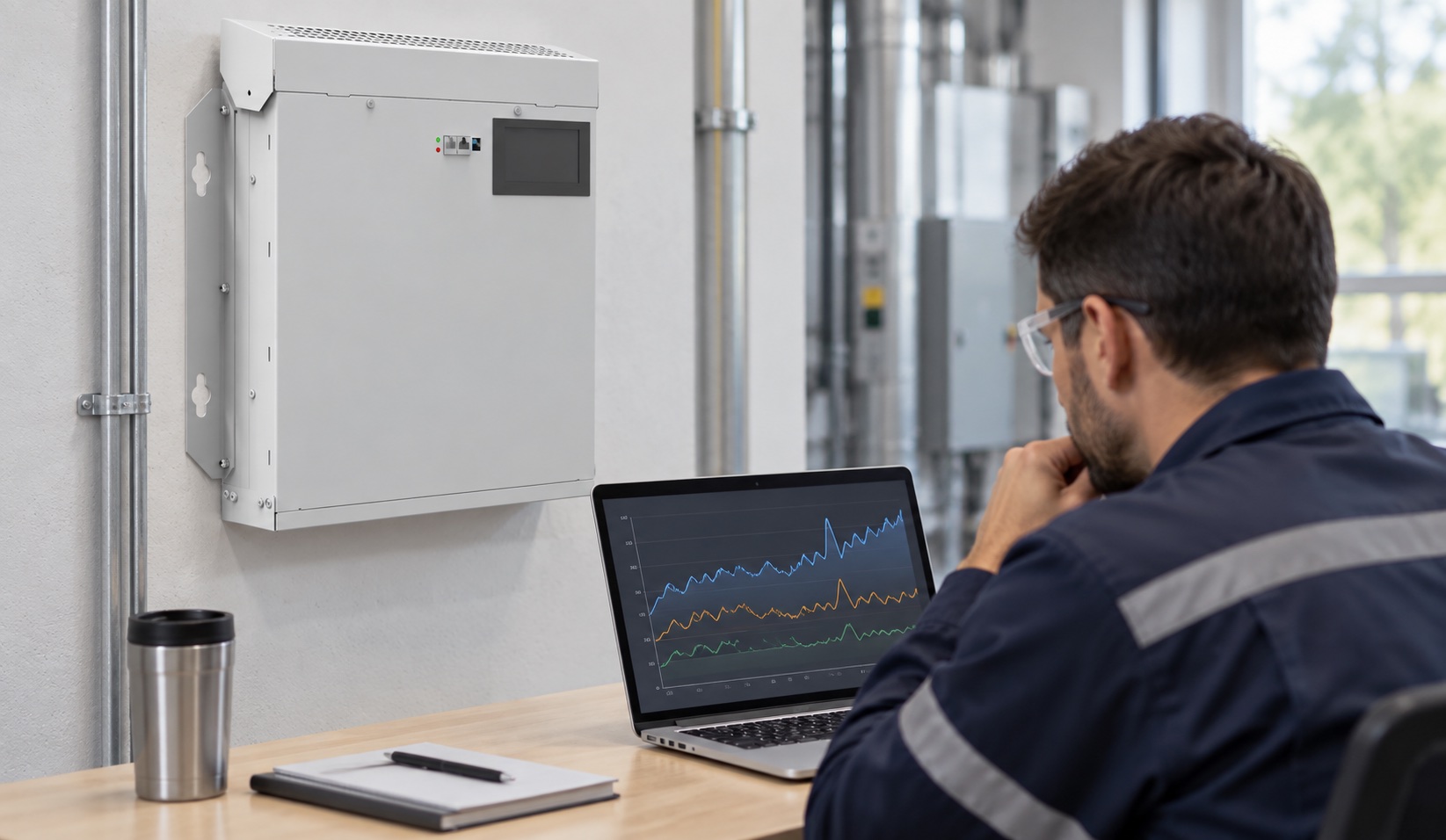
Image: illustrative trend review near a product-referenced wall AHF; the chart is not site performance data.
Build a layered schedule, then adjust it from evidence
The table translates common maintenance tasks into an initial workflow. “Daily,” “monthly” and “planned outage” are example planning buckets for a continuously operated critical installation. They are not replacement frequencies or requirements for every site. A low-duty unit in a clean room may be reviewed differently from one operating near its current limit in a dusty plant. The model manual, risk assessment and local program can call for a different cadence.
| Example review window | Low-intrusion task | Escalate when | Ghi âm |
|---|---|---|---|
| Operator round or daily dashboard review for critical service | Confirm unit online, operating mode, alarm state and obvious enclosure obstruction | Unit offline, repeated alarms, unexpected current limit or blocked ventilation | Time, operator, asset ID, state and alarm reference |
| Weekly or monthly engineering trend review | Compare output current, load state, temperature indicators and harmonic results with baseline | Trend changes under comparable load or one parallel module carries unusual share | Trend plots, load notes and work order if needed |
| Seasonal or post-change review | Check room/cabinet ambient, filters, nearby heat sources and new nonlinear loads | Hot-weather alarm, dust accumulation, cabinet or process changes | Environmental condition, photographs and configuration revision |
| Planned qualified outage per manual and site program | Perform approved internal inspection, cleaning, fastening and component tests | Damage, failed fan, contaminated parts or test result outside model limits | Isolation record, test results, replacement part trace and return-to-service test |
| Immediately after event | Investigate trip, overload, protection action or unexplained harmonic deterioration | Any event without a clear, documented cause | Event log, measurements, corrective action and restart authorization |
The goal is to keep a schedule that responds to condition. If alarms recur between planned visits, shorten the review interval and investigate the cause. If trends remain stable, retain evidence rather than silently extending intervals. Never replace a required manufacturer or adopted-code task with a lighter table entry.
What operators can check without opening the equipment
During normal rounds, confirm the unit is enabled and in the intended mode, and check the visible alarm or event log. Record the time and the site’s operating state. An AHF that is idle because production is off should not be labeled failed; one that is disabled while a critical nonlinear load runs deserves attention. Compare output-current indication with expected process operation, but do not treat the displayed value as an independent calibration check.
Look for blocked exterior ventilation, unusual fan noise, water intrusion, dust accumulation and missing cabinet access. Observations from outside a closed enclosure can be useful. Do not remove covers or touch a CT secondary circuit during an operator round. For the thermal design behind these checks, see the AHF cabinet cooling guide. That guide covers airflow and enclosure design; this page covers when and how to review condition over the asset’s life.
If the interface shows an alarm code, preserve the exact code, time, firmware and surrounding conditions. Generic internet alarm lists are unreliable across models. Use the installed manual to identify meaning and permitted response. Escalate unfamiliar codes rather than repeatedly resetting the AHF and erasing evidence.
Review trends under comparable operating conditions
A weekly or monthly comparison is useful only when the underlying load is comparable. Log production state, drive speed, major switching events and ambient temperature next to the harmonic record. A current-THD percentage can shift when the fundamental current changes even if absolute harmonic amperes do not. Compare order-by-order current, source current, AHF output and voltage distortion as appropriate to the site’s target. If the project has a PCC requirement, include the PCC; a local AHF dashboard cannot prove site-wide results.
The IEEE 519-2022 standard frames harmonic-control design goals at the PCC. It does not prescribe an AHF maintenance frequency. Use it only for the applicable harmonic-performance question, with the proper measurement point and method. The AHF response-time article explains how a rapidly changing load can affect dynamic tests; a scheduled trend review should consider both steady and event-driven behavior.
For a condition-based program, define a meaningful change threshold from site data and the model’s limits, not from an arbitrary universal percentage. Watch for repeated thermal derating, rising fan or filter issues, unexpected current limiting, new dominant harmonic orders, or one module in a parallel set carrying disproportionate output. A change in the process may explain a trend, but it must be documented rather than assumed.
Plan intrusive work with the right controls
Internal cleaning, fan replacement, capacitor inspection, terminal checks and electrical tests may require isolation, stored-energy discharge and trained personnel. The exact tasks and method vary by product. Do not open a live power-electronic cabinet or improvise a test because an article recommends “annual maintenance.” The qualified team should use the manufacturer’s approved procedure, site lockout/tagout process, suitable instruments and specified replacement parts.
After a component replacement or configuration update, verify both basic operation and harmonic performance at a comparable load. Confirm the alarm history is preserved or exported before any reset. Record the part number, reason for replacement, test results and person authorizing return to service. An undocumented fan swap can later become an unexplained difference in airflow or alarm history.
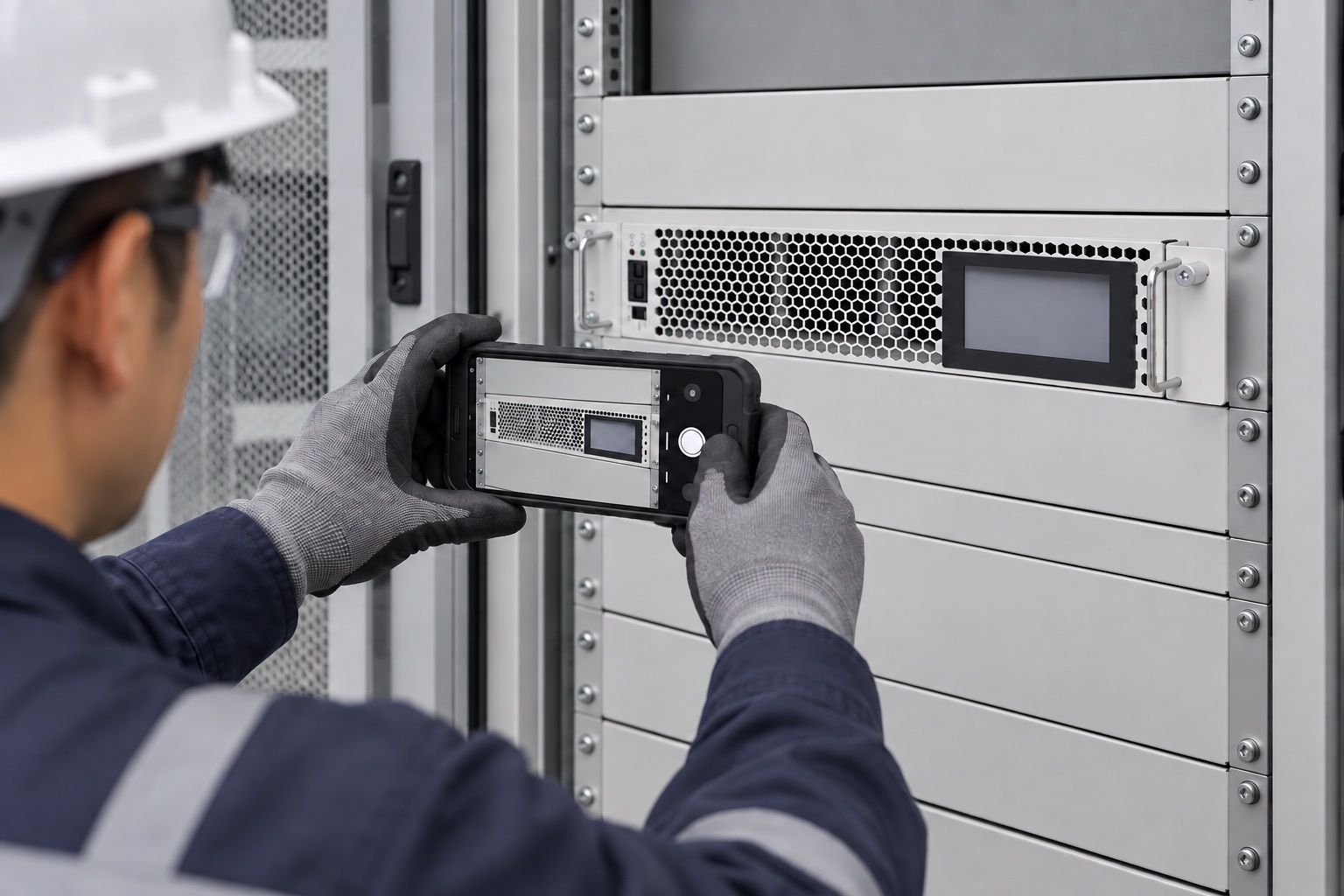
Image: exterior asset documentation of a rack AHF; it does not show an internal service procedure.
Use events to change the schedule
Reassess the plan after a sustained overload, multiple trips, a flood or dust incident, a new VFD bank, a cabinet ventilation change, CT replacement or a software update. New loads can change the harmonic spectrum and duty cycle; a previously adequate filter may now run hotter or closer to its current limit. The AHF sizing guide for VFD loads helps distinguish a maintenance problem from a capacity issue. Changing the maintenance frequency cannot solve an undersized installation.
Keep corrective and preventive tasks separate. A recurring thermal alarm demands root-cause analysis and corrective action now; adding “check alarm monthly” to the plan is not a fix. Likewise, a one-off communication outage may need network investigation rather than a filter component replacement. Preserve the event log so the diagnosis can be reviewed.
For procurement or spares planning, ask the CNBYG AHF supplier for the exact model’s service manual, supported spare parts, recommended inspections, environmental limits and expected replacement criteria. Do not infer those specifications from the general product page.
Neutral video on an electrical maintenance program
The International Association of Electrical Inspectors’ video Navigating NFPA 70B – Electrical Maintenance introduces program-level thinking about electrical maintenance. It discusses the 2023 edition; check the current adopted edition and the equipment manual for actual requirements. It is not an AHF-specific service demonstration.
Các câu hỏi thường gặp
How often should an active harmonic filter be serviced?
There is no safe universal interval. Start with the exact model manual and the site’s electrical maintenance program, then adjust based on operating duty, dust, ambient conditions, alarm history and measured performance. The table above is a planning example, not a replacement for manufacturer instructions.
Is an online status light enough to prove the AHF is working?
No. It shows a limited operating state. Compare alarms, output current and representative upstream harmonic measurements with the accepted baseline. For a PCC objective, measure at the PCC as required.
Can operators clean the AHF while it is running?
Do not assume so. External housekeeping and internal cleaning have different hazards. Follow the model manual and approved site safety procedure; only qualified personnel should open electrical covers or perform intrusive work.
What should a maintenance log contain?
Record asset ID, location, model, firmware, date, load and ambient conditions, observed state, alarm details, measurements, work performed, parts changed, person responsible, authorization and the next review trigger. Keep the underlying trend files when possible.
Make the schedule auditable
The practical result is a living asset record: a clear baseline, a documented set of recurring checks, event-triggered investigations, qualified outage tasks and an owner for each action. Review the plan when the electrical system changes. A maintenance schedule is effective when it catches loss of availability or harmonic performance early—and when another engineer can reconstruct why a decision was made.