Điều khiển AHF Mở vòng lặp so với Điều khiển AHF Khoá vòng lặp
Open loop vs closed loop AHF control describes how the filter determines a compensation target and uses measurements to assess the result. In a simplified load-current feedforward arrangement, the controller estimates the unwanted current from the load measurement and commands the filter to supply a compensating component. In a source-current feedback arrangement, it observes the remaining source current and adjusts compensation toward its target. Actual filters can combine these approaches and contain internal current and DC-link control loops. Therefore, an open-loop description at the system boundary does not mean the equipment contains no feedback anywhere.
Define which loop you are comparing
Before comparing products, identify the controlled quantity and measurement boundary. An article, specification, or supplier may use open loop to describe an external harmonic-control relationship while another uses closed loop for the converter’s internal output-current regulator. Those descriptions can both apply to the same equipment without contradiction.
Ask whether the discussion concerns load-current harmonic extraction, source-current residual correction, output-current tracking, DC-link voltage regulation, or coordination among parallel modules. Record the answer with a block diagram from approved documentation. Do not infer the complete control architecture from a catalogue phrase or the apparent location of one sensor.
The Trang sản phẩm CNBYG AHF identifies the relevant equipment family. Its appearance does not prove that a particular algorithm, feedback mode, bandwidth, or sensor arrangement is available. Confirm those details for the actual model and configuration before selecting or commissioning a system.
Understand feedforward and feedback at the source boundary
A useful conceptual distinction is whether compensation is primarily derived from the load disturbance or adjusted from the observed residual on the supply side. Feedforward acts on the measured disturbance. Feedback acts on the difference between an observed result and its desired condition. Neither label alone gives the response time, stability margin, compensation bandwidth, or achievable harmonic performance.
A simplified shunt-filter description separates source current, load current, and filter current. Depending on the selected current directions, their instantaneous values satisfy a current-balance relationship at the connection point. The engineering drawing must define those directions; changing a sign convention can make a correct equation look inconsistent.
The Hokkaido University research record on combined active-filter control provides an example of a design using multiple measured quantities. It demonstrates why a two-label comparison is incomplete. It is a research reference rather than evidence that CNBYG uses the same topology or implementation.
Compare the information each arrangement needs
| Mục so sánh | Load-derived feedforward perspective | Source-residual feedback perspective |
|---|---|---|
| Primary external observation | The load disturbance being compensated | The remaining source-current condition |
| Câu hỏi về giới hạn | Which loads are represented by the sensors? | Which compensation devices lie inside the observed boundary? |
| Installation risk to review | Omitted loads or incorrect phase association | Incorrect feedback sign or an unintended boundary |
| Capacity question | Can the commanded compensation be delivered? | Can the residual target be reached within permitted output? |
| Verification requirement | Compare source results with the estimated disturbance | Confirm stable residual correction under representative loads |
| Procurement evidence | Approved sensing diagram and supported operating modes | Approved feedback arrangement and documented coordination |
This qualitative table is not a universal wiring diagram. Sensor locations, signal processing, and mode names vary. A filter can use several sensors or a combined strategy, and its approved installation instructions take precedence over an informal open-loop or closed-loop label.
Why CT placement must follow the documented mode
Sensor position determines which current the controller sees. A load-side CT that excludes the filter branch generally provides a different signal from a source-side CT that observes the combined result. Whether either position is suitable depends on the intended algorithm, connection topology, and other devices inside the measurement boundary.
Changing sensor position without changing the documented control arrangement can turn an apparently reasonable installation into an incorrect one. Incorrect polarity or phase association can also corrupt the interpretation. Do not move CTs simply because another manufacturer’s example places them on the other side of the filter connection.
The Hướng dẫn vị trí tuyển dụng AHF CT addresses the installation records, while the AHF CT ratio guide addresses signal scaling. Together they support verification of the chosen mode without replacing the installed unit’s wiring diagram.
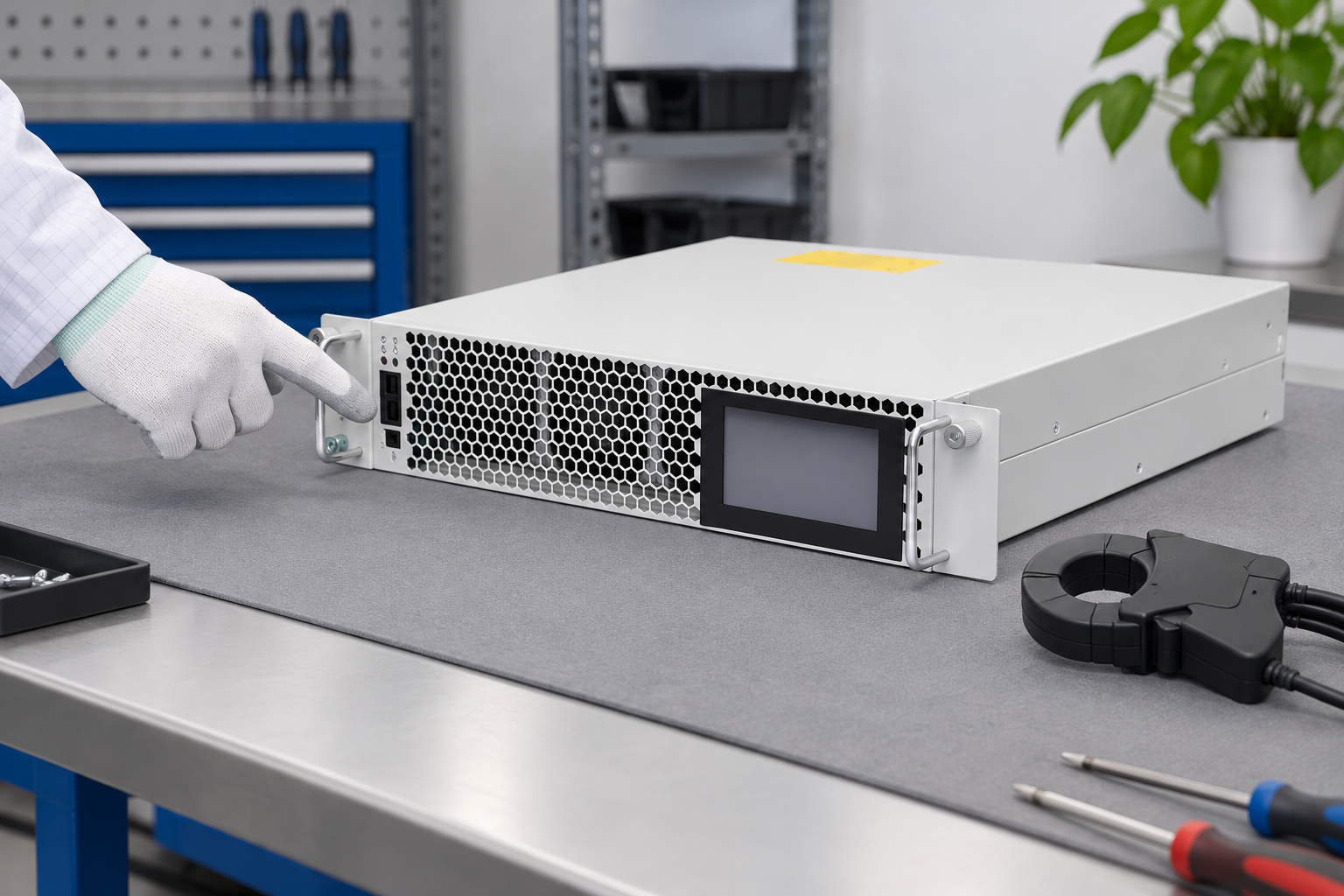
The product-reference illustration shows a closed unpowered module. It does not display a verified open-loop or closed-loop circuit. Establish the actual sensing arrangement from the approved drawing and site records, then plan any necessary physical verification with qualified personnel.
Evaluate dynamic behavior with a defined test
Feedforward is not automatically faster, and feedback is not automatically more accurate in every installation. Sensor quality, processing delay, current tracking, output limits, load changes, and system impedance all contribute to observed behavior. A label cannot substitute for a documented performance test.
Describe the load event you need the filter to handle. A steady rectifier load, a rapidly changing drive load, and an intermittently switched group of loads present different verification questions. Decide whether the priority is steady harmonic reduction, recovery after a load change, stable parallel operation, or a combination of those objectives.
cURL Too many subrequests by single Worker invocation. To configure this limit, refer to https://developers.cloudflare.com/workers/wrangler/configuration/#limits.
The cURL Too many subrequests by single Worker invocation. To configure this limit, refer to https://developers.cloudflare.com/workers/wrangler/configuration/#limits cURL Too many subrequests by single Worker invocation. To configure this limit, refer to https://developers.cloudflare.com/workers/wrangler/configuration/#limits.
cURL Too many subrequests by single Worker invocation. To configure this limit, refer to https://developers.cloudflare.com/workers/wrangler/configuration/#limits
cURL Too many subrequests by single Worker invocation. To configure this limit, refer to https://developers.cloudflare.com/workers/wrangler/configuration/#limits.
cURL Too many subrequests by single Worker invocation. To configure this limit, refer to https://developers.cloudflare.com/workers/wrangler/configuration/#limits.
cURL Too many subrequests by single Worker invocation. To configure this limit, refer to https://developers.cloudflare.com/workers/wrangler/configuration/#limits.
cURL Too many subrequests by single Worker invocation. To configure this limit, refer to https://developers.cloudflare.com/workers/wrangler/configuration/#limits
cURL Too many subrequests by single Worker invocation. To configure this limit, refer to https://developers.cloudflare.com/workers/wrangler/configuration/#limits.
Record the effect of adding or removing a module, switching capacitor stages, transferring supply, or connecting another nonlinear load. These changes can alter both the disturbance and the observed residual. An unexplained improvement during one arrangement does not prove the system will remain stable in every planned configuration.
Avoid universal statements that parallel closed-loop filters always interact badly or that feedforward systems never interact. Those outcomes depend on the actual implementation and network. Request documented coordination guidance and verify the installed configuration under representative operating conditions.
Write a specification that can be verified
Specify the measurement boundary, expected load spectrum, supply conditions, three-wire or four-wire requirements, enabled compensation functions, and available expansion arrangements. Ask the supplier to provide the supported sensing modes and an approved connection diagram for the proposed system.
Define performance using measurable results at the agreed point. Include harmonic currents in amperes, relevant voltage distortion, representative loading, and the agreed evaluation period. The Thông tin tiêu chuẩn IEEE 519 supports the distinction between a filter’s local behavior and harmonic-control evaluation at the system boundary.
Require settings and event records to accompany commissioning results. A statement that the equipment is closed loop does not demonstrate a passed test. Similarly, a low THD screenshot without load and meter-point information is not a reproducible acceptance record.

Document the chosen operating mode, the reason it fits the installation, and the checks needed after future changes. This makes the selection maintainable: another engineer can understand the intended boundary without reverse-engineering a controller menu years later.
Safe verification and further learning
CT work and live electrical measurement require qualified personnel, rated equipment, and the site’s approved procedure. Never open a CT secondary while its primary carries current. Do not change sensor wiring or polarity while experimenting with a controller setting. Follow the manufacturer’s documentation and verified safe isolation arrangements.
The NPTEL IIT Delhi lesson below explains standards and monitoring relevant to assessing the result of a control strategy. It supplements the measurement discussion. It does not identify the internal algorithm of the pictured CNBYG unit or provide an installation diagram.
Xem Power Quality: Tiêu chuẩn và giám sát
Các câu hỏi thường gặp
Điều khiển mở vòng có nghĩa là AHF không có điều khiển phản hồi không?
No. The term may refer to the external harmonic compensation relationship. The converter can still have internal current regulation and DC-link voltage control. Identify the particular loop and controlled quantity before interpreting the label.
Kiểm soát vòng kín AHF luôn là lựa chọn tốt hơn không?
Không có thứ hạng chung nào bắt nguồn từ nhãn này. Hãy xem xét các bố trí cảm biến được hỗ trợ, hành vi động học, giới hạn dòng điện, sự phối hợp và hiệu suất được tài liệu hóa dưới các điều kiện tải dự định. Hãy chọn phương án thực hiện có thể đáp ứng yêu cầu xác minh đã xác định.
Tôi có thể chuyển đổi CT để thay đổi từ mạch mở sang mạch kín không?
Không nên giả định rằng chức năng đó được hỗ trợ. Vị trí đặt cảm biến phải phù hợp với thuật toán và cấu hình đã được phê duyệt của đúng model. Việc di dời cảm biến về mặt vật lý có thể tạo ra tín hiệu phản hồi không chính xác hoặc gây sai lệch trong việc xác định pha nếu đó không phải là một phần của thiết kế đã được tài liệu hóa.
Làm thế nào để chiến lược đã chọn được chấp nhận tại hiện trường?
Use the agreed measurement point, representative load states, documented settings, and suitable instruments. Retain source, load, and filter observations where required, and evaluate both the target harmonic result and stable operation through relevant changes.