APF and SVG for Automobile Manufacturing Power Quality: Selection and Integration Guide
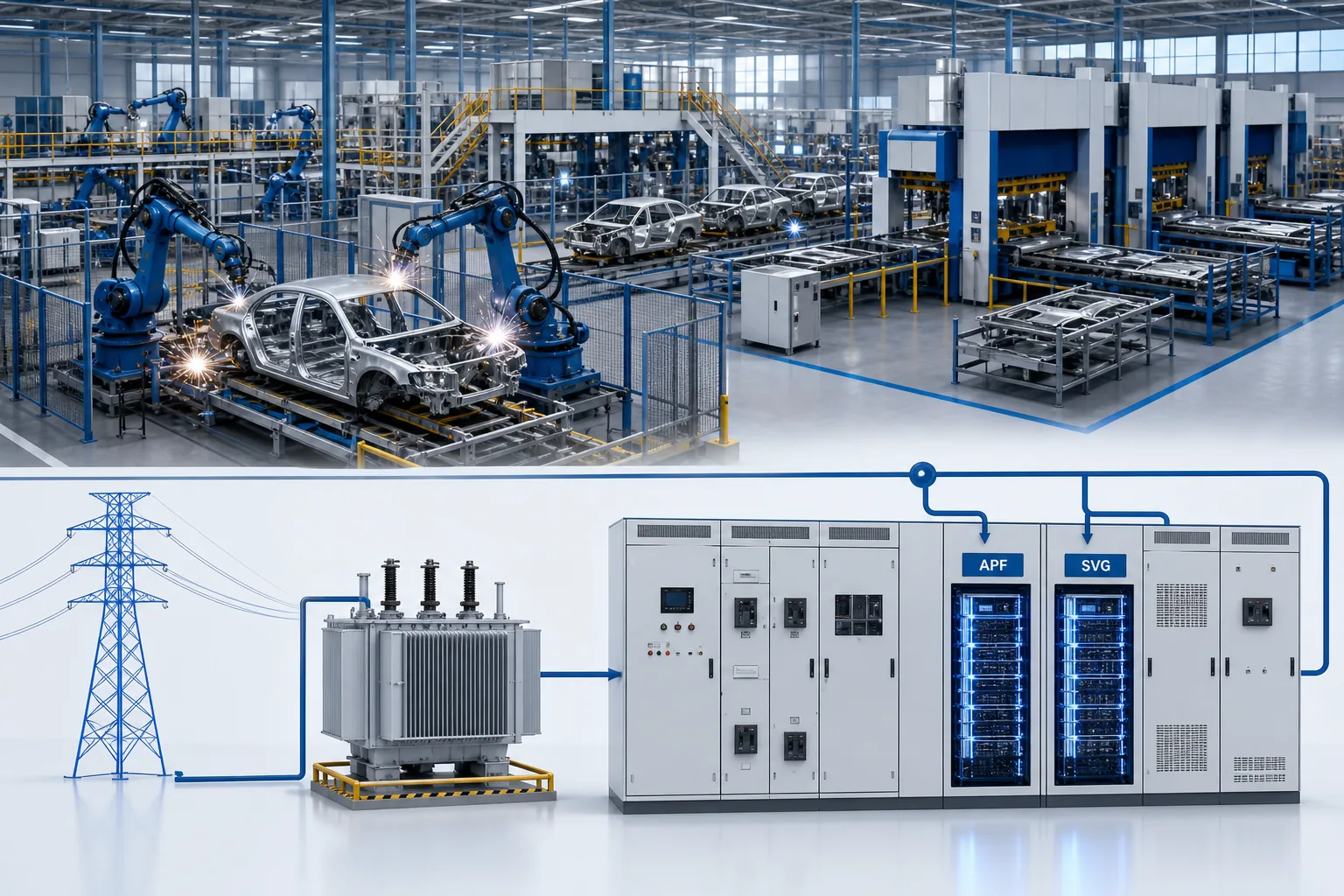
Automobile manufacturing power quality depends on managing fast-changing reactive power and harmonic currents from automated production equipment. Modern vehicle plants combine welding robots, stamping presses, paint-line variable-frequency drives (VFDs), servo systems, and conveyor controls—loads that can depress power factor, raise total harmonic distortion, and disturb voltage stability if left uncorrected.
This guide explains how active harmonic filters (APF/AHF) and static var generators (SVG) address different disturbances in automotive facilities, when to deploy them together, and what measurement data engineers should collect before specification.
Part 1. Why do automotive plants need dedicated power quality equipment?
Automotive production lines prioritize throughput and repeatable process quality. Spot welders and robot welders draw pulsed current; stamping lines create impact loads; paint shops use VFDs that draw nonlinear current.
Without mitigation, typical consequences include:
| Issue | Typical cause in auto plants | Operational risk |
|---|---|---|
| Low or unstable power factor | Welding duty cycles, mixed VFD loads | Higher apparent demand, utility PF charges |
| Elevated THD / TDD | VFDs, rectifiers, robot supplies | Transformer and cable heating |
| Voltage flicker | Spot welding, motor starts | Weld quality variation, control resets |
| Harmonic orders (5th, 7th, 11th+) | Drive front ends | Capacitor stress, overheating |
| Control interference | Distorted waveforms | PLC and robot faults |
See the power quality system overview.
Dedicated equipment is justified when PCC measurements exceed planning targets.
Part 2. What harmonic and power factor problems appear on welding and VFD loads?
Welding robots and spot welders
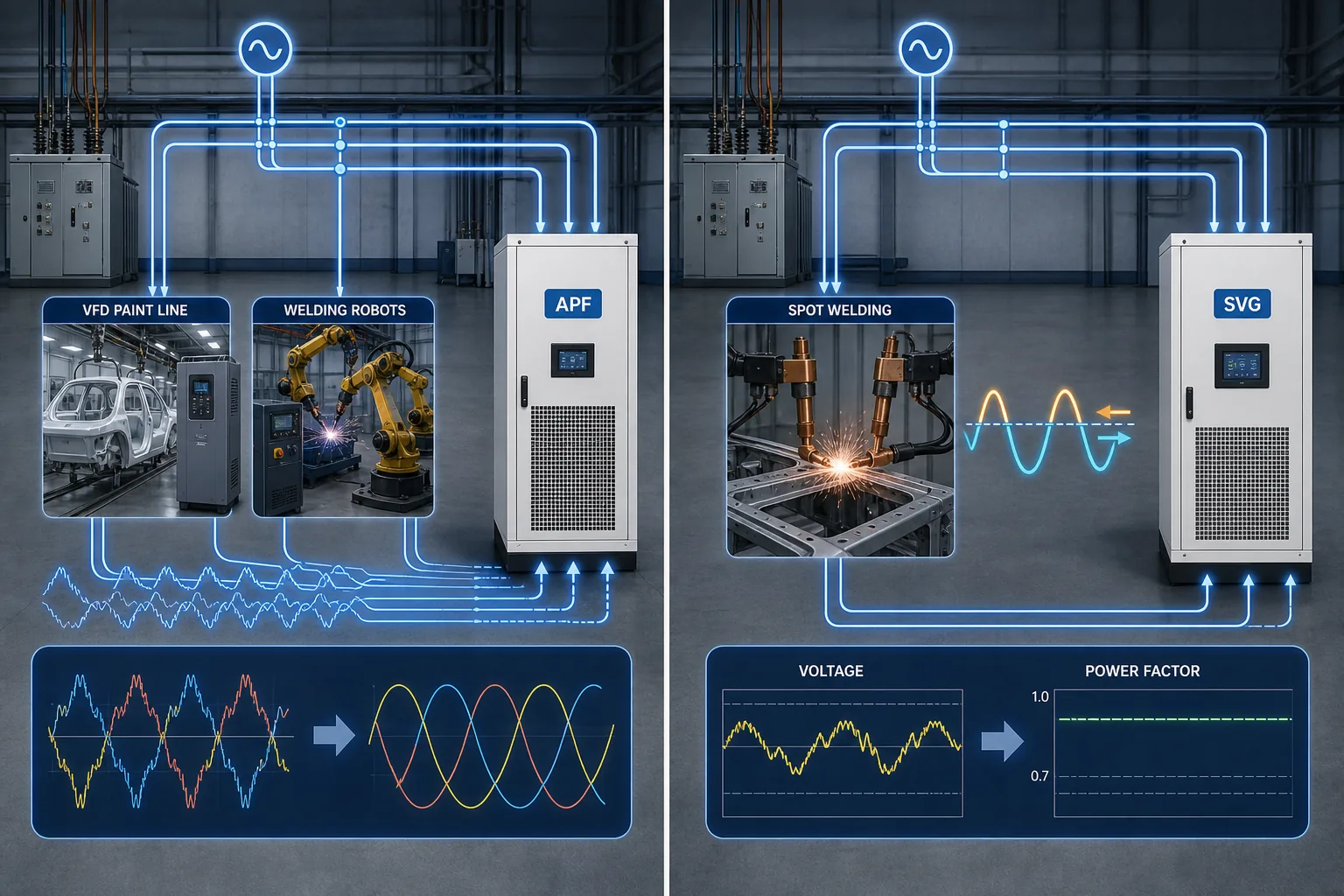
Resistance welding draws high pulsed current during short intervals, producing fast reactive power swings and voltage flicker.
Stamping and large motors
Impact loads create step changes in real and reactive power depending on source stiffness.
Paint lines and VFDs
VFDs generate 5th, 7th, and 11th harmonic currents on the line side.
Planning limits in U.S. projects
Engineers reference IEEE Std 519 for harmonic planning at PCC. Measure THDi, TDD, and power factor across representative production shifts.
Part 3. When should you specify APF (AHF) versus SVG?
| If the primary problem is… | Primary device | Why |
|---|---|---|
| High harmonic current | APF / AHF | Cancels targeted harmonic orders |
| Fast reactive power swings | SVG | Millisecond-level var response |
| Voltage flicker from welding | SVG + study | Fast var when study supports |
| Both harmonics and var swings | APF + SVG | Complementary control |
Read What Is an Active Power Filter (APF)?, Advantages of Static Var Generator (SVG), and AHF Selection Guide.
Part 4. How do you size APF and SVG for automotive production loads?
- Log multiple production shifts including changeovers.
- Capture phase current, THDi, harmonic orders, and power factor.
- Agree PCC with utility and protection study.
- Size APF from harmonic spectrum; add 10–20% margin.
- Size SVG for worst-case reactive power during welding peaks.
- On three-phase four-wire systems, check neutral current if triplen effects are measured.
Part 5. How should APF and SVG be integrated in the plant electrical system?
| Topic | Recommendation |
|---|---|
| Connection point | Main PCC or production hall switchboard per study |
| Protection | Coordinate with existing breakers and motor protection |
| Redundancy | Match N / N+1 production goals |
| Monitoring | Export THD, PF, alarms to SCADA/EMS |
| Control | Verify APF + SVG under step-load tests |
See CNBYG automobile manufacturing solution.
Part 6. What should buyers verify before purchase and commissioning?
- Baseline PCC measurement report
- Target THD/TDD and power factor
- Voltage class and 60 Hz rating for United States designs
- Harmonic orders covered and response time
- Expansion capability for new body-shop lines
- Communication interfaces
- Commissioning with welding-sequence tests
- Spare parts scope
Fit boundary: Requires engineered study; not a substitute for arc-flash or coordination analysis.
Part 7. Which CNBYG products fit typical automotive power quality projects?
- SVG Static Var Generators — dynamic reactive compensation
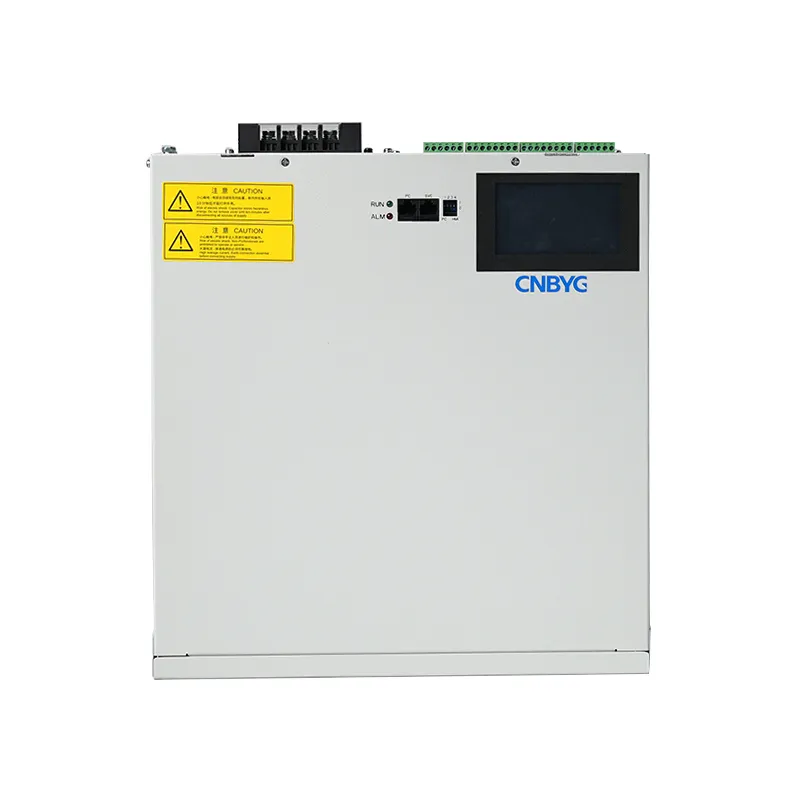
- AHF Active Harmonic Filter — harmonic mitigation
- Power Quality System — portfolio overview
Share diagrams and measurements via the contact page.
FAQ
What is automobile manufacturing power quality?
The degree to which voltage and current waveforms stay within agreed limits for reliable welding, robotics, and drives.
Do welding robots always need an active harmonic filter?
No—measurements show whether harmonics or reactive swings dominate.
Can SVG replace APF on VFD paint lines?
SVG handles reactive power; it does not cancel VFD harmonic currents.
Where should equipment be installed?
At the PCC or switchboard defined in the power quality study.
What loads change power factor fastest?
Spot welders, robot welders, and stamping equipment with short duty cycles.
Which harmonic orders are common with VFDs?
5th, 7th, and 11th are frequent; confirm with a site spectrum study.
Does IEEE 519 apply to United States auto plants?
Commonly used as a planning reference at agreed PCC locations.
What belongs in an APF/SVG RFQ?
Voltage, load list, THDi/TDD spectrum, targets, duty profile, redundancy needs.