Flood-Damaged AHF: Quarantine and Manufacturer Evaluation
An active harmonic filter exposed to floodwater should remain out of service until qualified personnel and the equipment manufacturer have evaluated the affected assembly. An AHF flood exposure quarantine records what happened, prevents accidental reuse, and obtains a written decision on replacement or any permitted recovery. A cabinet that looks dry is not evidence that its insulation, electronics, connections or protective functions are safe. The procedure below is a proposed incident and procurement workflow for plant engineers. It is not a cleaning recipe, an authorization to open equipment, or a claim that a particular CNBYG model can be reconditioned.
Separate flood damage from routine storage moisture
Temporary storage condensation and floodwater exposure require different decisions. Condensation may arise during a temperature transition; flooding can carry conductive residue, sediment and unknown contaminants into areas that cannot be assessed from the exterior. Firefighting water and a leaking pipe can also create a water exposure incident, even when no regional flood occurred. Record the actual event rather than selecting the least alarming label.
The Texas Department of Insurance disaster recovery guidance calls for qualified evaluation, manufacturer consultation before reconditioning, and attention to local inspection requirements. It also explains that drying alone can leave significant risks. These principles support a conservative hold point; they do not classify every harmonic filter as either recoverable or automatically reusable.
For a CNBYG active harmonic filter, ask for advice against the exact model, serial number and supplied assembly. A public product photograph establishes the product family, not flood resistance, an ingress rating, a recovery method or a warranty decision.
Establish a controlled hold without creating another hazard
The site electrical authority should arrange the applicable isolation, control of energy sources and safe access. Personnel must not enter standing water to reach a disconnect or approach exposed electrical equipment. Quarantine paperwork supplements the site’s electrical safety system; attaching a colored tag does not itself establish safe isolation. Keep incident coordination separate from permission to perform electrical work.
Create one incident identifier and associate every affected asset with it. Record the person controlling access and the person authorized to change disposition. Where equipment is moved by approved personnel, preserve its identity and destination. Do not let a warehouse transfer change the label from incident equipment to available spare stock. For installed equipment, record the cabinet location and the boundaries of the affected circuit or assembly.
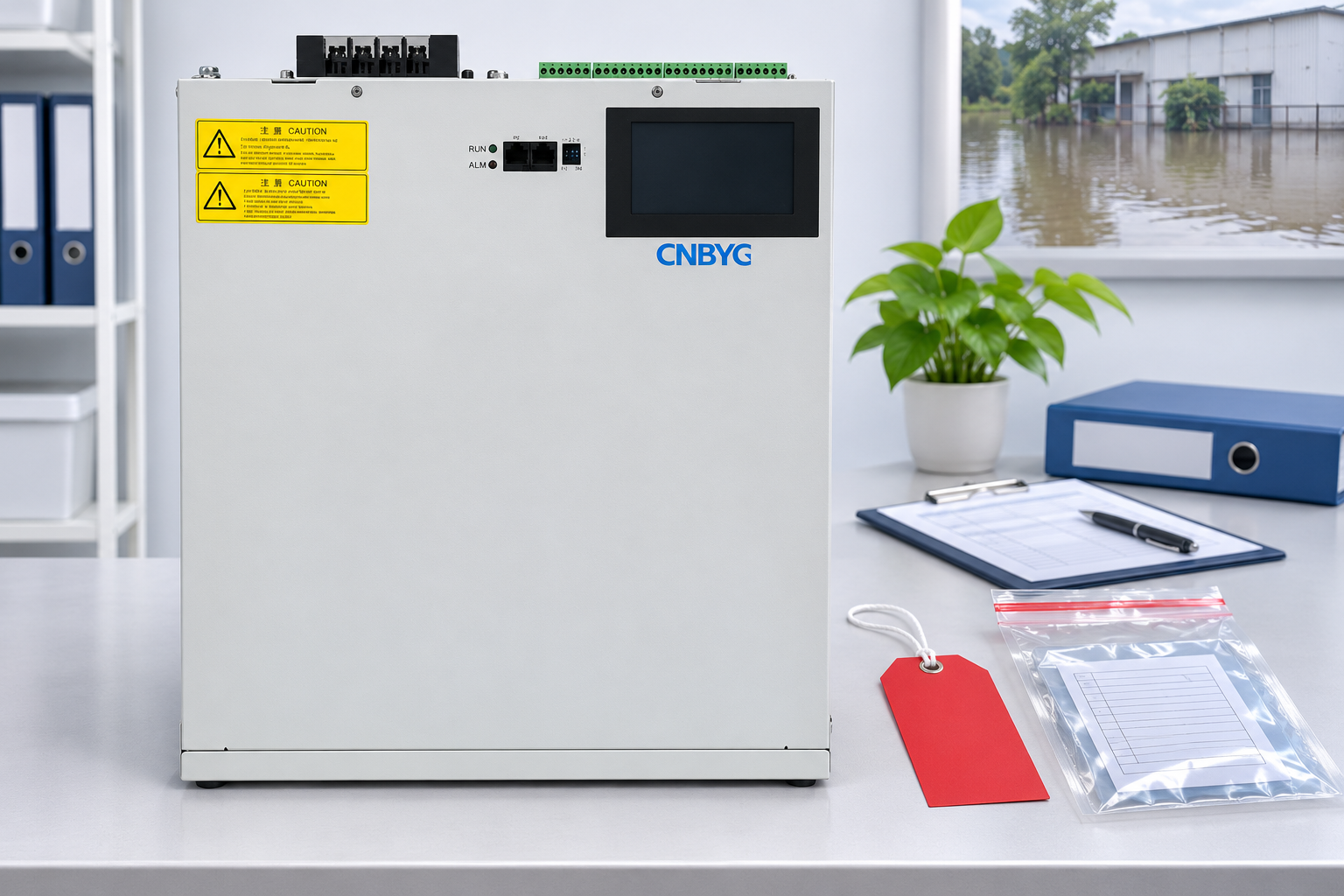
Photographs should be taken only from positions already assessed as safe. Capture the overall location, available nameplate details and visible water evidence without opening covers or disturbing residues. A missing photograph is preferable to an unsafe approach. Include the photographer, time, viewpoint and limitations so the next reviewer can distinguish an observed condition from an assumption.
Build an exposure record the manufacturer can use
Describe the water source: rainwater entry, pipe leakage, firefighting discharge, sewage-contaminated floodwater, saltwater, or unknown. Record why the classification is believed to be correct. If it is unknown, retain that uncertainty. An unsupported statement that the water was clean can lead to a recovery recommendation based on the wrong exposure conditions.
Record the earliest known exposure, discovery time and any known duration. Mark estimated water levels on a photograph or drawing rather than on live equipment. Note whether the equipment was operating when the event occurred, whether upstream protective devices operated, and whether anyone subsequently attempted a restart. Do not run a test merely to complete the history.
Include neighboring equipment and the cable route in the incident boundary. Water can affect connected equipment, cable ends and associated controls even if the AHF front face appears untouched. The reviewer needs a system view. Link the incident package to the site’s AHF installation checklist to identify the original supply, mounting and connection documentation without treating that checklist as a flood release certificate.
Use a disposition table with evidence-based hold points
The following table is a suggested project record. Its decisions require confirmation for the installed assembly. The NEMA water-damaged equipment guide hosted by New Jersey provides general equipment evaluation context and emphasizes manufacturer involvement. It does not supply CNBYG-specific recovery instructions.
| Review item | Evidence to collect safely | Keep the hold open when |
|---|---|---|
| Asset identity | Installed model, serial, assembly reference and location | Identity or affected boundary is uncertain |
| Exposure conditions | Source, duration estimate, water level evidence and contamination uncertainty | Advice assumes conditions not established by the record |
| Manufacturer disposition | Written recommendation naming the equipment and incident | Only a generic statement or distributor assurance is available |
| Associated equipment | Supply, protection, controls and cable-route review | Connected affected equipment has no disposition |
| Recovery or replacement scope | Approved work package, responsible personnel and inspection requirements | Cleaning, testing or replacement scope is undefined |
| Return to service | Completed evidence and site authorization | Any required acceptance item remains unresolved |
The table deliberately avoids drying hours, insulation thresholds and cleaning chemicals. Those values depend on equipment construction and the authorized procedure. A generic internet instruction can be particularly misleading for an assembly containing electronic power components. Do not apply a test voltage or cleaning process simply because it is familiar from another type of switchboard.
Request a written decision rather than a verbal reassurance
Send the incident identifier, asset list, photographs and exposure history through the manufacturer’s approved support route. Ask whether the assembly must be replaced, returned for evaluation, or handled through a specifically approved recovery process. Request the assumptions, exclusions and inspection requirements behind the response. Clarify which parts of the supplied system the decision covers.
If the response refers to replacement components, require the affected part identity and the approved assembly configuration. An unaffected enclosure does not make its internal electronic devices reusable. Conversely, a general equipment list should not be used to invent a recovery decision for a product it does not explicitly cover. The written recommendation must bridge that gap.
Assign separate owners to technical disposition, purchasing and return-to-service approval. Purchasing can obtain a quotation while the technical review continues, but a shipment date should not be mistaken for acceptance. Record whether any removed equipment must be returned, retained for investigation or disposed of through an approved route. Avoid circulating damaged units as undocumented spares.
Preserve the evidence while planning continuity
Keep original photographs and correspondence with their dates. If annotated copies are created, preserve the originals separately. Record any authorized intervention, including who performed it, which procedure was used and what evidence changed. This allows the manufacturer to understand whether the present condition still represents the original exposure.
A plant may need a temporary operating arrangement while harmonic mitigation is unavailable. That decision belongs to the responsible electrical engineer after reviewing the connected loads, supply conditions and other compensation equipment. Do not assume removing the AHF is harmless, and do not bypass protection to restore production. Changes to operating conditions may affect what the original power-quality study represented.
Use the AHF maintenance schedule to locate previous service records and normal observations. Those records can help distinguish pre-existing defects from incident findings, but past maintenance does not prove the equipment survived the water event. Maintain a clear boundary between historical condition evidence and current acceptance evidence.
Close the incident in stages
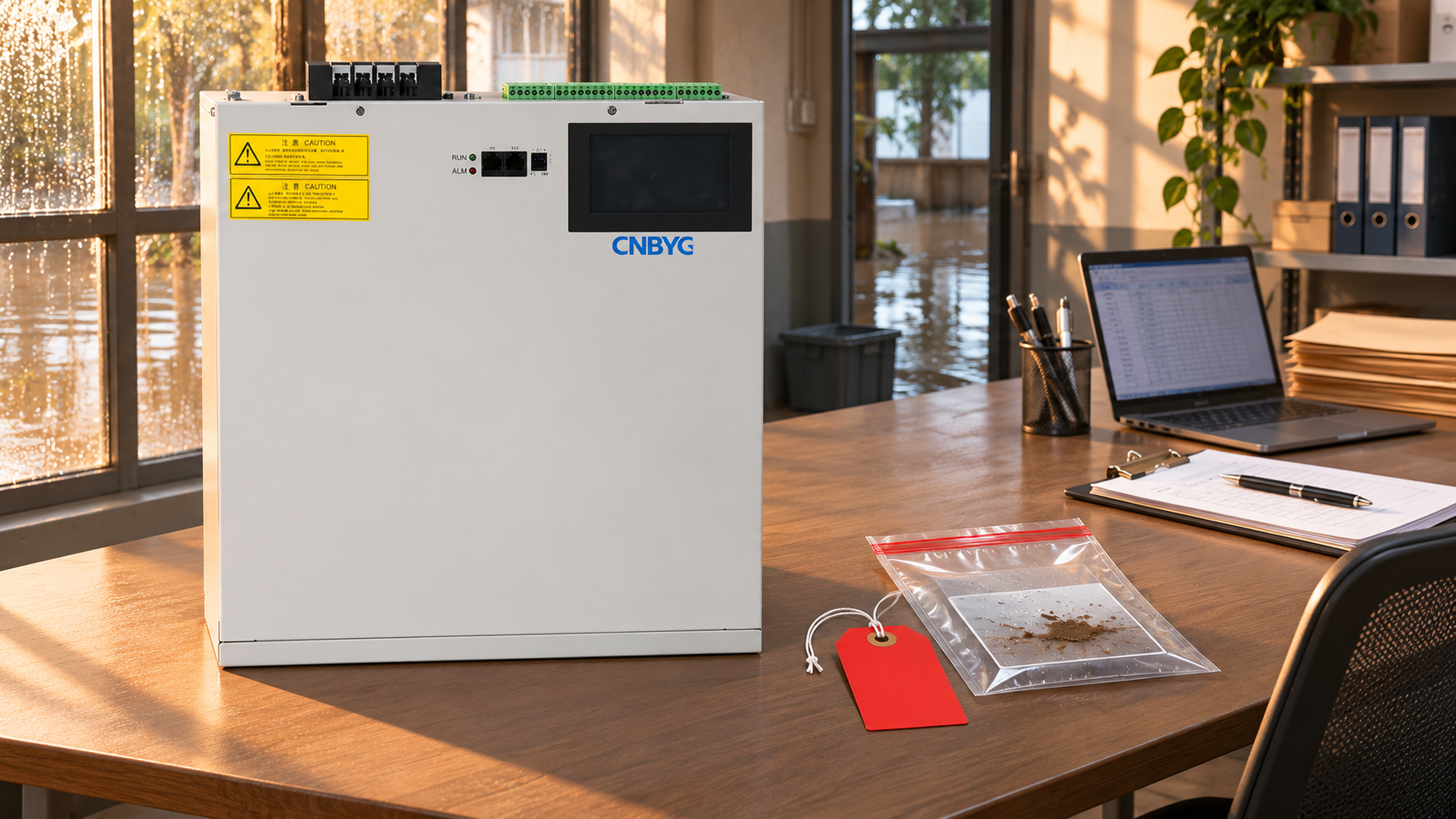
A practical incident register can use four stages: held, disposition received, authorized work completed, and released. Define the evidence needed to move between stages. A manufacturer email may close the disposition question while replacement installation and site inspection remain open. The register should show those unfinished tasks explicitly rather than displaying one misleading green completion field.
For replacement, reconcile the delivered identity with the order and approved scope. For any permitted recovery, retain the actual work and evaluation records rather than a note saying serviced. In either case, confirm the site requirements for inspection and authorization before energization. Track outstanding actions for connected equipment as well as the filter itself.
When operational checks are authorized, use the appropriate AHF performance verification approach under representative conditions. Electrical safety acceptance and harmonic performance acceptance answer different questions. A satisfactory harmonic reading cannot establish that water-exposed insulation is safe, while a safe replacement installation still needs its intended performance checked.
Electrical safety lesson for incident reviewers
The US Department of Labor lesson below addresses the consequences of unsafe electrical panel repair. It is relevant to the access and work-control boundary during an incident review. It does not demonstrate AHF flood recovery or authorize a test or cleaning method. Reviewers can use it to reinforce why evidence collection must stay within the site’s approved safety arrangements.

Frequently asked questions
Can a flooded AHF be switched on after it dries?
Dry appearance is not a release criterion. Keep the affected equipment out of service until qualified evaluation, a manufacturer disposition and the applicable site acceptance requirements have been completed. Do not restart it merely to see whether an alarm appears.
Does an enclosure rating prove the filter survived flooding?
No. The exact enclosure rating and its test conditions must be verified, and they do not establish the condition of a particular exposed assembly. Give the manufacturer the actual exposure history instead of inferring survivability from the cabinet appearance.
What should be included in the first manufacturer request?
Include the incident identifier, exact asset identity, location, safely obtained photographs, water source and contamination uncertainty, estimated duration, known operating status and any intervention already performed. Ask for a written disposition that identifies its scope and assumptions.
Is normal harmonic performance enough to release the equipment?
No. Performance measurements do not replace electrical safety evaluation or the manufacturer-approved disposition. Complete the safety and installation acceptance first, then conduct authorized operational and power-quality checks as separate acceptance activities.