


AHF maintenance permit conflicts should be reviewed across all work that can affect the same equipment, supply boundary, access route or operating assumption. Compare the jobs before they start, identify their dependencies, and record who can authorize a change. Two separately approved tasks can still interfere with each other. A coordination record should state which activities can proceed together, which must be sequenced, and what change requires reassessment. This guide gives a planning framework for maintenance involving an active harmonic filter; it does not provide switching instructions or replace the site’s electrical safety procedures.
Start with related work, not only the AHF job
An AHF intervention may share a working area with switchboard inspection, cable work, cleaning, ventilation maintenance or power-quality measurements. The job titles do not reveal every connection. One team may expect a supply to remain unavailable while another expects it to become available for a test. A corridor needed for equipment movement may also be the route used by another contractor. Ask the site coordinator to identify such relationships before the work is authorized.
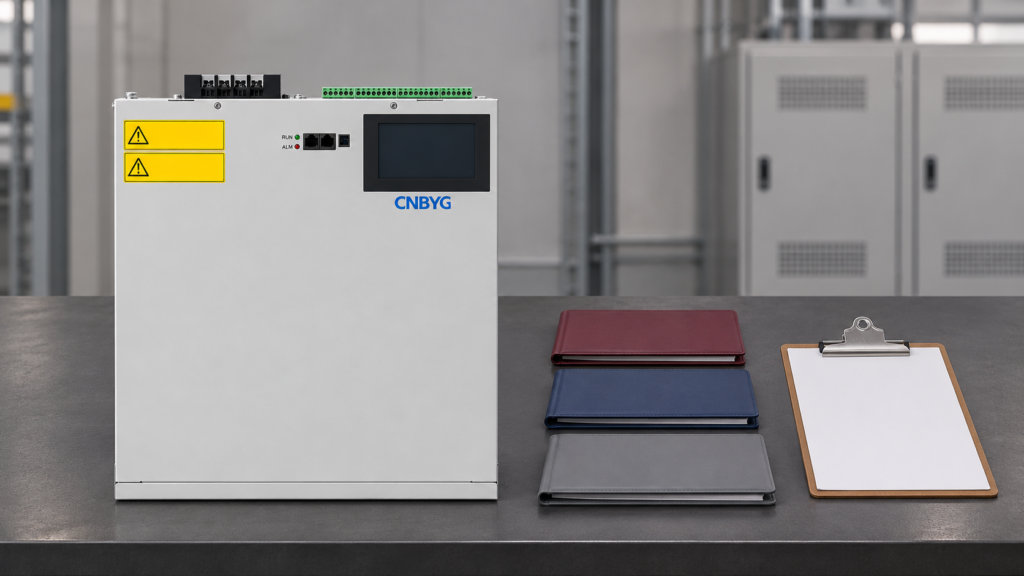
Use the actual CNBYG AHF product information and the installed equipment documentation to define the asset under review. A catalogue outline is not a drawing of the customer’s supply arrangement. Shared sources, adjacent equipment and access boundaries must come from verified site information. If that information is incomplete, keep the relevant planning decision open rather than assuming that two differently named tasks are independent.
The HSE permit-to-work guidance explains that permits support communication and coordination, and specifically calls for relationships between simultaneous and interdependent tasks to be considered. This is general UK guidance. The actual permit categories, responsible roles and legal requirements depend on the site and jurisdiction; this article does not declare that every AHF activity requires the same permit.
Draw the boundary of each planned activity
Give each activity a concise scope, location and planned equipment state. Include who is responsible for the task and the approved method reference. A permit description such as “AHF maintenance” may be too broad for conflict review. The coordinator needs to understand what conditions the team relies on and what conditions the activity could change. Keep the description at the level needed for authorized coordination, with detailed electrical steps in the approved procedure.
Separate physical work from an operational test in the planning record. They may involve different conditions and different people. A time estimate is useful for scheduling, but elapsed time is not proof that another team has finished. A later task should depend on a verified handback or other agreed milestone, not an optimistic calendar entry. Record how the next team will be told that its prerequisite has actually been satisfied.
Where the boundary is uncertain, name the owner of the uncertainty. For example, an equipment identifier may need confirmation from the site engineer before the job can be coordinated. Avoid a vague comment such as “check on arrival” if the answer changes whether simultaneous work is acceptable. Resolve the dependency early enough for the responsible person to review the revised plan.
Use a dependency register to make conflicts visible
The following table is an illustrative coordination aid. It does not establish isolation points or prescribe a switching sequence. Populate it from the verified work plans and the site’s authorized process.
| Relationship to review | Possible conflict | Evidence for the coordination decision |
|---|---|---|
| Shared supply assumption | One task needs an unavailable supply while another requests a test | Verified boundary record and responsible authority’s decision |
| Common access area | Equipment movement obstructs another team’s safe route | Agreed work area and access arrangement |
| Shared support service | Ventilation work changes conditions assumed by another job | Reviewed environmental dependency and sequencing decision |
| Measurement activity | A changing system state makes a planned comparison unsuitable | Agreed measurement window and recorded operating context |
| Personnel responsibility | Two teams assume the other owns the same handback | Named owner and explicit acceptance milestone |
| Schedule change | A delayed job overlaps an activity originally planned later | Updated permit relationship review before continuation |
HSE’s separate COSHH permit guidance describes task scope, time frame, precautions and declarations within a permit process. It is not an AHF engineering specification. The register above is a proposed planning tool that helps the relevant people locate those relationships without claiming that the source mandates its exact fields.


Decide whether to separate, sequence or reassess the jobs
A coordination decision should be more precise than “no conflict.” Record the relationship reviewed and why the chosen arrangement is acceptable under the site’s procedures. Possible outcomes include completing one task before another begins, changing the work window, establishing a different approved access arrangement, or postponing an activity until missing information is available. Only the responsible authorized people can determine which option is suitable.
Do not change an electrical boundary merely to preserve the original timetable. If a dependency cannot be resolved within the approved arrangement, return it for technical review. The coordination record should make that escalation visible. Keeping a task on hold can be the correct planning result; a full schedule is not evidence of a safe work sequence.
For installation preparation, the complementary AHF installation checklist covers a wider set of installation questions. Use it to locate relevant documentation, not as an automatically approved method for the current site. A conflict register coordinates the actual jobs; it should reference the applicable work pack rather than duplicate or override its technical instructions.
Establish how changes will be communicated
Before work starts, agree which changes require the relationship between tasks to be reviewed again. Examples include a different work boundary, an added contractor, an extended duration, unavailable access, or a request to perform a different test. The person discovering the change needs a clear contact route and an instruction to use the site’s stop and escalation process where required. A revised message in an unattended group chat is an unreliable sole control.
Keep a revision reference on the coordination record. When a changed plan is approved, identify who was informed and which prior version is superseded. Teams should not continue from conflicting printed and digital copies. The record owner should make the current version retrievable at the point where the site’s permit procedure expects it to be available.
A shift handover is a related but different process. It transfers the state of unfinished work between responsible people. Conflict review compares relationships between activities. When a job crosses a shift, both processes may be needed: the incoming team must understand the current job and the dependencies that remain in force. Neither process should be treated as an automatic release to operate equipment.
Illustrative conflict: maintenance and a requested measurement window
Consider a hypothetical site planning external AHF maintenance and a separate power-quality survey during the same outage. The survey plan assumes a particular system operating condition, while the maintenance plan expects that condition to remain unavailable. Each team has prepared its own paperwork, but the assumptions are incompatible. The coordinator records the dependency and returns the proposed sequence to the responsible technical authority.
The revised plan identifies an accepted milestone before the measurement activity can be considered. It also names the person who will communicate that milestone and the person who must accept it. If the maintenance task is delayed, the survey does not proceed simply because its original start time arrives. This example shows how an administrative dependency can prevent misunderstanding; it does not specify a safe switching order or claim a measured CNBYG performance result.
Keep completion and handback accountable
At the end of an activity, its responsible person should provide the completion or outstanding-work information required by the site’s process. The coordinator checks whether any dependent tasks still rely on the old condition. A job can be physically complete while its records or required verification remain unfinished. Make that distinction explicit so the next team does not interpret “crew left” as a release milestone.
Use the AHF commissioning guide for the broader commissioning context when that scope is actually involved. Commissioning evidence, permit closeout and coordination closeout answer different questions. The conflict register can point to them but should not claim that one signature satisfies every requirement.


An auditable closeout identifies the decisions made, the changes encountered and any open dependencies carried forward. Do not erase an early conflict after the plan changes. Retaining the reason for the revision helps the next planner understand why the activities were separated and prevents the same incompatible assumptions from being reintroduced at the next visit.
Safety lesson for planning teams
The following US Department of Labor educational video concerns an electrical repair incident. It reinforces the need for proper safety controls around electrical work. It is not a demonstration of an AHF permit system, and it does not replace task-specific training or the site’s authorized procedures.

At the end of each coordinated activity, use the separate AHF service report acceptance guide to check the agreed deliverables. Receiving a report does not by itself close every linked permit or release another team’s dependency.
Frequently asked questions
Are two approved permits automatically compatible?
No. Their conditions may depend on the same supply, equipment state, access area or responsible person. Review related activities together before they proceed.
Can the coordination register define the isolation points?
No. Isolation boundaries and electrical methods must come from the applicable approved procedures and authorized technical review. The register records dependencies and decision references.
What happens when a job runs beyond its planned time?
Review the changed overlap under the site’s permit and change process. A later task should wait for its verified prerequisite rather than relying only on the original timetable.
Does every AHF task require the same permit?
No. Permit needs depend on the actual work, hazards, jurisdiction and site rules. This framework does not assign a universal permit category to every AHF maintenance activity.