


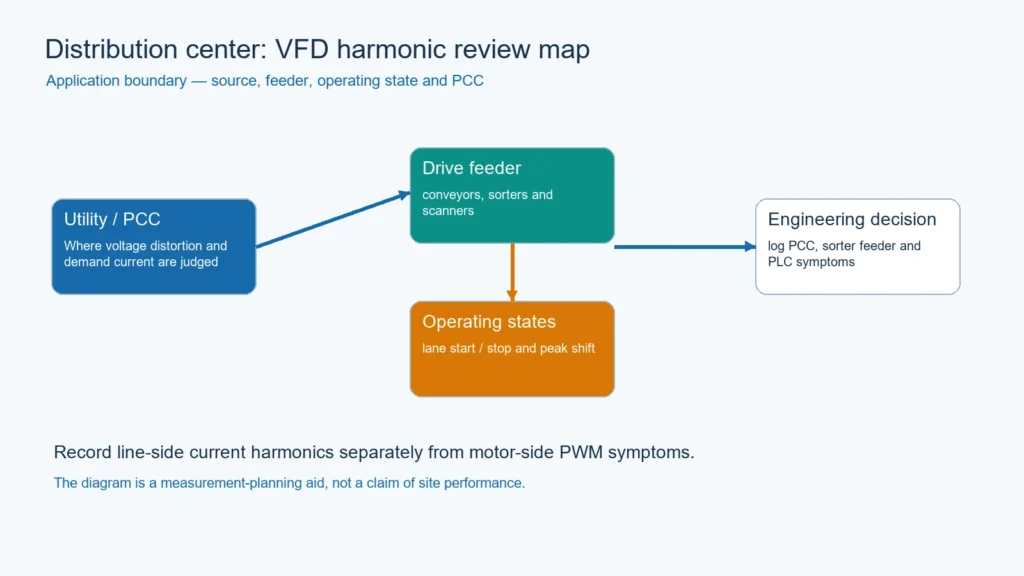
Automated distribution centers combine many small conveyor and sorter drives with scanners, PLCs and switched-mode controls. A lane stop can be a software or mechanical event, while a feeder harmonic issue can be a separate electrical condition. The measurement plan should keep those evidence streams separate, then line them up by timestamp.

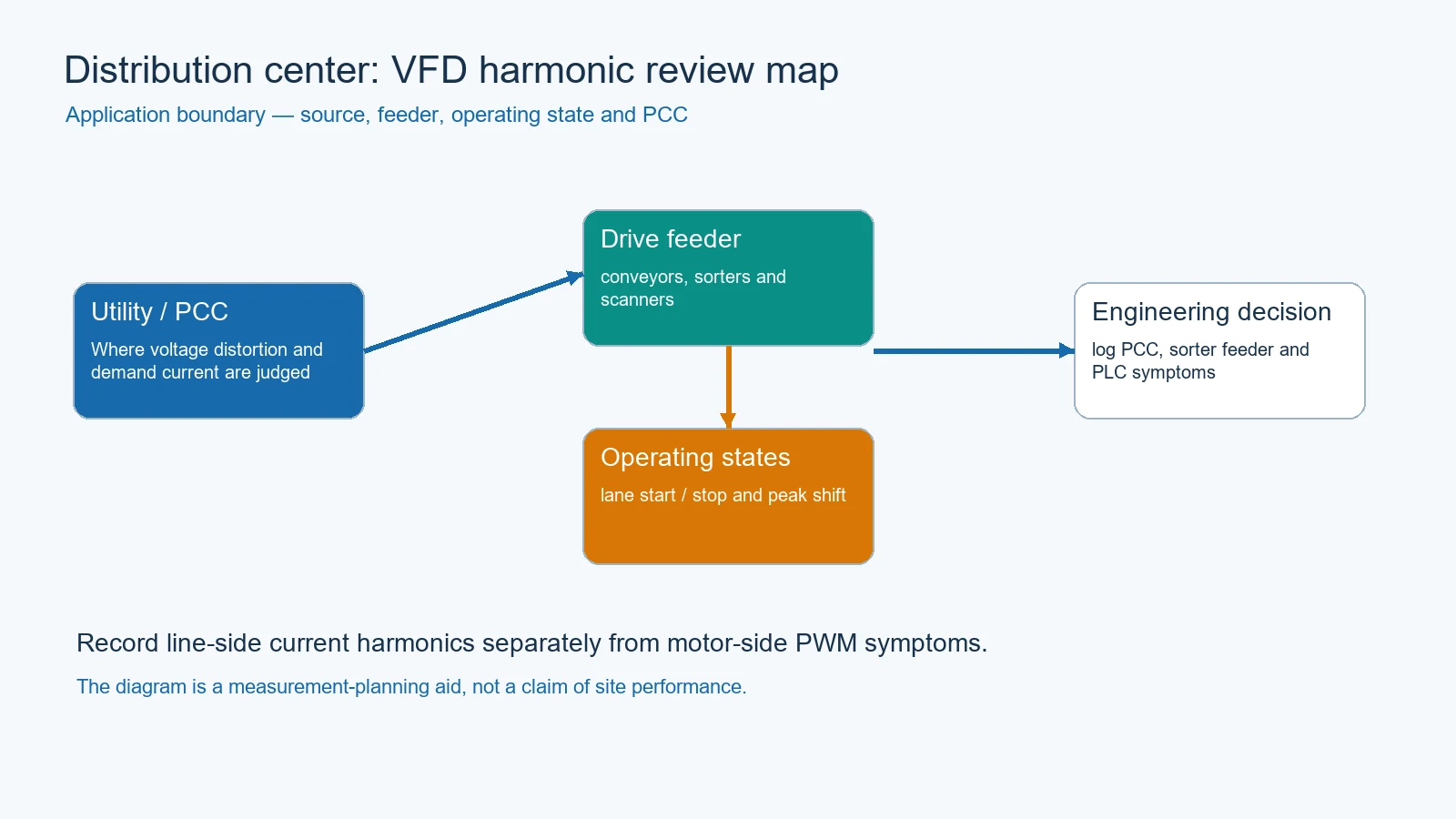
Map the automation electrical boundary
Begin with the sorter or conveyor lanes that share a feeder, transformer or panel. Record the VFDs, scanner power supplies, PLC cabinets and any bypass or maintenance state on the one-line. YTElect’s sorting-system article is useful for discovering the problem language, but its vendor case figures are not a substitute for a CNBYG or site record.
Use lane state and peak-shift timestamps
Log lane start, steady run, accumulation release, stop, jam clear and restart. Add shift, parcel volume or throughput tags that the operation already uses. The aim is not to correlate every operational variable; it is to avoid comparing a quiet lane with a peak-shift feeder and calling the difference a harmonic trend.
| Location | Useful record | Limitation |
|---|---|---|
| Sorter/conveyor feeder | phase current, spectrum, alarms | May miss another feeder |
| Automation panel | PLC, scanner and drive events | A symptom is not a harmonic proof |
| Main bus / PCC | combined upstream distortion | Cannot identify one lane alone |
| Motor terminals | PWM, cable and bearing clues | Not a utility-facing result |
Keep PLC symptoms as clues
Nuisance trips, communication errors or scanner resets deserve a timestamped record. CSE’s facility discussion and Blackhawk’s line-side versus shaft-current distinction support separating symptoms from diagnosis. Verify the electrical hypothesis with feeder and PCC data before changing controls or adding a filter.
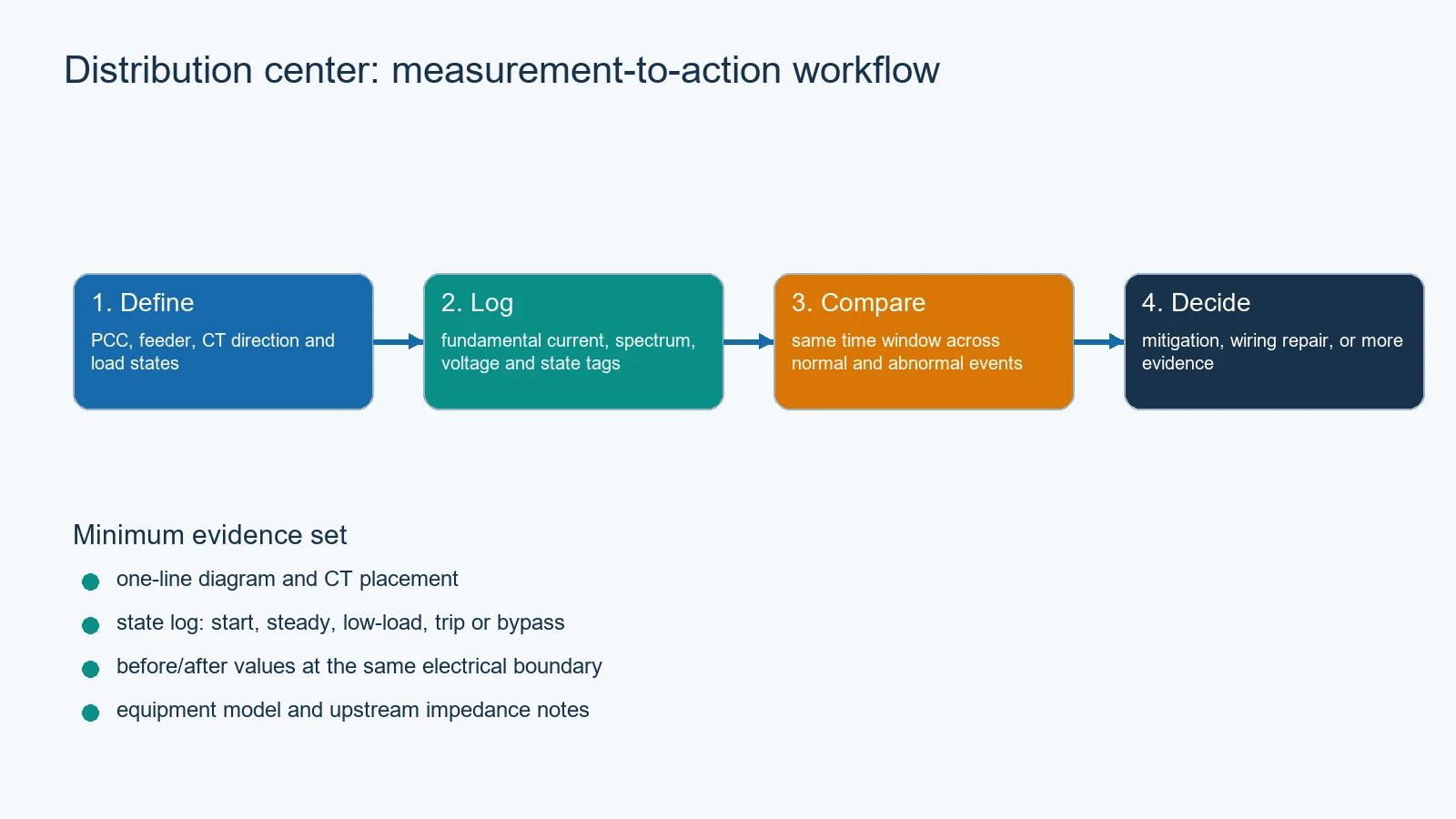
A staged decision for a dense drive population
- Capture a representative peak shift and a low-activity period.
- Compare feeder spectra with PCC data and lane-state tags.
- Check drive topology, source impedance, cable routing and grouped loads.
- Decide whether a local reactor/choke, AFE, passive filter or APF study is appropriate.
- Define the acceptance boundary and readback fields before a trial.

When an AHF path fits a distribution-center feeder
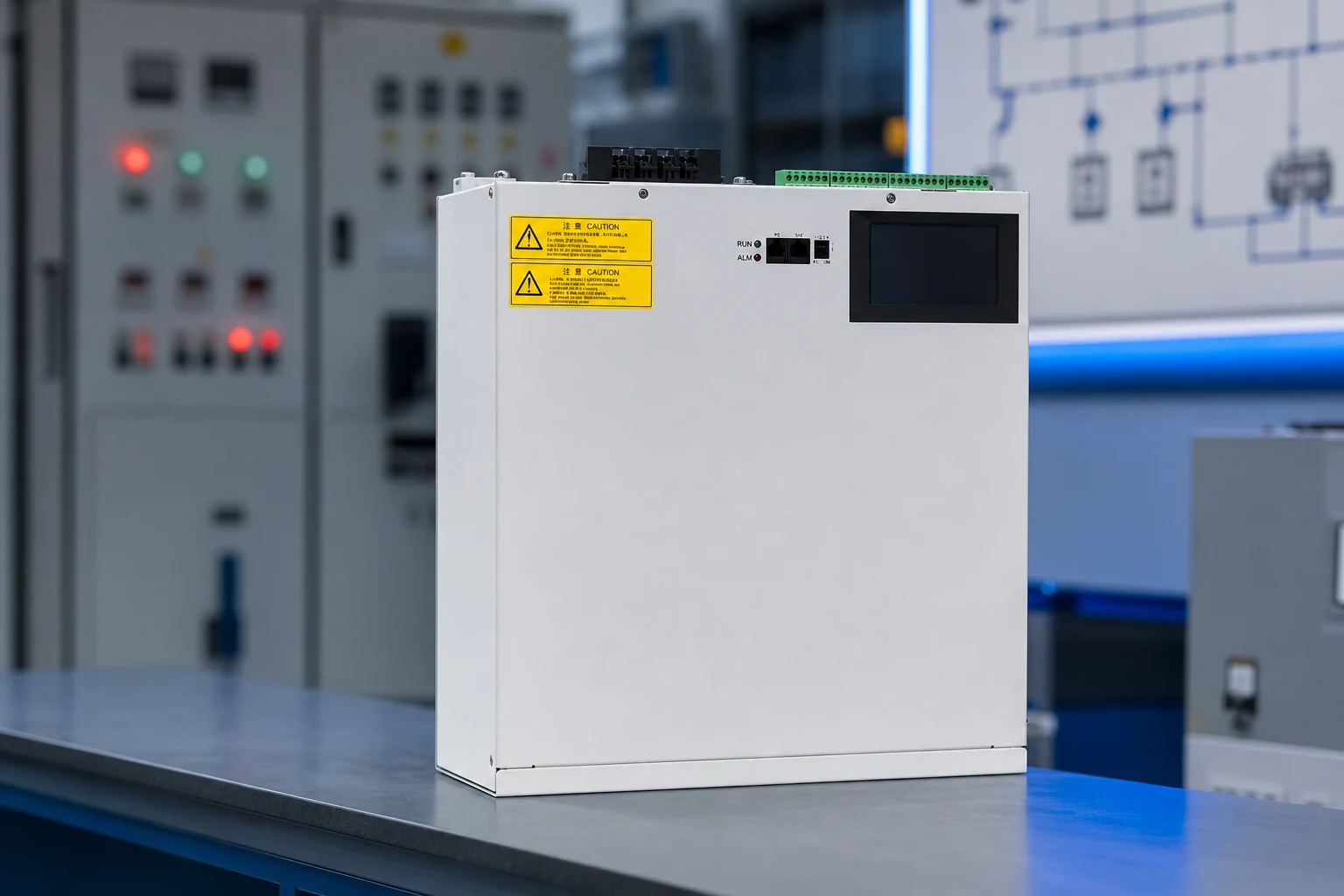
The CNBYG AHF/APF product path can be the next path when a measured sorter or conveyor feeder shows a line-side harmonic problem that matters at the chosen boundary. Request model-level current, CT placement, cooling, bypass and commissioning evidence. The recommendation does not imply a particular warehouse fit, uptime or performance result.
Use the Power Quality System pillar, industrial VFD selection article and power-quality metering guide to keep the investigation in one topic cluster.
References


