Solution for Upgrading the Reactive Power Compensation System in Large Residential Power Distribution Rooms
Subtitle: Old Distribution Room Retrofit with SVG Modules | High-Voltage Sampling & Low-Voltage Compensation | Three-Phase Imbalance
I. Project Background
With the continuous development of modern residential areas, the number of inductive load devices—such as home appliances, elevators, air conditioners, and water pumps—is increasing, making reactive power issues in power distribution systems more prominent.
The original reactive power compensation method in the distribution room of a certain large residential area was a traditional combination cabinet of power capacitors and reactors. This used to be the mainstream choice, providing capacitive reactive power through parallel capacitors and suppressing harmonic amplification through series reactors, which met the compensation needs at the time.
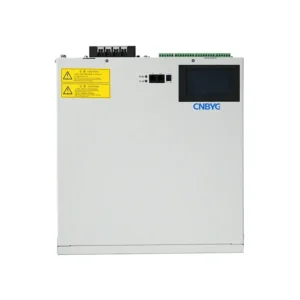
However, with changes in residential power loads and the integration of new energy sources like solar power, the limitations of the traditional capacitor-reactor method have become obvious: poor compensation, substandard power factor, and increased power factor penalties. To solve this, we propose an upgrade solution that introduces SVG (Static Var Generator) modules into the original compensation cabinets to comprehensively improve the power quality of the distribution room.
II. Current Situation and Problem Analysis
2.1 Original Compensation Method
The existing reactive power compensation cabinet uses a “power capacitor + reactor” combination. Capacitors are connected in parallel to the grid to provide capacitive reactive power, while reactors are connected in series to protect the capacitors from harmonics.
2.2 Main Problems
(1) Slow response, unable to track load changes
Residential power usage fluctuates significantly—stable during the day, peaking in the evening and night, and dropping in the early morning. Traditional compensation switches capacitor banks via contactors or thyristors, which usually takes over 200 milliseconds. When the load changes rapidly, the compensation cannot keep up, causing large power factor fluctuations.
(2) Step-like compensation, causing over- or under-compensation
Capacitor banks are switched in stages, meaning the output current is step-like rather than smooth and continuous. In actual operation, this often leads to awkward situations: switching on one more bank causes over-compensation, while switching on one less causes under-compensation.
(3) Capacitor degradation and frequent failures
Power capacitors gradually lose capacity over long-term operation, weakening their compensation effect year by year. Additionally, harmonics generate extra heat, accelerating aging and causing premature damage. Some capacitors in this distribution room have already degraded or failed.
(4) Risk of harmonic amplification
Capacitors can amplify harmonic currents and may trigger system resonance at specific frequencies. This not only ruins the compensation effect but also threatens equipment safety.
(5) Substandard power factor and financial penalties
Due to the combined issues above, the actual power factor of this distribution room often falls below the 0.9 standard required by the power supply utility. This results in power factor penalties (fines), increasing operational costs.
III. Advantages of SVG Technology
SVG (Static Var Generator) is a new type of reactive power compensation device based on modern power electronics. It connects a self-commutated bridge circuit to the grid via a reactor and uses an IGBT power converter to output the required capacitive or inductive fundamental current for dynamic compensation. Compared to traditional methods, SVG has the following significant advantages:
3.1 Extremely Fast Response
The overall dynamic response time of SVG is ≤5ms, and it can complete a compensation cycle within 5-20 milliseconds. Compared to the 200ms+ response of traditional capacitors, SVG can track load changes in real-time, achieving true dynamic compensation.
3.2 High Precision, No Over/Under-Compensation
As an active compensation device, SVG provides continuous and fast compensation for both inductive and capacitive reactive power. It eliminates over- or under-compensation and adjusts smoothly without causing inrush current shocks to the load or grid. The compensated power factor can reach 0.98 or higher.
3.3 Bidirectional Compensation
Traditional capacitors can only provide capacitive reactive power (one-way). SVG, however, can both generate capacitive reactive power and absorb inductive reactive power (two-way), making it adaptable to complex load conditions.
3.4 Built-in Harmonic Filtering
SVG can sample and analyze harmonic currents in real-time, then output a compensation current of equal size but opposite direction to cancel them out, effectively filtering harmonics while compensating for reactive power.
3.5 Compact Size and Space-Saving
SVG uses fewer reactors and capacitors than traditional setups, greatly reducing the size and footprint of the equipment. This is especially beneficial for retrofitting distribution rooms with limited space.
3.6 No Resonance Risk
Using active compensation technology, SVG will not resonate with the system or load devices, fundamentally eliminating the resonance risks associated with traditional capacitor compensation.
IV. Upgrade Solution
4.1 Retrofit Principles
This upgrade follows the principle of “maximizing existing assets while optimizing performance”:
- Reuse Cabinets: Keep the original cabinet frames, remove the old internal components, and install the new equipment.
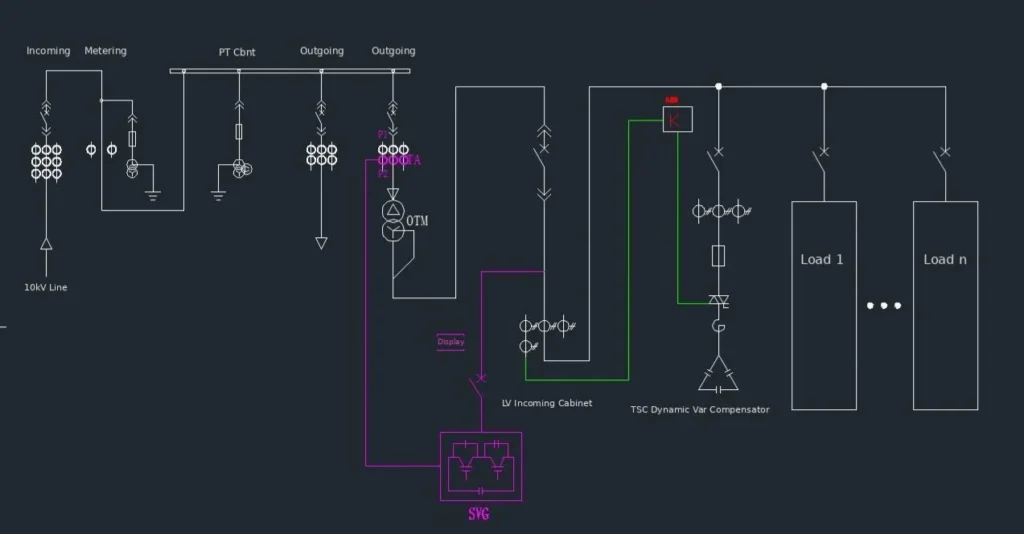
- Hybrid Compensation: Adopt an “SVG + Capacitor/Reactor (LC)” hybrid solution to balance performance and cost.
- Minimal Downtime: Plan the installation carefully to minimize power interruptions for the residential area.
4.2 Technical Plan
(1) Add SVG Modules
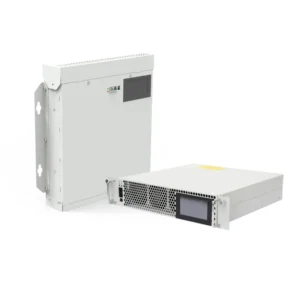
Install SVG power modules inside the original cabinets, sizing the capacity based on on-site measurements. The SVG modules will handle the fast-fluctuating parts of the load with millisecond-level response.
(2) Optimize and Retain LC Components
Keep the capacitors and reactors that are still in good condition to provide base compensation capacity. The LC part will handle steady-state reactive power, complementing the SVG.
(3) Smart Coordinated Control
Use a unified controller to monitor system voltage, current, and power parameters in real-time. It will coordinate the SVG and LC modules: the SVG reacts instantly first, followed by the LC modules, while the SVG fine-tunes its output to meet precise requirements.
(4) Harmonic Mitigation
To address existing harmonics, reactors with appropriate reactance rates (e.g., 7% or 14%) will remain connected in series with the capacitor circuits to suppress harmonic amplification and protect the capacitors.
4.3 Implementation Process
| Stage | Tasks |
|---|---|
| Site Survey | Measure voltage, current, power factor, and harmonics on-site to determine required capacity. |
| Solution Design | Create a detailed SVG + LC hybrid plan based on the collected data. |
| Removal | Remove old capacitors, reactors, and controllers from the existing cabinets. |
| Installation | Install SVG modules, new controllers, transformers, and protection devices. |
| Commissioning | Complete electrical wiring, parameter setup, and joint testing. |
| Handover | Verify all metrics meet design standards and officially put the system into operation. |
V. Before and After Comparison
5.1 Core Metrics Comparison
| Metric | Before (Capacitor + Reactor) | After (SVG + LC Hybrid) |
|---|---|---|
| Response Time | ≥200ms | ≤5ms |
| Adjustment | Step-by-step switching | Continuous, stepless adjustment |
| Power Factor | 0.85 – 0.90 (Fluctuates) | ≥0.98 (Stable) |
| Over/Under-comp | Frequent | Completely eliminated |
| Harmonics | No active filtering; may amplify | Active compensation; suppresses harmonics |
| Resonance Risk | Yes | None |
| Lifespan | Capacitors degrade annually | Electronic modules have a long, stable lifespan |
5.2 Expected Results
- Significantly Improved Power Quality: The power factor will stably increase from 0.85-0.90 to over 0.98, and phase current distortion will drop dramatically.
- Elimination of Penalties: With a compliant power factor, utility fines will be completely eliminated, and in some cases, power bill rewards may be earned.
- Higher Reliability: SVG prevents system resonance. With SVG doing the heavy lifting, the LC components will switch less frequently, running more smoothly and reducing failure rates.
- Better Voltage Stability: SVG quickly suppresses voltage fluctuations and flicker, keeping voltage stable during heavy impacts like elevators starting or AC units turning on.
- Energy Savings: A higher power factor significantly reduces line and transformer losses, achieving real energy savings.
VI. Conclusion
For large residential power distribution rooms, upgrading from the traditional “capacitor + reactor” method to an “SVG + LC” hybrid solution is not just a technical update, but a qualitative leap in power quality management.
With its lightning-fast response, precise compensation, bidirectional adjustment, and harmonic filtering capabilities, SVG completely solves the inherent flaws of traditional methods—such as slow response, step-like switching, over/under-compensation, and resonance risks.
SVG is currently the optimal solution in reactive power control and represents the future of compensation technology. By fully utilizing existing cabinets, this upgrade achieves a comprehensive improvement in power quality with a reasonable investment, making it the ideal path for modernizing residential distribution systems.