Überdrucktrenner für Kondensatoren: Überprüfung der Abstände und Anschlüsse
Capacitor overpressure disconnector clearance is the unobstructed movement space required by the installed capacitor’s pressure-operated safety mechanism. It must come from the exact manufacturer’s installation drawing or written instructions. Ordinary cooling spacing is not automatically the required expansion distance. Before approving a capacitor layout, check the direction of movement, nearby rigid parts, terminal connections, covers, mounting restraints, and the installation’s actual tolerances. Do not use a clearance value from a different capacitor family or assume that a neat, compact arrangement leaves the safety mechanism free to operate.
Why an apparently good installation can obstruct protection
A capacitor may fit into its mounting space and still have an unsuitable connection arrangement. A rigid connection, close-fitting cover, or structural member can interfere with movement that forms part of a safety mechanism. The engineering question is therefore broader than whether the component can be installed without touching another object. It is whether the documented protective movement remains possible after the entire assembly is complete.
This review complements normal mechanical, electrical, and thermal checks. It does not replace fuse selection, overload assessment, discharge provisions, or an investigation of a failed capacitor. Use the separate power capacitor failure guide when there is swelling, leakage, heat damage, or evidence of internal failure. Do not press a deformed can back into shape or attempt to reset a pressure-operated device unless the exact manufacturer explicitly provides such a service procedure.
Establish what the supplied capacitor actually contains
Die BSMJ cylindrical capacitor information describes a safety device that disconnects the capacitor following increased internal pressure or failure. Its installation guidance also calls for flexible copper connections. Confirm the delivered model, phase arrangement, mounting method, and installation instructions before translating these general statements into a panel drawing. Do not infer the mechanism’s dimensions or internal construction from a product photograph.
Ask the supplier for the applicable clearance drawing, the permitted mounting orientation, the movement direction, and any connection restrictions. A document that lists only overall body dimensions may be insufficient. State whether those dimensions describe the normal component envelope or include the protective movement allowance. Keep the supplier’s clarification with the approved layout so that a later replacement does not silently remove the allowance.
Keep four different spaces separate
An electrical clearance concerns insulation between conductive parts. A creepage path follows an insulating surface. A ventilation space supports cooling. A mechanical movement allowance permits a component or mechanism to travel as intended. These requirements can occupy the same physical area, but satisfying one does not prove the others have been satisfied. Treat each as a separate drawing check with its own reference.
The BSMJ product page includes a general installation-spacing instruction, but that statement should not be relabeled as a verified pressure-disconnector travel requirement. If the exact expansion allowance is not supplied, mark that item unresolved and obtain the missing information. It is better to reserve an identifiable space pending confirmation than to approve an invented distance that later becomes difficult to recover inside a finished enclosure.
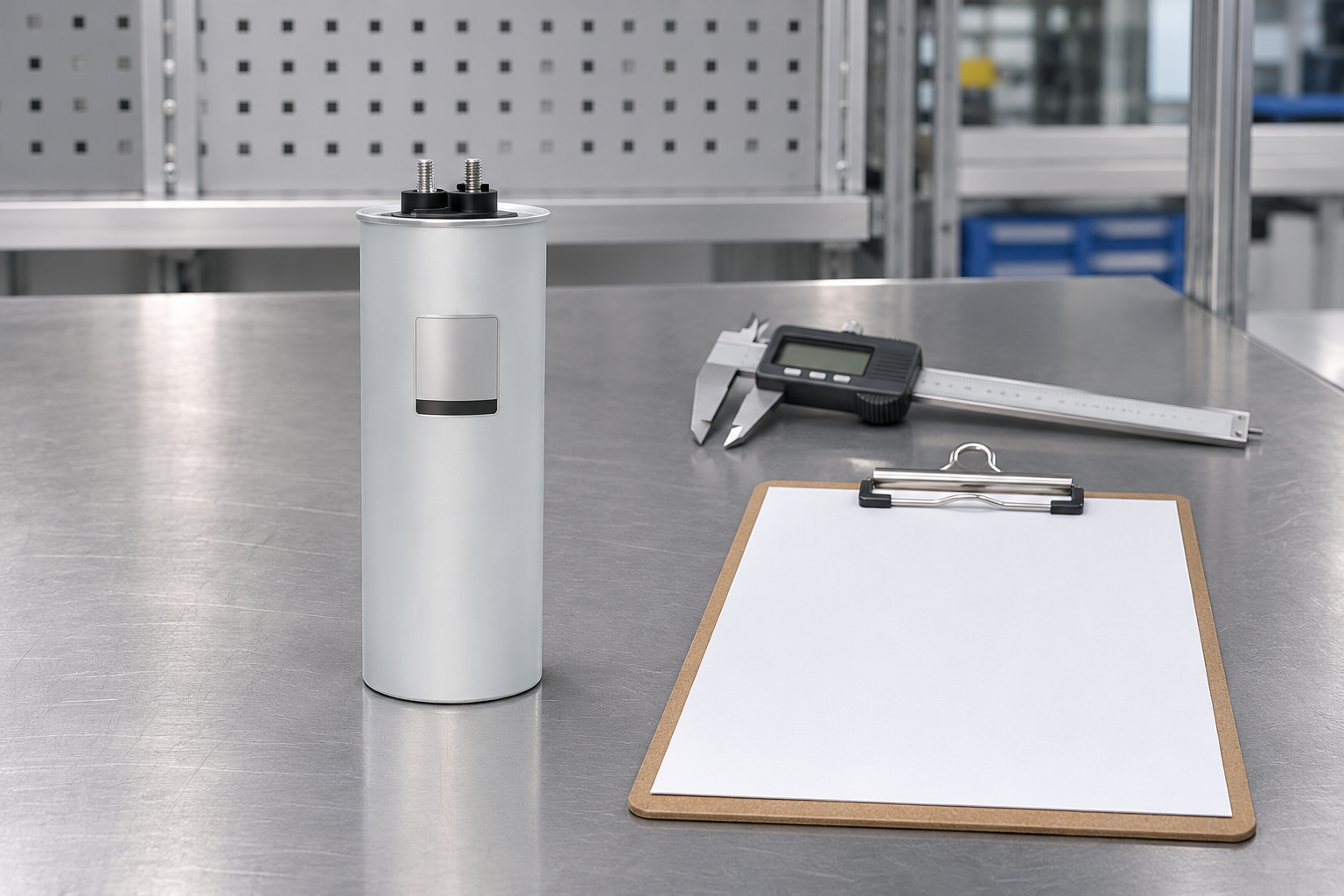
Build the clearance review around the installed assembly
The following checklist is qualitative. It intentionally contains no universal distance or cable bend radius. Use values from the installed capacitor, cable, terminal, and enclosure instructions. The evidence should describe the completed arrangement, including covers and adjacent components, rather than an empty enclosure before wiring.
| Zu prüfender Punkt | Zu beschaffende Beweise | Typical issue to resolve | Release criterion |
|---|---|---|---|
| Protective movement | Model-specific drawing or manufacturer statement | Movement direction or required envelope is unknown | Approved allowance is explicitly shown |
| Terminal connection | Approved cable type, routing and termination detail | A rigid bridge or taut lead restrains movement | Connection complies with the component instructions |
| Top cover or guard | Completed assembly dimensions and fixing details | Cover occupies the required movement space | Guard remains outside the documented envelope |
| Adjacent equipment | Worst-case location and tolerance stack | Nearby busbar, bracket or cable trunk restricts movement | Full assembly retains the required allowance |
| Mounting hardware | Approved clamping and orientation instructions | Additional restraint changes how the can can move | Installed fixing method matches the approved design |
| Kompatibilität als Ersatzgerät | Comparison of original and proposed component | Similar capacitance but a different mechanical safety arrangement | Revised layout and connection review are accepted |
cURL Too many subrequests by single Worker invocation. To configure this limit, refer to https://developers.cloudflare.com/workers/wrangler/configuration/#limits
cURL Too many subrequests by single Worker invocation. To configure this limit, refer to https://developers.cloudflare.com/workers/wrangler/configuration/#limits.
cURL Too many subrequests by single Worker invocation. To configure this limit, refer to https://developers.cloudflare.com/workers/wrangler/configuration/#limits.
cURL Too many subrequests by single Worker invocation. To configure this limit, refer to https://developers.cloudflare.com/workers/wrangler/configuration/#limits
cURL Too many subrequests by single Worker invocation. To configure this limit, refer to https://developers.cloudflare.com/workers/wrangler/configuration/#limits.
OSHA 1910.333 cURL Too many subrequests by single Worker invocation. To configure this limit, refer to https://developers.cloudflare.com/workers/wrangler/configuration/#limits.
What to record when a can is swollen or disconnected
Remove the affected stage from service under the approved procedure and preserve the condition record. Identify the capacitor, its stage, its connected reactor where applicable, protective devices, recent alarms, and the load condition associated with the event. Photographs should show the can, terminals, mounting restraints, cover, and adjacent parts before the assembly is disturbed. Do not use further switching attempts to determine whether the fault is repeatable.
Separate two conclusions in the report: whether the protective movement was unobstructed, and why the capacitor developed the condition that operated the mechanism. An unobstructed installation does not explain an underlying overload or voltage problem. Conversely, a nearby obstruction does not establish the complete initiating cause. Use the capacitor-bank overheating investigation to organize the broader electrical and thermal evidence.
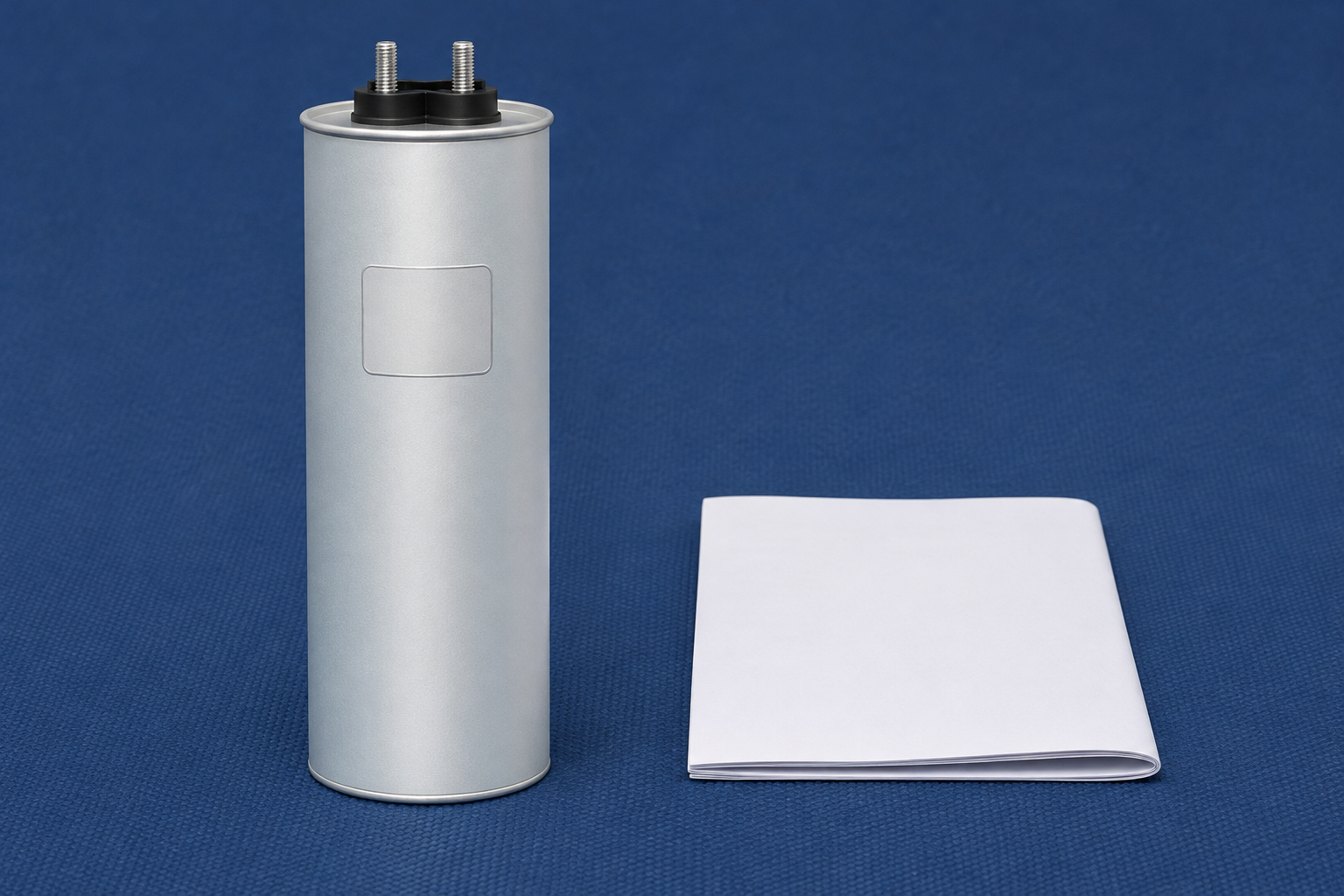
Include the safety arrangement in replacement approval
Replacement selection must cover more than capacitance and rated voltage. Compare phase configuration, frequency, duty, dimensions, terminals, discharge arrangement, mounting, environmental conditions, and the pressure-protection installation requirements. A shorter or wider replacement can require a different connection route even if it physically fits into the old mounting location. Review the complete stage and obtain approval before treating it as an interchangeable spare.
Supply the vendor with the existing layout and photographs, not only a nameplate request. Ask for the normal envelope and the required safety movement envelope to be identified separately. If a proposed replacement requires more room, resolve that requirement before procurement. Do not accept a drawing note that simply says allow sufficient space without an identifiable source and an inspection criterion. The maintenance team needs a requirement it can verify later.
Make the final inspection useful for future maintenance
Create a short record containing the component identification, the approved drawing revision, the source of the movement requirement, the installed connection detail, and the final acceptance decision. Link it to the stage number so that the next capacitor replacement can be checked against the same boundary. Include any restrictions on substituted covers, cable supports, or neighboring equipment that are necessary to preserve the approved allowance.
Add this item to the Wartungs-Checkliste für Kondensatorbanken after alterations or component replacement. Routine inspection should look for newly added restraints, displaced covers, damaged supports, and signs of overheating. Do not treat the initial factory check as permanent proof after the panel has been modified. Record an unresolved mechanical-safety requirement as an open defect rather than marking the bank ready based solely on an electrical reading.
Educational background: what a capacitor stores
Khan Academy’s capacitors and capacitance lesson introduces charge storage and the basic role of the dielectric. It supports understanding why a disconnected capacitor still needs a controlled discharge and verification procedure. The lesson is general physics education; it does not specify pressure-disconnector dimensions, industrial mounting details, or safe handling limits for the installed product.

Häufig gestellte Fragen
Ist der Lüftungsabstand mit dem Freiraum der Trennvorrichtung identisch?
No. Cooling space and mechanical movement allowance serve different purposes. Verify both against the installed product instructions and the completed panel layout. Do not use a general spacing value as an undocumented expansion requirement.
Gewährleistet ein flexibles Kabel eine uneingeschränkte Schutzbewegung?
Nein. Auch ein flexibles Kabel kann Bewegungen einschränken, wenn es zu straff gespannt oder an einer ungeeigneten Stelle befestigt ist. Überprüfen Sie gemeinsam die verlegte Kabelführung, die Befestigungen, die Anschlussdetails und den erforderlichen Bewegungsspielraum gemäß den Herstelleranweisungen.
Can a swollen capacitor be pressed back into shape?
Versuchen Sie nicht, einen defekten Kondensator im Rahmen einer Reparatur vor Ort wieder in Form zu bringen oder zurückzusetzen. Belassen Sie ihn im dafür vorgesehenen sicheren Zustand und befolgen Sie nach der ordnungsgemäßen elektrischen Trennung und Überprüfung die Anweisungen des Herstellers zur Begutachtung, zum Austausch, zur Handhabung und zur Entsorgung.
Can a replacement use the original clearance drawing?
Only after confirming that the drawing applies to the replacement's complete mechanical and safety arrangement. Similar electrical ratings do not establish identical terminals, dimensions, mounting conditions, or pressure-protection movement requirements.