Quel type de contacteur est utilisé avec un banc de condensateurs ?
Pour un banc de condensateurs, le contacteur de puissance vs contacteur de service pour condensateurs choix doit suivre la charge de commutation : utiliser un contacteur de fabricant certifié pour la commutation de condensateurs ou un contacteur AC-6b pour la phase de condensateurs, et sélectionner un contacteur de puissance ordinaire uniquement pour la charge résistive ou la charge moteur indiquée pour cet appareil. Des évaluations de courant en régime stable similaires ne rendent pas les deux catégories interchangeables. La charge de service et l’événement d’énergisation déterminent la catégorie appropriée ; les données de phase et de contrôle affinent ensuite le modèle final.
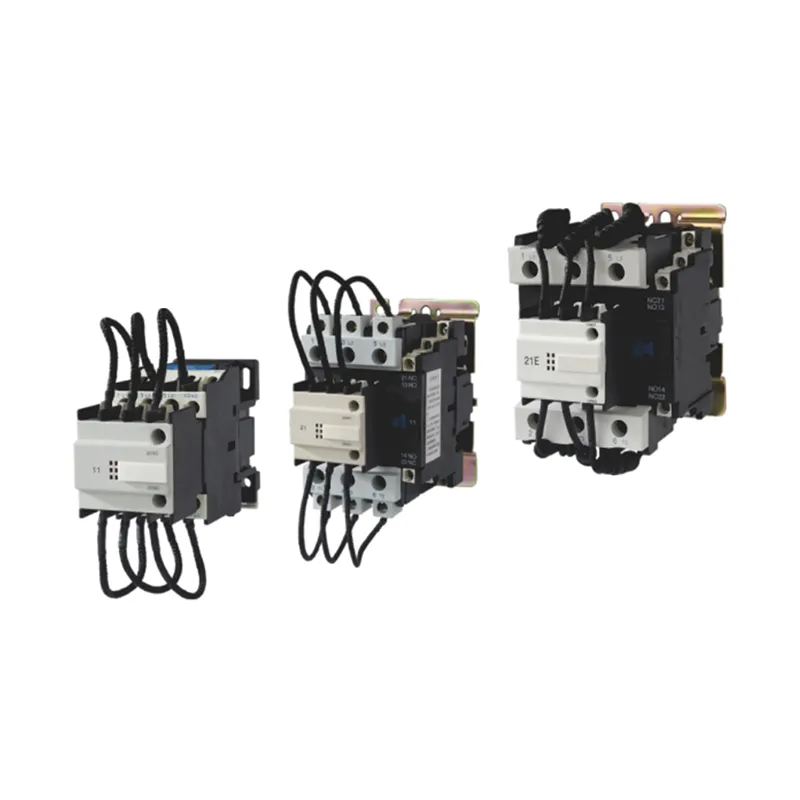
Contacteur de puissance vs contacteur de service pour condensateurs : la décision en un coup d’œil
Choisir selon la charge de service : un contacteur de puissance général sert la catégorie de charge ordinaire indiquée dans sa documentation, tandis qu’un contacteur de service pour condensateurs est conçu et évalué pour la commutation de bancs de condensateurs.
L’adéquation d’un contacteur de puissance est liée à une catégorie d’utilisation, qui décrit le type de charge et l’événement de commutation qu’il est censé gérer. Un contacteur de service pour condensateurs est la branche spécialisée de cette famille d’appareils utilisée pour une étape de condensateur PFC, où l’événement de fermeture est plus exigeant que ce que suggère le courant stable ultérieur.
| Point de décision | Contacteur de puissance ordinaire | Contacteur de service pour condensateurs |
|---|---|---|
| Décision de charge typique | Charge résistive, légèrement inductive ou charge moteur selon la catégorie indiquée | Banc de condensateurs ou étape de condensateur PFC |
| Catégorie à examiner | Souvent AC-1 ou AC-3, selon la charge | AC-6b ou devoir de commutation explicite du condensateur |
| Préoccupation liée à la fonction | Doit correspondre au comportement documenté de la charge ordinaire | Doit prendre en compte le pic de mise sous tension du stade de condensateur |
| Disposition des contacts | Disposition standard des contacts principaux pour la fonction indiquée | Certaines familles ajoutent des contacts de mise en marche anticipée et des résistances limitant le courant |
| Preuve de sélection | Type de charge, courant de fonctionnement, tension, données de la bobine et catégorie | Données du stade, tension, disposition de commutation, données de la bobine, capacité de mise en marche, et tableau précis des produits |
Considérez une liste d'achat contenant deux appareils avec des chiffres d'ampère similaires. Si l'un est catalogué pour la fonction de moteur à cage d'écureuil et l'autre pour la commutation de banc de condensateurs, les étiquettes décrivent des tâches différentes. Le chiffre en ampères reste important, mais il appartient à la décision de catégorie de charge plutôt que de la remplacer.
Pourquoi l’énergisation du banc de condensateurs modifie la charge du contacteur
Le premier instant de mise sous tension du condensateur crée une contrainte de courant de mise en marche qu'une étiquette de courant continu ne décrit pas.
La mise sous tension du condensateur crée un événement de mise en marche de haute intensité sur une courte durée. Ce courant d'appel atteint les contacts lors de la mise en marche, donc une sélection basée uniquement sur le courant après le transitoire manque l'événement qui distingue la fonction de condensateur de la charge ordinaire.
Dans un panneau de correction automatique du facteur de puissance, un contrôleur APFC détermine quand un stade de condensateur est commandé. Le contacteur doit encore effectuer la fonction de commutation du condensateur à chaque fermeture.
Cette distinction est importante lors du remplacement. Un constructeur de panneaux peut avoir un contacteur moteur familier avec une étiquette de courant continu correspondante en stock, mais sa documentation de fonction moteur ne établit pas la capacité de mise en marche du banc de condensateurs. La décision de remplacement doit revenir à la catégorie de charge et aux données de commutation du condensateur du fabricant.
Lire AC-1, AC-3 et AC-6b avant de comparer les évaluations de courant
AC-1, AC-3 et AC-6b identifient différents comportements de charge ; AC-6b est la catégorie d'utilisation pour la commutation de banc de condensateurs.
Une catégorie d'utilisation relie la performance de mise en marche et d'arrêt du contacteur à une application définie. En langage simple, le code AC indique à l'approvisionnement quel type de charge l'appareil est conçu pour commuter, et non simplement combien d'ampères apparaissent à côté du nom du modèle.
| Catégorie d'utilisation | Signification de l'application | Erreur de décision qu'il empêche |
|---|---|---|
| AC-1 | Charges AC non inductives ou légèrement inductives | Traiter une capacité de charge résistive comme une capacité de moteur ou de banque de condensateurs |
| AC-3 | Démarrage d'un moteur à cage d'écureuil et interruption pendant le fonctionnement normal | Traiter un contacteur de service moteur comme un contacteur de banque de condensateurs |
| AC-6b | Commutation de banques de condensateurs | Sélectionner un courant stable sans confirmer le devoir de commutation de condensateurs |
AC-6b identifies switching of capacitor banks in the utilization-categories overview. It gives the buyer the correct category starting point, while the final model still has to match the stage and control data.
If the unanswered question is how a coil, armature, and main contacts produce the switching action, see how the CJ19 contactor works. That operating-principle question is separate from deciding which utilization category belongs on a capacitor stage.
Comment les contacts à ouverture précoce et les résistances d’amortissement protègent le chemin de commutation principal
In documented capacitor-contactor families, an early path and resistor can limit the initial peak before the main contacts close.
An early-make contact closes before the main power contacts. When that path contains damping or current-limiting resistance, the stage first connects through the resistor; the main contacts then close and carry the normal current. In product families built this way, the pre-closing path limits current before the main path closes.
Looped leads and upper assemblies can make a capacitor switching contactor look different from an ordinary contactor. Their electrical role comes from the documented contact sequence rather than appearance alone.
The arrangement is product-family specific. A Schneider TeSys family uses early-make poles with damping resistors, while CNBYG documents a pre-closing current-limiting circuit for its GJ19/CJ19 family. Other capacitor-contactors may use a different documented arrangement, so construction should be read from the product data rather than inferred from the category name alone.
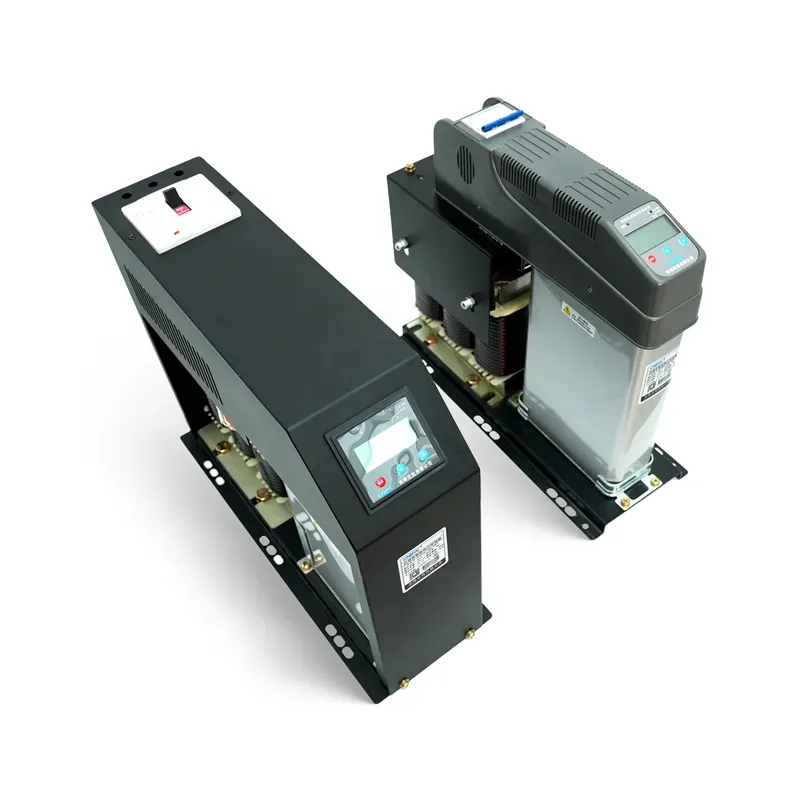
Sélectionner un contacteur de condensateurs en fonction de la charge, de la phase, de la tension et des données de contrôle
Start with capacitor-duty or AC-6b documentation, then match the stage voltage, kVAR or current, switching arrangement, coil supply, mounting, and the model-specific making data.
The duty category answers “which kind of contactor?” The project inputs answer “which model?” A buyer who has only a capacitor-stage kVAR value is missing the voltage and control information needed to connect those two decisions.
| Input to collect | Why it changes the choice | Where to compare it |
|---|---|---|
| Tension et fréquence du système | Establishes whether the product family and rating table apply | Product electrical data |
| Capacitor-stage kVAR or operating current | Identifies the stage duty at the stated voltage | Model table for that voltage |
| Stage arrangement and switching sequence | Describes what the contactor connects and how the bank is stepped | Panel design and capacitor-switching documentation |
| Catégorie d'utilisation | Confirms that the stated rating belongs to capacitor-bank duty | Category or application-rating line |
| Published making or inrush capability | Addresses the closing event that steady current omits | Manufacturer’s exact family data |
| Coil voltage and frequency | Matches the controller or control-power supply | Coil and ordering table |
| Mounting and terminal arrangement | Confirms mechanical and wiring compatibility | Dimension and installation document |
| Exact model revision | Keeps all ratings tied to the item being ordered | Current datasheet and product table |
The connection schematic below is a document-reading aid for CJ19-63/21 and CJ19-95/21 arrangements. It is not a substitute for the project’s wiring drawing or the electrical data for the selected model.
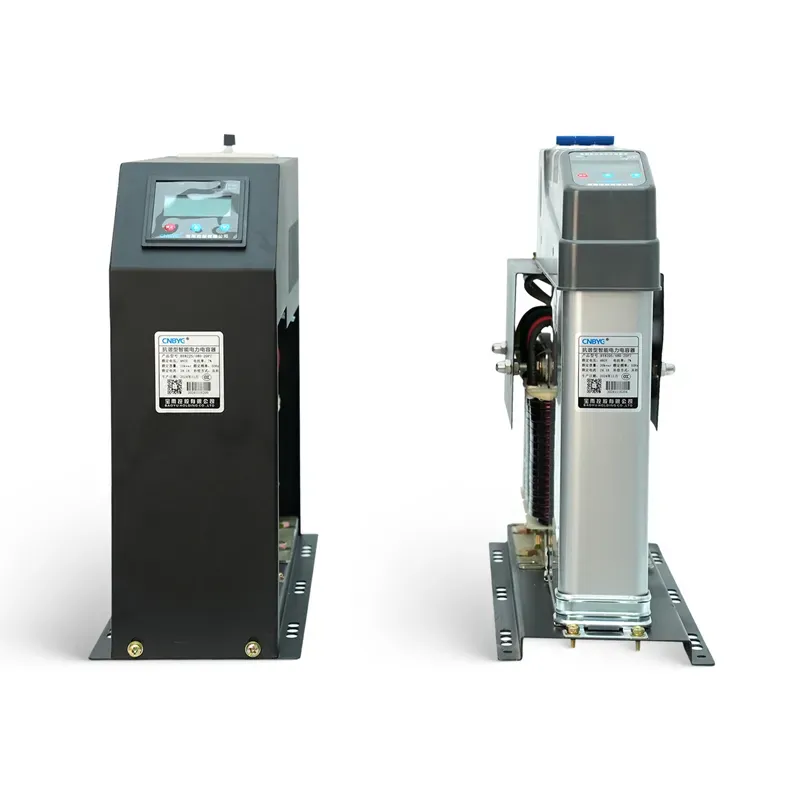
One universal multiplier cannot replace these inputs. Published making capabilities and capacitor ratings stay with the named product family and stated conditions. Compare the actual stage record with the applicable model table rather than transferring one family’s value to another.
Calculating the compensation value still leaves a practical specification gap. In this capacitor-bank practitioner discussion, cURL Too many subrequests by single Worker invocation. To configure this limit, refer to https://developers.cloudflare.com/workers/wrangler/configuration/#limits.
Éviter la sélection basée uniquement sur les ampères, les kVAR ou la photo
cURL Too many subrequests by single Worker invocation. To configure this limit, refer to https://developers.cloudflare.com/workers/wrangler/configuration/#limits.
cURL Too many subrequests by single Worker invocation. To configure this limit, refer to https://developers.cloudflare.com/workers/wrangler/configuration/#limits.
cURL Too many subrequests by single Worker invocation. To configure this limit, refer to https://developers.cloudflare.com/workers/wrangler/configuration/#limits.
Important : cURL Too many subrequests by single Worker invocation. To configure this limit, refer to https://developers.cloudflare.com/workers/wrangler/configuration/#limits cURL Too many subrequests by single Worker invocation. To configure this limit, refer to https://developers.cloudflare.com/workers/wrangler/configuration/#limits cURL Too many subrequests by single Worker invocation. To configure this limit, refer to https://developers.cloudflare.com/workers/wrangler/configuration/#limits.
cURL Too many subrequests by single Worker invocation. To configure this limit, refer to https://developers.cloudflare.com/workers/wrangler/configuration/#limits.
Où le CNBYG GJ19 s’intègre — et quand escalader la revue de la charge
cURL Too many subrequests by single Worker invocation. To configure this limit, refer to https://developers.cloudflare.com/workers/wrangler/configuration/#limits.
La GJ19 Series switching capacitor contactor is presented for switching low-voltage parallel capacitors. Its product information describes an upper current-limiting contact and resistor circuit that connects before the working contacts, and it supplies model and coil-ordering data for the next selection step.

Review that family when the load is a capacitor stage and the project inputs can be compared with its product table. Do not select it merely because its current resembles an ordinary power contactor, and do not treat it as the answer to a motor-load or general resistive-load requirement. The broader compensateur de puissance réactive page places the contactor beside the other components used in compensation systems.
The decision becomes a system-duty question when a detuned bank, reactors, harmonic-producing loads, controller sequence, or measured switching records shape the stress. When harmonic conditions or reactor topology determine contactor stress, continue with the capacitor switching contactor duty review for harmonic networks before fixing the contactor model.
FAQ
Why use a capacitor-duty contactor?
Use it because capacitor-bank energization creates a distinct making-current peak. A capacitor-duty contactor is rated for that switching job, and some documented families add a pre-closing resistor path to limit the initial peak.
What is a capacitor-duty contactor?
It is a contactor intended for switching capacitor banks or PFC stages. Its application category, making capability, and product construction are documented for capacitor duty rather than inferred from an ordinary-load ampere rating.
Can a normal power contactor switch a capacitor bank?
Only when the exact manufacturer documentation approves that device for the capacitor-switching duty and the stage conditions. A motor-duty or resistive-load rating with a similar current value is not enough to establish that fit.
What does AC-6b mean on a contactor?
AC-6b is the utilization category for switching capacitor banks. It separates capacitor-bank duty from AC-1 resistive or slightly inductive duty and AC-3 motor duty.
Is AC-3 the same as capacitor duty?
No. AC-3 applies to squirrel-cage motor duty, while AC-6b applies to capacitor-bank switching. The two codes describe different load behavior and should not be substituted on current rating alone.
Does a contactor supply reactive power to the capacitor?
No. The contactor connects or disconnects the capacitor stage from the power circuit. The energized capacitor supplies reactive power; the contactor performs the switching action.
How should I choose the contactor size for a capacitor bank?
Confirm capacitor-duty or AC-6b suitability, then match system voltage, stage kVAR or current, switching arrangement, making capability, coil supply, mounting, and the exact manufacturer’s model table. Avoid a cross-manufacturer sizing multiplier.
Are early-make contacts and resistors used in every capacitor contactor?
Not necessarily. They are documented in specific capacitor-contactor families, including the GJ19/CJ19 arrangement discussed here. Read the construction and sequence for the exact family being considered.
When does a comparison become a harmonic-network duty review?
Escalate when harmonics, reactors, detuning, switching records, or bank topology influence the contactor stress. Those conditions require a system-level duty assessment rather than a category comparison alone.
Références
FAQ pratique
What type of contactor is used with a capacitor bank?
Utilisez un contacteur spécialement conçu pour les batteries de condensateurs, dimensionné en fonction de la puissance réactive de la batterie (kvar), de la tension du réseau, du courant d'appel, de la fréquence de commutation, des conditions ambiantes et du dispositif de protection.
Un contacteur moteur ordinaire peut-il commuter des gradins de condensateurs ?
Ne supposez pas cela à partir des ampères continus. L'activation du condensateur a une forte montée en courant et nécessite une cote de service de condensateur publiée.
Pourquoi les contacteurs pour condensateurs utilisent-ils des contacts à fermeture anticipée ?
They insert an impedance briefly to limit inrush before the main contacts carry steady capacitor current.
Que signifie AC-6b ?
AC-6b is the utilization category associated with switching capacitor banks under the applicable low-voltage contactor standard.
Quand doit-on envisager la commutation par thyristor?
Consider it for fast-changing loads or high switching frequency after checking losses, cooling, harmonics, and protection.