Capacitor Bank FAT Punch List: Evidence Before Shipment
Capacitor bank FAT punch list closure means proving that every recorded factory acceptance finding has an agreed disposition, supporting evidence and an authorized decision before shipment. A supplier saying “rectified” is only the start: the buyer needs to know which assembly was changed, whether affected checks were repeated and whether the delivered drawings now describe the equipment. This guide provides a practical closeout method for low-voltage compensation projects. It does not prescribe test voltages, discharge times or universal acceptance limits. Those belong in the approved inspection plan, applicable requirements and manufacturer documentation for the actual bank.
Separate the FAT result from permission to ship
A factory acceptance test checks the supplied assembly against an agreed scope. A punch list records incomplete work, deviations and questions identified during that process. Shipment release is a separate decision about whether the present condition satisfies the contract and any approved conditions. Keep all three records linked, but do not treat them as interchangeable signatures.
For example, a successful functional demonstration does not resolve a missing component certificate. Equally, a corrected drawing does not prove that the assembled wiring matches it. The practical question is which requirement each item addresses and what evidence would allow an independent reviewer to close it. Define that answer while the equipment, test team and witnesses are still available.
The NASA building and equipment acceptance guide lists capacitor bank acceptance documentation including manufacturer information, drawings, test reports and signed acceptance records. It is a historical facilities guide, not a current CNBYG test specification. Its useful contribution here is the connection between the physical asset and the supporting document package.
Start with a frozen acceptance baseline
Record the purchase order, assembly identifier, drawing revisions, bill of materials revision and approved FAT procedure. Include the capacitor unit identities where traceability is required by the contract. This prevents a finding raised against one arrangement from being closed with evidence taken from another. If the baseline changes during FAT, record the change rather than silently replacing the original attachment.
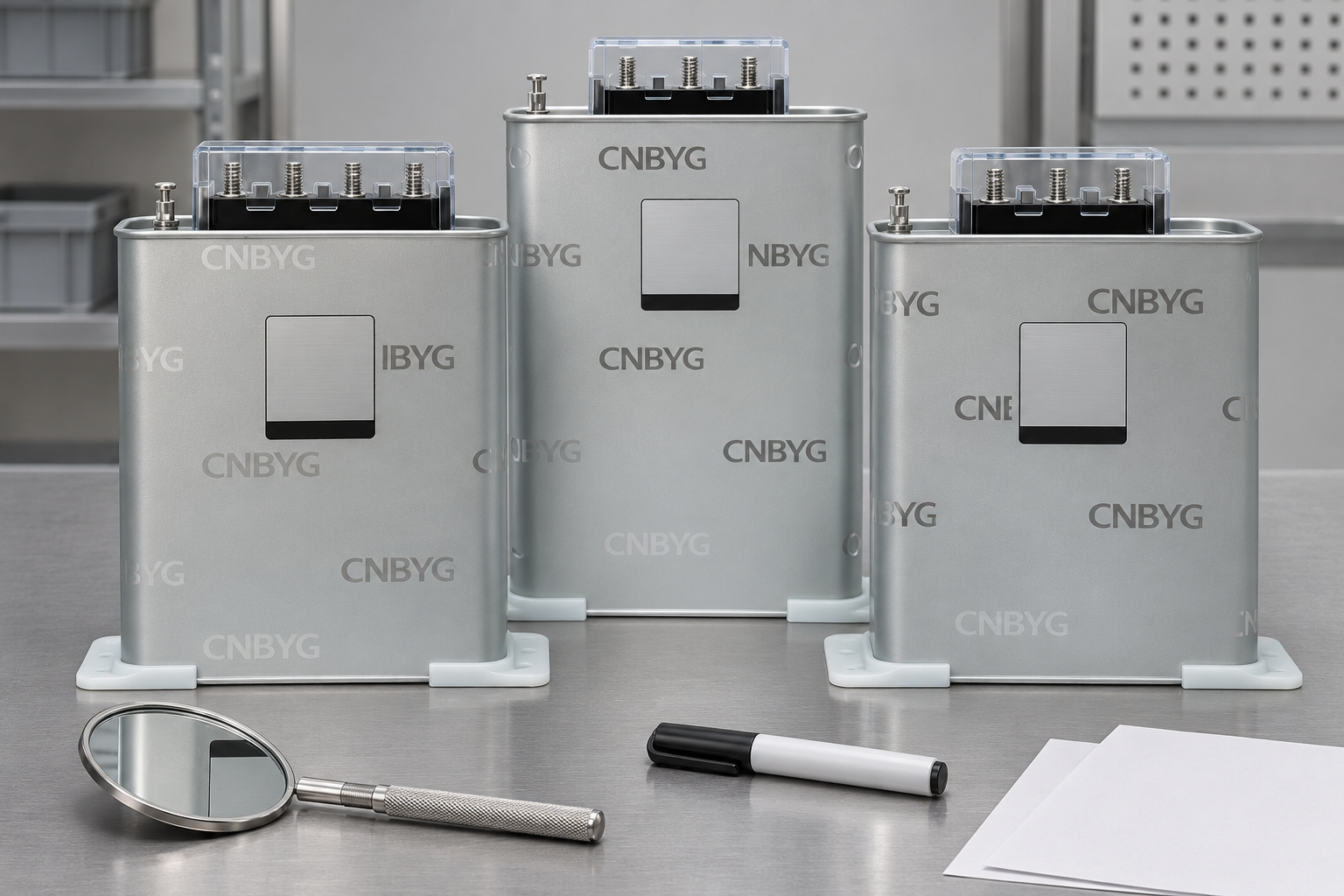
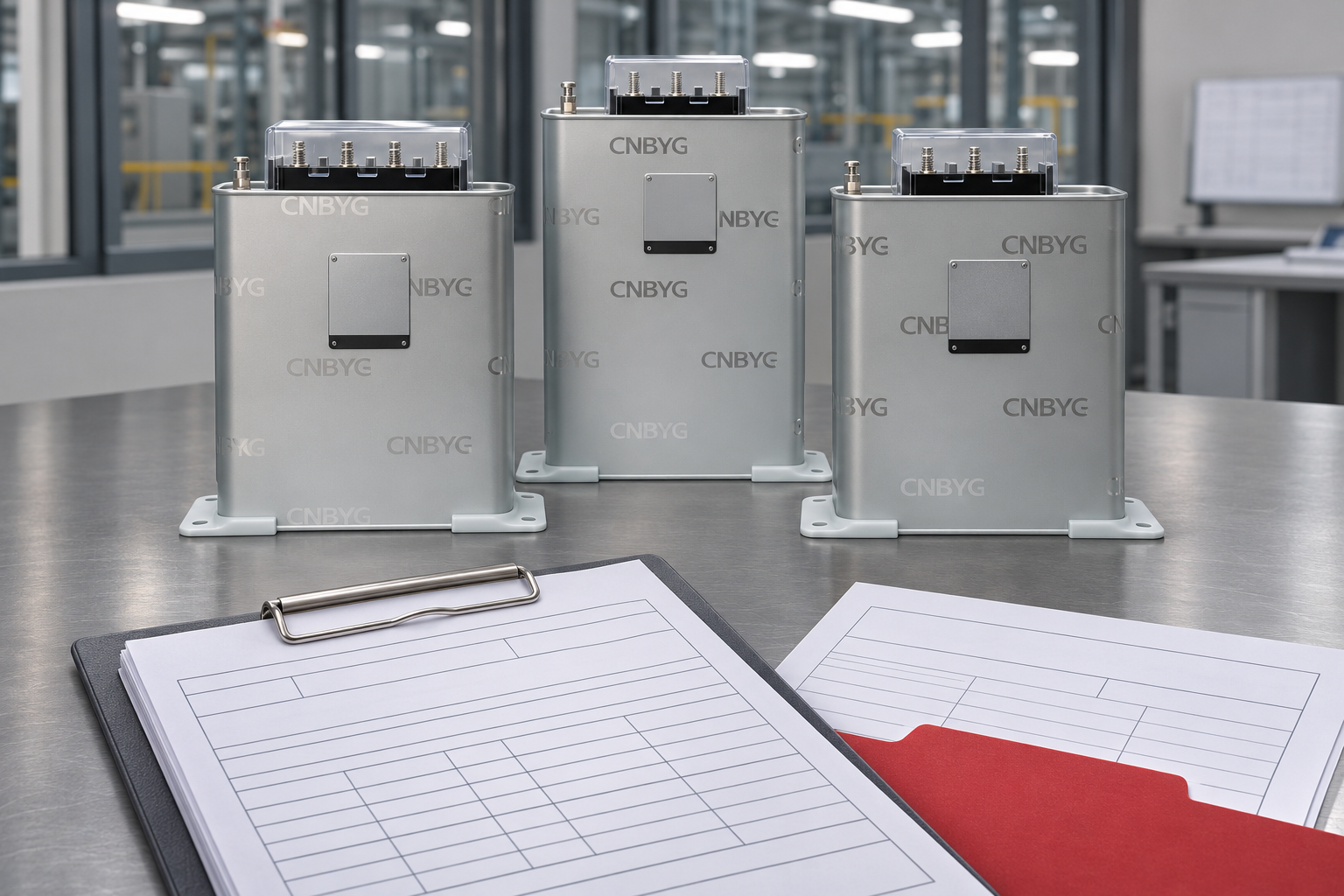
A component and a complete bank have different acceptance scopes. The CNBYG BSMJ low-voltage parallel capacitor range is a component reference for compensation projects; its presence does not establish that a complete panel passed assembly verification. Likewise, a panel photograph cannot confirm the internal component rating. Check the delivered configuration against its approved documentation.
Identify which checks occur at the factory and which remain site responsibilities. Supply conditions, final cable interfaces and site protection coordination may need later verification. The official IEC 61921 publication summary identifies low-voltage AC power factor correction banks as its scope. That summary helps distinguish a bank from an individual capacitor, but does not provide a complete test procedure. Obtain the applicable full requirements and agree the project inspection plan rather than copying a test list from a different voltage class.
Build a punch list that can actually be closed
Each entry should describe an observed condition rather than a proposed solution alone. “Replace label” does not explain the issue. “Assembly identifier differs between the rating plate and approved drawing” establishes a verifiable discrepancy. Attach the relevant photograph or marked drawing, identify the requirement and assign a responsible owner.
Use the following qualitative matrix as a working example. Its release decisions are recommendations for organizing review, not standardized severity classes. Agree the actual classification and approval authority before using it.
| Finding | Evidence to request | Review question | Typical next decision |
|---|---|---|---|
| Component differs from approved material list | Actual identity, proposed substitution and revised list | Has the responsible engineer accepted equivalence and affected design checks? | Hold until the substitution decision is documented |
| Drawing and assembled wiring disagree | Marked correction, as-built revision and affected verification record | Does the drawing now match the tested assembly? | Review and repeat affected checks as required |
| Required report is missing | Identified report linked to the tested item | Is it the correct asset, procedure and revision? | Keep documentation item open until accepted |
| Functional sequence produces an unexpected response | Defect description, correction and witnessed retest record | Did the intended sequence pass after the change? | Close only after accepted verification |
| Cosmetic damage is reported | Clear location photographs and agreed repair evidence | Could protection, durability or safe handling be affected? | Obtain an engineering disposition if consequences are uncertain |
| Site work remains incomplete | Scope, owner, due point and explicit purchaser acceptance | Can it safely remain outstanding during shipment? | Conditional release only by authorized agreement |
Avoid a single “done” column that hides how completion was verified. Keep the observed defect, corrective action, verification result and acceptance decision distinct. If a finding splits into several actions, retain its original number and create linked subactions so that none disappear during spreadsheet sorting.
Decide whether the correction invalidates earlier evidence
Not every correction requires repeating the full FAT. However, the supplier should explain the impact of each change. A component substitution may affect a circuit, thermal arrangement, protection setting or documentation. A wiring correction can affect several operating sequences. The responsible engineer decides the verification scope using the actual design and approved procedure.
Record the reasoning even when no retest is required. An annotation correction may need a controlled drawing update and a check that the actual assembly was already correct. A physical modification needs a different evidence trail. Without this distinction, a reviewer may accept an old report that describes the assembly before the final modification.
Where retesting is required, identify the test record, date, personnel, instrument references where relevant and acceptance criterion. Preserve the original failed result rather than overwriting it with a pass. The history should show what failed, what changed and what evidence supports the final conclusion. Test execution remains work for competent personnel under an approved safe system.
Define closure evidence before the supplier leaves the bench
Agree acceptable evidence for each item. Photographs can demonstrate that a guard or label is present, but may not establish continuity, operation or performance. A test sheet can record a result, but may be unusable if it lacks the equipment identity or references an obsolete procedure. Ask for evidence appropriate to the requirement instead of accepting whichever attachment arrives first.
For a repeat functional check, specify the affected sequence and required witness arrangement. For a document correction, request the controlled replacement revision and identify withdrawn copies. For a material deviation, obtain approval from the role entitled to accept that deviation. A commercial coordinator can collect files without necessarily having authority to approve an engineering change.
Maintain one closure index containing the finding number and evidence location. Keep filenames descriptive and stable. If files are exchanged by email, save the final approved package in the project record rather than relying on an inbox thread that another reviewer cannot access. The index should work after the original project team has moved on.
Use conditional release carefully
A conditionally accepted item remains an obligation. Record the remaining action, responsible organization, completion deadline or hold point, verification method and consequence if it is missed. The buyer should explicitly accept the condition through the agreed authority. A supplier note saying “to be done at site” does not by itself transfer responsibility.
Do not use conditional release to bypass unresolved safety or essential design questions. If the effect of a discrepancy is unknown, obtain the appropriate assessment before deciding that shipment is acceptable. Delivery pressure is not technical evidence. Record any storage or transport constraints that result from the accepted condition so that the logistics team receives the same instruction.
Keep FAT closeout separate from capacitor bank commissioning tests. Factory evidence supports acceptance of the supplied condition; site checks address the installed arrangement. One cannot automatically replace the other. The handover package should tell the commissioning team which factory findings remain relevant.
Walk through an example without inventing test limits
Consider a hypothetical bank with a drawing mismatch and a missing capacitor report. Create two findings. For the mismatch, the supplier identifies whether the drawing or assembly is wrong, proposes a correction and assesses affected verification. For the missing report, the supplier supplies the correct document linked to the actual capacitor identity.
If the mismatch required physical changes, attach the resulting checks and final drawing revision before closure. If the report belongs to a different shipment, reject it as evidence even when the model name looks similar. The reviewer records acceptance separately for each finding. Only then does the authorized release decision consider the complete package.
This example does not establish any specific CNBYG defect, test outcome or production practice. It demonstrates how evidence supports a decision. The same method works when there are no physical defects but several missing records: the absence of a visible fault does not make an incomplete contractual package complete.
Pass the accepted condition to the receiving team
Before dispatch, save the final list, closure evidence, approved drawings, release authorization and any accepted site actions together. Note the packing list and equipment identities. The receiving team should compare the delivered condition with that release baseline rather than with an early quotation photograph.
Use the separate transport damage receiving checklist after arrival. A bank can leave the factory in an accepted condition and still suffer transit damage. Receiving photographs and discrepancy records protect that distinction. They also help avoid reopening a factory item when the new damage occurred later.
Plan access and safe handling using the capacitor bank safety requirements and actual equipment instructions. No amount of paperwork makes an unassessed bank safe to touch. Confirm electrical state, residual-energy controls and the permitted inspection scope through the responsible site personnel.
Electrical safety lesson for the acceptance team
The following US Department of Labor electrical panel accident lesson supports awareness of hazardous energy controls. It is background education for planning competent work, not a capacitor bank FAT procedure, model-specific discharge instruction or authorization to test.

Frequently asked questions
Does a signed FAT report automatically release the bank for shipment?
Only if the agreed contract and release process make that signature sufficient and all applicable conditions are satisfied. Otherwise retain a separate shipment release decision linked to the FAT result and punch list status.
Can a photograph close an electrical test finding?
A photograph normally cannot establish an electrical measurement or functional result. Use evidence suited to the original requirement, such as an identified test record and any agreed witness confirmation.
Must every correction trigger a complete FAT repeat?
The responsible engineer should assess the affected scope. Record the decision and repeat the required checks; do not assume either that every correction needs a full repeat or that earlier results remain valid after a physical change.
Can an open item be transferred to site work?
Only through an explicit authorized agreement defining the remaining task, owner, completion point and verification. An unresolved safety or essential design question needs an appropriate disposition before release.