Main Meter vs Submeter Totals: Reconcile Energy Differences
A main meter and its submeters will not necessarily show identical totals. To investigate a main meter versus submeter energy difference, compare the same electrical boundary, energy direction, unit and start-to-end period before questioning meter accuracy. Then account for unmetered branches, equipment between measurement points, missing records and configuration errors. A residual is an investigation result; it does not prove that all of the difference is electrical loss.
This guide gives facility teams a repeatable reconciliation worksheet. It applies to operational energy monitoring. Tenant billing, utility disputes and contractual acceptance also require the applicable metrology rules, approved equipment and agreed verification procedure.
Define what the main meter actually includes
Start with an approved single-line diagram and the installed meter schedule. Mark the main measurement point, every included feeder, generation connection, transformer and storage connection. A submeter is meaningful only in relation to that boundary. The DOE Federal Metering Guidance describes submeters as measuring portions of a building’s consumption and supports defining a purposeful metering plan.
For example, a main meter upstream of a transformer includes energy supplied to the transformer and downstream network. Submeters installed at outgoing low-voltage feeders may omit transformer losses, switchboard auxiliaries and any branch taken before those feeders. Conversely, a submeter on a generator feeder may record generation rather than an additional consumption branch. Adding every available energy channel without checking direction can count the same flow twice.
Use the three-phase electric power meter guide to establish the overall measurement context. Keep physical boundary review separate from software naming: a point called “Building A Main” is not evidence that it measures the complete building.

Select matching quantities before doing arithmetic
Use active energy on both sides when reconciling kWh. Do not substitute apparent energy, reactive energy, maximum demand or a momentary power reading. Similar labels can conceal different definitions. Confirm whether each record means import, export, net flow, a tariff register or a lifetime cumulative total.
Document the sign convention. Some systems keep separate positive import and export counters; others expose a signed net value. A difference between net main energy and gross branch consumption may be expected where generation is inside the boundary. The import and export energy guide explains why direction belongs in the point definition.
Convert compatible prefixes consistently: MWh and kWh can be normalized, while kW and kWh cannot be made equivalent by changing a label. Check whether CT and voltage ratios have already been applied by the instrument or gateway. Apply a factor only at its documented location. An unexplained multiplier can make a plausible dashboard systematically wrong.
Match the comparison period and data coverage
Choose explicit start and end instants, including the time zone. For cumulative counters, calculate each meter’s increment from comparable endpoints. For interval records, include intervals within the same defined window and verify whether timestamps represent interval start or end. A midnight label alone does not resolve that distinction.
A utility billing period and a calendar month may have different endpoints. Likewise, a report generated in local time can differ from a gateway export in UTC. Daylight-saving changes, where applicable, require explicit handling rather than assuming every local day has the same duration. Review power meter time synchronization when the discrepancy is concentrated near boundaries or load changes.
Do not turn communication outages into zero consumption. Mark missing intervals and decide whether the comparison is complete, partially observed or estimated. Preserve actual observations separately from substituted values. A later cumulative reading may recover total energy across an outage, but it does not reconstruct the exact load profile within it.
Build a reconciliation worksheet
Use one row for each independent branch and one clearly identified main total. Keep meter identifiers, endpoint readings, units, direction and coverage flags with the arithmetic. The following entries are illustrative checks, not universal acceptance limits or manufacturer specifications.
| Check | Evidence to retain | What a mismatch suggests | Next action |
|---|---|---|---|
| Boundary completeness | Approved diagram and feeder list | Common service or branch omitted | Trace that branch and quantify separately |
| Measurement period | Start/end timestamps and time zone | Different reporting windows | Recalculate on aligned endpoints |
| Energy direction | Import/export register definitions | Gross and net energy mixed | Rebuild a consistent balance |
| Units and ratios | Raw units, scaling map and applied factors | Prefix or CT/VT factor duplicated | Correct the documented mapping |
| Coverage | Expected versus observed records | Missing intervals treated as zero | Recover totals or mark incomplete |
| Counter continuity | Reset, rollover and replacement log | Discontinuity mistaken for usage | Split the period into valid segments |
| Measurement uncertainty | Exact specifications and verification records | Residual comparable to uncertainty | Assess the combined measurement chain |
The DOE guidance supports metering scope and planning; this worksheet is an operational investigation method. Its categories do not establish a legally permissible billing error or a guaranteed device performance level.
Calculate the residual without naming it prematurely
For a simple consumption-only boundary with no generation or storage, define:
Residual energy = main active energy increment − sum of included branch active energy increments.
If the main increment is 12,000 kWh and three independent branches total 10,900 kWh over the same period, the residual is 1,100 kWh. Relative to the main increment, the illustrative residual is 1,100 ÷ 12,000 × 100 = approximately 9.17%. These invented worksheet values demonstrate arithmetic only. They are not a typical loss rate, equipment claim or acceptance threshold.
Suppose a separately verified common-services branch contributes another 800 kWh within that boundary. Including it reduces the unexplained portion to 300 kWh. That remaining amount still combines possible physical losses, measurement uncertainty and unresolved data issues. Do not adjust a meter factor until the evidence identifies the cause.
Where generation or storage crosses the balance, draw every inflow and outflow and derive the equation from that diagram. Avoid applying the simple expression unchanged. Be particularly careful with storage charging, discharging and a net counter that already includes both directions.
Investigate the shape of the difference
A residual proportional to total consumption can suggest a scaling issue, although it is not proof. A nearly constant daily amount can point toward an omitted continuous load. A difference that appears after a gateway replacement suggests reviewing changed mappings, while a sudden jump at one date warrants checking a counter reset or instrument exchange.
Compare progressively shorter periods only when their records have sufficient resolution and consistent timestamps. A monthly balance can conceal opposite daily errors that cancel. On the other hand, a very short window can exaggerate endpoint timing differences. Select a window that fits the diagnostic question and record the reason.
Ask qualified personnel to investigate physical wiring, CT polarity or circuit associations under the site’s electrical safety procedure. A spreadsheet reconciliation is not permission to open energized equipment. Do not disconnect CT secondary circuits to “see what changes.” Use approved testing and isolation methods.
Separate measurement uncertainty from missing energy
The measurement chain includes sensors, wiring, instrument processing, configuration and data handling. An instrument accuracy statement alone does not describe the complete installed system. Different load levels, power factor conditions and sensor ranges can affect how specifications apply. Review the exact equipment documentation and the meter accuracy verification workflow before assigning an acceptance decision.
Avoid simply adding percentage nameplate figures and declaring the residual acceptable. Decide how uncertainties are expressed, what conditions apply and whether errors may be correlated. A competent measurement specialist should define the assessment for the project, especially where costs or compliance depend on the result.
Keep the investigation outcome distinct from a correction. “Unmetered pump feeder identified” is evidence; “all residual assigned to losses” is an assumption unless independently supported. Report both the quantified components and the remaining unexplained amount.
Preserve a traceable correction and verification record
Save raw exports before editing mappings. Record which point changed, the previous setting, approved replacement, effective time and responsible reviewer. Recalculate the same historical comparison where the source data supports it, then observe a new complete window. The NIST Guide to Operational Technology Security provides the broader basis for controlled configuration and operational records; it does not prescribe this particular energy-balance equation.
Acceptance should state the boundary, period, completeness rule and project-specific tolerance, together with unresolved limitations. If historic records cannot be recovered, retain the incomplete result rather than silently manufacturing observations. Subsequent improvements to data collection should be tested on a new window.
Specify metering equipment around the investigation
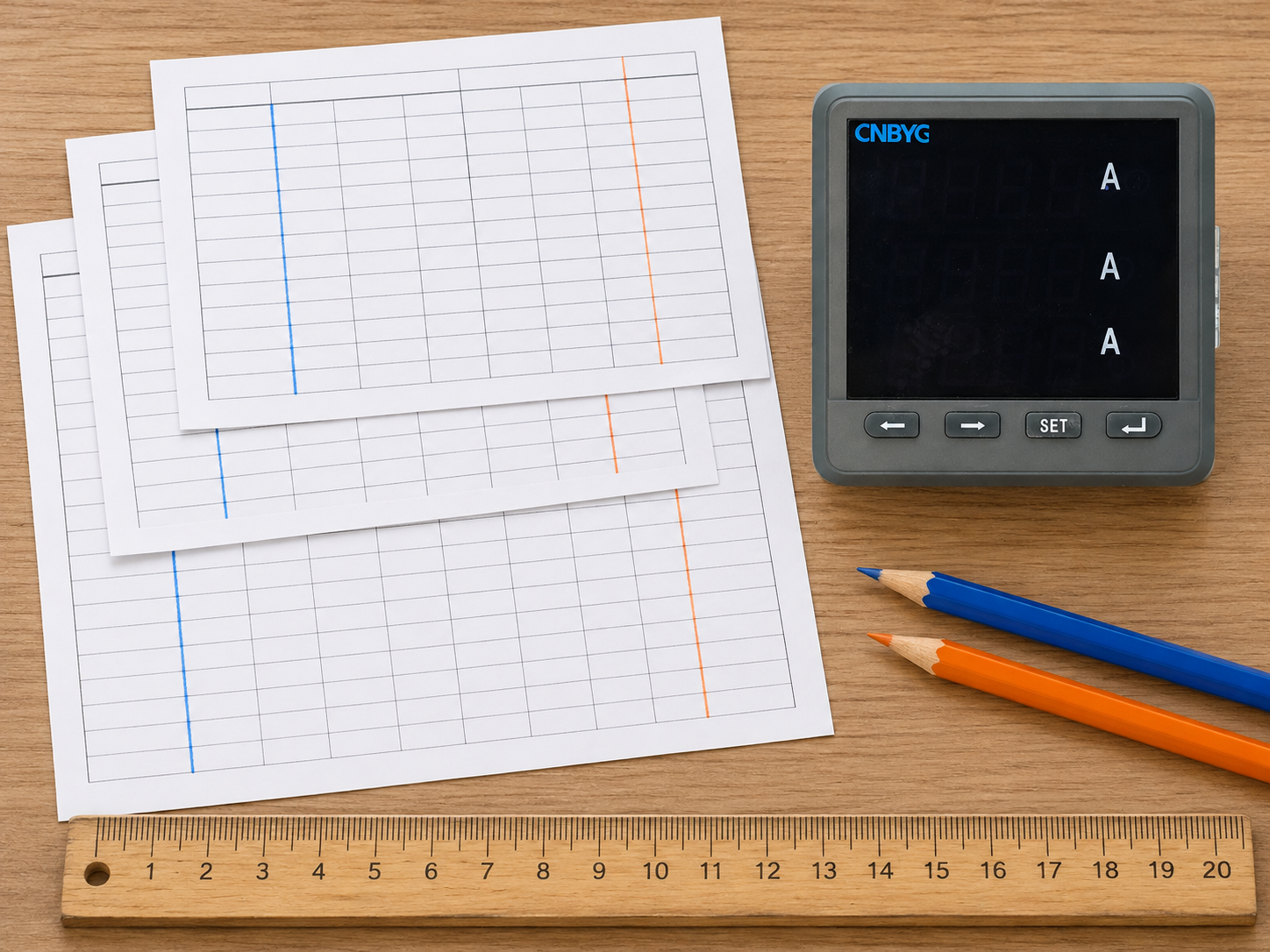
The BY194 multifunctional power instrument family is a relevant product starting point for panel measurement. Confirm the exact variant, inputs, ratios, energy registers, communication option and applicable accuracy documentation before procurement. A family photograph does not establish any particular register, logging feature or approval for billing.
An RFQ should identify the measurement boundary, expected electrical conditions, required energy directions, reporting interval, integration method and verification evidence. Include sensor selection and commissioning responsibilities. This makes it possible to compare proposed systems on their ability to produce usable records, rather than merely on the appearance of their front displays.
Further learning: what a kilowatt-hour represents
The Khan Academy lesson below explains the electrical energy unit used by the worksheet. It supports understanding energy accumulation; it is not a tutorial on a BY194 register map, installation or billing certification.
Frequently asked questions
Should submeter totals always equal the main meter?
Only when the meters cover the same complete boundary, compatible quantities and identical period, with appropriate consideration of losses, uncertainty and data coverage. An unexplained difference requires investigation rather than an automatic correction factor.
Is a positive residual proof of theft or electrical losses?
No. Omitted loads, timestamps, direction conventions, duplicated scaling and missing data can all contribute. Identify and quantify supported causes before attributing the remaining energy to any one explanation.
Can missing intervals be entered as zero?
Only if there is independent evidence that consumption was zero. Otherwise retain a missing-data flag. An estimated replacement must be clearly distinguished from an observed reading and handled under an agreed reporting rule.
Which difference percentage is acceptable?
There is no universal percentage established by this workflow. Acceptance depends on the actual measurement chain, boundary, completeness, contractual requirements and applicable rules. Agree the assessment method before using the result for billing or equipment acceptance.