Power Meter Gateway Stale Data: Cache Age and Freshness Checks
Power meter gateway stale data occurs when a client receives an older stored reading without enough information to recognize its age. A successful connection or fast response proves that the gateway answered; it does not prove the meter was recently polled. Diagnose freshness by tracing acquisition time, last successful source read, quality state and cache behavior through the complete measurement path.
The practical objective is to prevent unavailable measurements from appearing fresh. This guide focuses on industrial monitoring and reporting, not protective control. Begin with the power meter Modbus setup guide to confirm addressing and interpretation. A cache-age investigation should preserve existing records and use approved read-only observations before any network or gateway configuration change.
Map the path that produced the value
Draw the actual chain from instrument to report. A typical installation may include a serial meter, a serial-to-network device, polling software, a database and a dashboard. Some gateways transparently forward requests; others answer from an internal cache. A product described merely as a gateway does not establish which model applies. Obtain the exact product and software documentation.
Identify which component performs the source read and which component supplies each timestamp. A dashboard may label a value with its own refresh time even when the underlying database row has not changed. Similarly, a gateway can remain reachable while the downstream serial link fails. Monitoring only the upstream connection leaves an important blind spot.
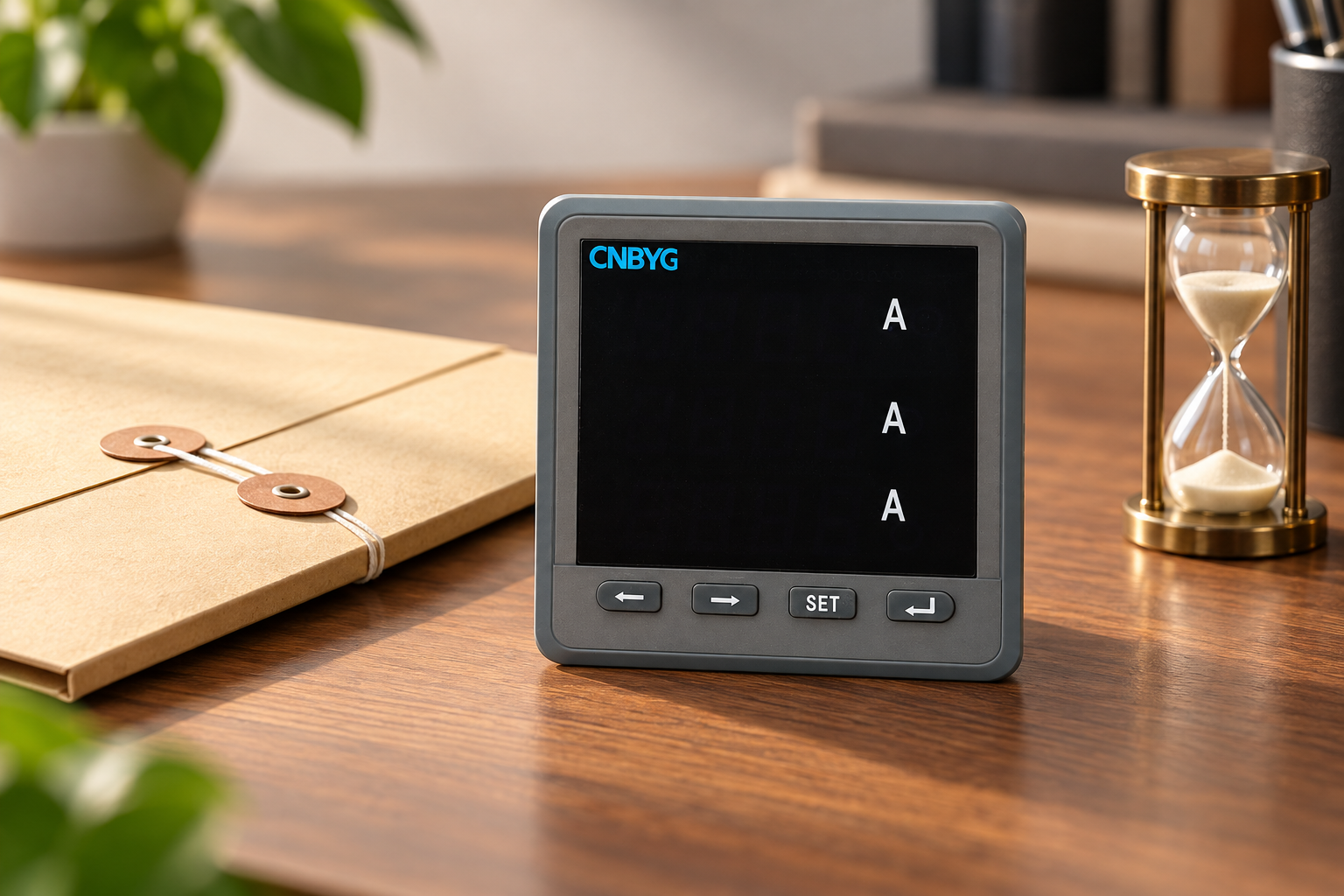
The CNBYG BY194 product family offers optional RS485/MODBUS communication. Its exterior and family description do not establish a gateway cache, an onboard timestamp field or a freshness flag. Confirm fitted options and documented interface behavior for the particular instrument. Keep claims about third-party gateway functions separate from claims about the meter.
Distinguish the times in a measurement record
A source measurement time describes when the quantity was measured, if the device provides such information. An acquisition time describes when a collector obtained it. A storage time describes when a database accepted the record. A presentation time describes when the user interface displayed it. Those times can differ legitimately and should not be silently substituted for each other.
For a simple live register interface without source timestamps, the last successful meter read may be the best available freshness evidence. State that limitation. It can establish when the communication path returned the register, but may not reveal the instrument’s internal measurement averaging window. Do not invent a source timestamp to make the data structure look complete.
Store the timestamp origin and timezone with the record. Where different machines supply times, check their synchronization. If a clock moves backwards or is incorrect, a naive age calculation can produce a negative number. Treat that as a time-quality fault requiring investigation instead of clipping the age to zero and reporting the data as fresh.
A repeated number is not automatically stale
A constant load can produce identical consecutive measurements, and a cumulative energy counter can remain unchanged at its displayed resolution. Conversely, a stale value can still change if another software component rescales, rounds or recalculates it. Comparing the numerical value alone is therefore a weak freshness test.
Use acquisition evidence: a confirmed new source transaction, an advancing documented sequence value, or an applicable source timestamp. Correlate that evidence with gateway diagnostics. If no such information is exposed, record freshness as uncertain and ask for a documented monitoring method. Guessing from a slowly moving graph does not provide a reliable acceptance criterion.
Check each signal group. The gateway might poll voltage frequently while updating an energy block less often. A single overall connection indicator can conceal the older block. Verify that the age and quality attached to a displayed quantity actually describe that quantity’s acquisition, rather than an unrelated successful transaction somewhere on the same device.
Define an age policy that fits the application
An illustrative age calculation is evaluation time minus the last trustworthy acquisition time. If both times use the same valid time basis, a reading acquired at 10:00:00 and evaluated at 10:00:18 has an age of 18 seconds. Whether that is acceptable depends on the reporting or operating requirement. Eighteen seconds is an example, not a recommended universal limit.
Set the acceptable age before testing. Consider the documented meter refresh, gateway poll cycle, network delay and reporting interval. A monthly energy review and an operator’s near-real-time display have different needs. Ordinary polling should not be treated as a substitute for a protective measurement function with its own performance requirements.
Use the polling interval guide when checking whether the desired freshness is achievable. Increasing requests can overload a serial bus without changing the instrument’s internal update period. The solution may involve a different acquisition architecture or a revised reporting expectation, rather than simply reducing every polling delay.
| Observation | What it establishes | Next check |
|---|---|---|
| Gateway responds quickly | Upstream gateway path is available | Confirm last successful downstream meter acquisition |
| Reading remains unchanged | Number has not changed at recorded resolution | Check source transaction and age evidence |
| Display time advances | Interface refreshed its presentation | Compare with acquisition timestamp origin |
| One block is old | That block lacks a recent accepted acquisition | Inspect its polling schedule, errors and mapping |
| Source link recovers | New transactions may resume | Verify fresh quality and record the historical gap |
| Age is negative | Timestamp basis or clock ordering is inconsistent | Investigate clocks and timestamp provenance |
Collect a read-only diagnostic baseline
Record asset identity, meter variant, gateway model, firmware, polling application version and route. Retain the map revision, signal definitions and current polling schedule. Capture a time-limited diagnostic log that shows source-read outcomes and the values presented upstream. Avoid storing credentials in the report or exposing unnecessary network details.
The Modbus Application Protocol Specification explains request and response structures. It does not by itself tell a client whether a gateway generated its reply from a newly obtained meter value or a cache. That distinction belongs to the implementation and must be established through its manual and acquisition evidence.
Compare a documented live-read path with the normal application path when the architecture permits it. Coordinate access so that the diagnostic client does not compete improperly with an existing serial master. Do not attach an additional master to a live serial network merely to obtain a comparison; use an approved collection point or an isolated test arrangement.
Test failure behavior under controlled conditions
A useful test distinguishes gateway reachability from meter availability. In an approved laboratory or maintenance window, observe what happens when source reads fail while the gateway service remains available. Record whether upstream replies stop, return exceptions, retain a previous value or include a quality indicator. These are possible behaviors to investigate, not assumptions about a particular product.
Set the test duration and stop conditions in advance. Keep the last valid acquisition time and observe whether it remains fixed during source failure. If the gateway updates the timestamp while reusing the old value, determine what that timestamp actually means. A delivery timestamp can be valid as a delivery record while being unsuitable as measurement freshness evidence.
NIST’s OT security guide provides the wider framework for controlled operational changes. Coordinate any deliberate interruption with operations and reporting owners. A simulated source failure must not disable an important process function or contaminate contractual reports. A software-only simulation tests application policy but cannot establish the real gateway’s behavior.
Keep value, quality and age together
An application may retain the last accepted number for context, provided it preserves the original acquisition time and clearly marks the value as stale or unavailable. It should not convert a failed read into an ordinary zero. Zero can represent a real operating condition, so substituting it silently can mislead both operators and later calculations.
A documented quality field should travel with the signal through the collector, database, API and dashboard. Check that every mapping preserves its meaning. A gateway error bit is useful only if the downstream system interprets it consistently. Some integrations drop quality while retaining the numeric field, producing a plausible-looking value with its essential qualification removed.
The related invalid meter readings guide explains handling unavailable numerical results. Freshness is a separate dimension: an older value can be mathematically finite and still unsuitable for the task. Treat validity, age and completeness as distinct checks so that passing one does not silently override a failure in another.
Recover without rewriting the outage as valid history
When source reads resume, confirm a new successful acquisition before clearing the stale indication. Keep the interruption event and the first accepted recovery reading. Do not retimestamp old cached samples as if they were newly measured. A clean graph produced by filling every gap can conceal the very failure the monitoring system should reveal.
For energy totals, a later valid cumulative reading may support a total change over a longer period, depending on the meter and counter continuity. It does not automatically reconstruct the consumption profile within the missing interval. State which totals are observed and which interval allocations are estimated, and obtain approval for any estimation method used in formal reporting.
Release the repaired integration only after checking source-read evidence, timestamp meaning, quality propagation and outage recovery. Keep a short acceptance record with expected behavior, actual observations and unresolved limitations. Assign ownership for future stale-data alerts; an alarm with no responsible recipient or response procedure does little to protect reporting reliability.
Further learning: caches preserve earlier answers
The educational Computerphile lesson below explains why computers keep copies of earlier data in caches. It offers background for the distinction between a quick response and a newly acquired measurement. CPU cache mechanisms differ from gateway software; use the gateway’s own documentation for its refresh, expiry and failure behavior.

Frequently asked questions
Does a successful gateway reply prove the meter reading is fresh?
No. Confirm the last successful source acquisition and the documented cache behavior. The gateway can remain reachable while its downstream meter link is unavailable.
Is a reading stale whenever its value does not change?
No. Stable loads and limited display resolution can produce repeated valid values. Use acquisition time, documented source status or transaction evidence to assess freshness.
Should failed reads be replaced with zero?
Do not silently substitute zero. Preserve the failure state and, if retaining an older value for context, keep its original acquisition time and clearly mark its age and quality.
Can one recovered reading fill the missing interval profile?
Not automatically. A cumulative counter may support a longer-period total under verified continuity, but it does not establish the detailed time distribution during the outage.