Welding Robot Harmonics in Automotive Plants: Measurement and APF/SVG Mitigation Guide
Welding robot harmonics are a common power quality problem in automotive body shops because resistance welding loads switch quickly, draw high pulsed current, and often operate in uneven duty cycles across phases. The result can be harmonic distortion, voltage dips, flicker, low power factor, and stress on transformers, cables, robot controllers, and existing capacitor banks.
This guide explains how to read the harmonic profile of welding robot lines, what data to collect before sizing mitigation equipment, and when an active harmonic filter (APF/AHF), static var generator (SVG), or combined system should be specified.
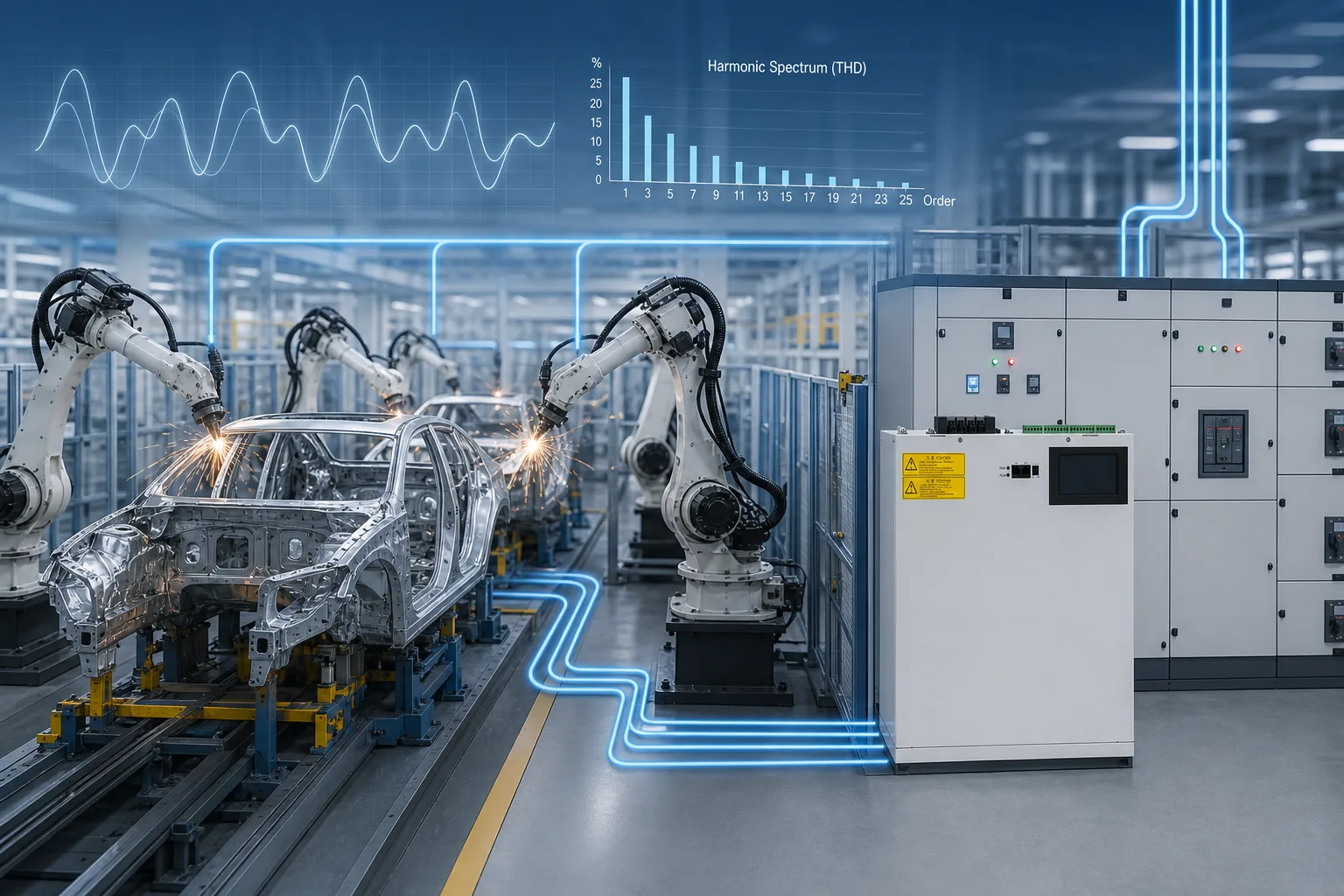
Part 1. Why do welding robots create power quality problems?
Robotic spot welding and resistance welding are not steady linear loads. A robot arm may draw a sharp current pulse during the weld interval, drop close to idle, then repeat the cycle hundreds or thousands of times across a production shift. When many robots operate on overlapping cycles, the electrical system sees a fast-changing and often unbalanced load pattern.
In an automotive body shop, the same switchboard may also feed conveyors, servo drives, VFD-driven auxiliaries, and control systems. The combined load can create several disturbances at once:
| Disturbance | Welding-line cause | Plant risk |
|---|---|---|
| Current harmonics | Rectifiers, inverter welders, nonlinear input stages | Transformer and cable heating |
| Voltage dips | Short high-current weld pulses | Robot faults and poor weld consistency |
| Flicker | Repeated current swings | Visible voltage fluctuation and control instability |
| Low power factor | Reactive demand during weld cycles | Higher apparent demand and utility PF penalties |
| Three-phase unbalance | Uneven single-phase or line-to-line weld loading | Neutral stress and reduced transformer utilization |
For the wider plant context, see the CNBYG automobile manufacturing solution.
Part 2. What does a welding robot harmonic profile include?
A welding robot harmonic profile is more than one THD number. Engineers should look at the time pattern, the harmonic spectrum, the voltage response, and whether distortion appears only during weld pulses or persists across the production shift.
Typical profile elements include:
| Measurement | Why it matters |
|---|---|
| THDi and individual current harmonics | Shows which harmonic orders the APF must target |
| THDv at the bus or PCC | Shows whether current distortion is affecting voltage quality |
| TDD | Better for IEEE 519-style planning than only instantaneous THDi |
| Pst / Plt flicker | Captures repetitive voltage fluctuation from weld cycles |
| Power factor / kvar swing | Determines whether SVG or fast var compensation is required |
| Phase current unbalance | Identifies uneven robot grouping or single-phase weld loading |
| Cycle-level current waveform | Shows peak demand and duty-cycle severity |
Published weld-shop case studies often report strong 3rd, 5th, 7th, 9th, and 11th harmonic components, but each plant must be measured. Robot brand, welder topology, transformer impedance, production scheduling, and the number of simultaneous welds can all change the spectrum.
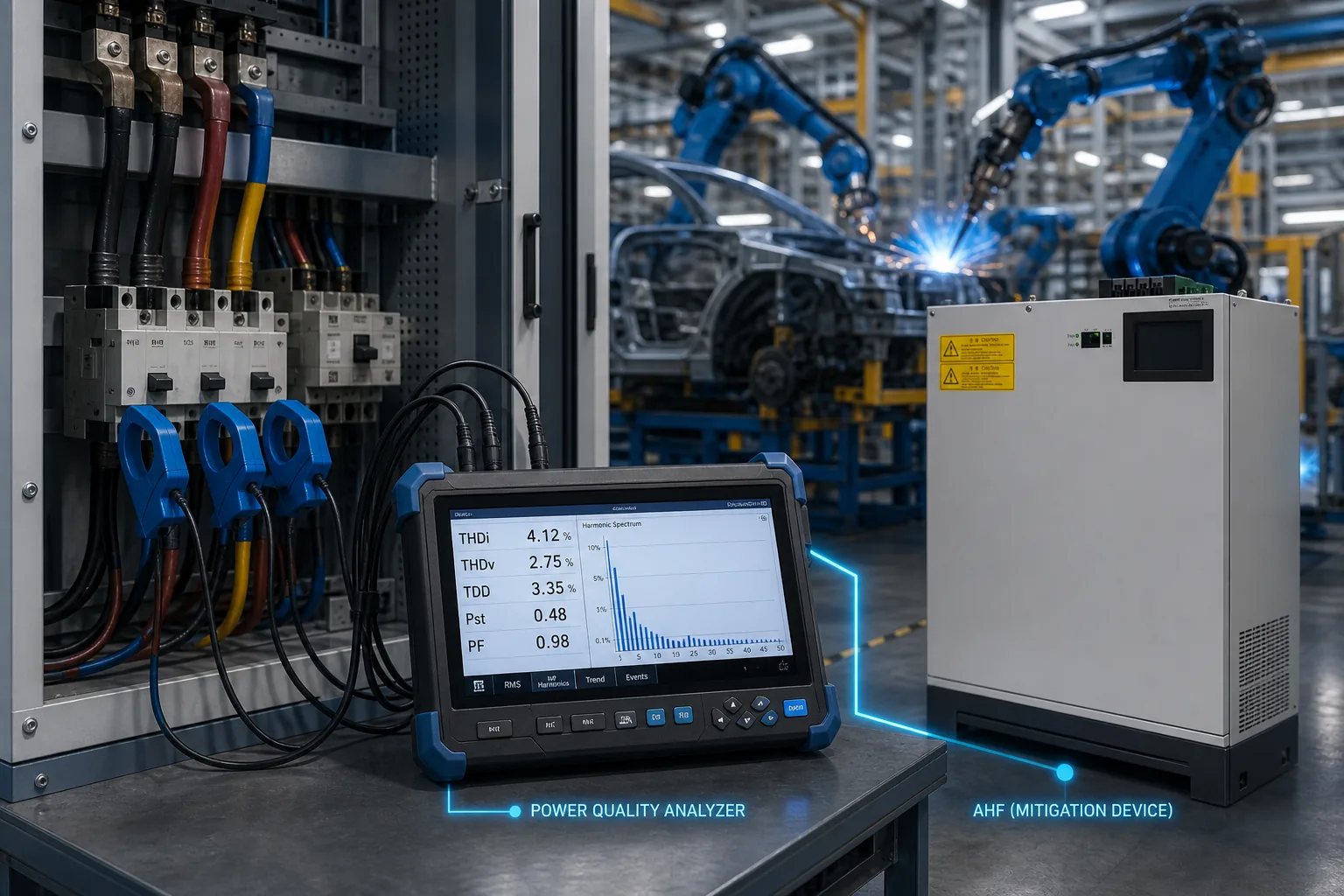
Part 3. How should engineers measure welding-line power quality?
Start at the point where the problem is visible, then work upstream. Many projects measure both the welding-line switchboard and the plant PCC. The line-level measurement helps specify mitigation equipment; the PCC measurement helps verify utility-facing harmonic and power factor targets.
Use a power quality analyzer that can record harmonics, flicker, current waveform, voltage dips, and unbalance during real production. A short idle measurement is not enough. Capture at least one representative production window, including start-up, peak welding, line changeover, and planned downtime.
| Data to collect | Recommended note |
|---|---|
| Voltage and frequency | Confirm 480 V / 60 Hz or project-specific design |
| Wiring | 3P3W or 3P4W, neutral current if present |
| Transformer rating and impedance | Needed for voltage distortion and short-circuit context |
| Robot count and grouping | Needed to understand simultaneous weld events |
| THDi / THDv / TDD | Capture trend and harmonic spectrum |
| Pst / Plt | Important for flicker and voltage fluctuation |
| Existing capacitor bank details | Check detuning and resonance risk |
| Production duty profile | Needed for realistic APF/SVG sizing |
For harmonic planning, engineers commonly reference IEEE Std 519, which applies distortion goals at the point of common coupling. Do not assume that a clean PCC result means the welding line itself is healthy; sensitive robots may still need localized correction.
Part 4. How do harmonics affect weld quality, robots, and transformers?
Harmonics and fast voltage changes can create practical production problems, not just electrical reports. Distorted current raises RMS heating in cables, busbars, transformers, and protective devices. Voltage distortion and dips can disturb robot controllers, servo drives, PLCs, sensors, and communication modules.
For welding quality, voltage stability matters because weld heat depends on current and time. Severe voltage dips or fluctuating reactive demand can reduce repeatability. The operator may see nuisance alarms, inconsistent weld quality, overheating cabinets, or unexplained trips during peak production rather than during maintenance tests.
The biggest risk is treating every symptom as a simple power factor problem. Conventional capacitor banks can help steady inductive loads, but weld shops are dynamic and nonlinear.
If the bank is not detuned and the harmonic profile is ignored, capacitors can be overstressed or participate in resonance. This is why weld-shop projects should measure harmonics before adding or expanding capacitor compensation.
Part 5. When should APF, SVG, or both be specified?
APF/AHF and SVG solve different parts of the welding robot power quality problem. The device choice should follow measured data.
| Primary finding | Preferred mitigation | Reason |
|---|---|---|
| High current harmonics / high TDD | AHF / APF Active Harmonic Filter | Injects counter-harmonic current in real time |
| Fast reactive power swings / low PF | SVG Static Var Generator | Provides fast dynamic kvar compensation |
| Flicker with PF swings | SVG plus engineering study | Stabilizes voltage when source impedance supports correction |
| Harmonics plus low PF and unbalance | APF + SVG or integrated power quality system | Separates harmonic and reactive-power control |
| Existing capacitor bank resonance risk | Re-study before adding capacitance | Avoids amplifying harmonic voltage |
For a broader APF/SVG decision framework in automotive plants, see the automobile manufacturing power quality guide. For filter selection basics, see the AHF selection guide.
Part 6. How should mitigation equipment be integrated and commissioned?
Most welding-line projects connect mitigation equipment at the welding switchboard, the body-shop main distribution board, or the plant PCC. The right point depends on where distortion is created, how sensitive nearby equipment is, and whether the utility-facing limit is also exceeded.
Integration should include:
- Current transformer location and polarity verification
- Protection coordination with the welding feeder
- Thermal clearance and ventilation for power electronics
- Communication with SCADA, EMS, or plant monitoring where available
- Step-load testing under real welding sequences
- Before/after report for THDi, THDv, TDD, PF, flicker, and unbalance
Commissioning should not stop at “device powered on.” Engineers should compare baseline and post-mitigation waveforms during the same production condition. If robots are sequenced differently, the comparison may be misleading.
Part 7. What should go into a welding-line APF/SVG RFQ?
A good RFQ lets the supplier distinguish harmonic mitigation from reactive compensation and avoid under-sizing. Include the electrical single-line diagram, transformer data, welding-line duty profile, and baseline measurement files.
Recommended RFQ checklist:
- Site voltage, frequency, grounding, and wiring
- Welding robot count, process type, and duty-cycle pattern
- Harmonic spectrum by phase and by time window
- THDi, THDv, TDD, Pst, Plt, power factor, and unbalance
- Existing capacitor bank / detuned reactor / PFC system details
- Target PF and harmonic planning requirement
- Preferred installation point and available cabinet space
- Communication protocol and alarm requirements
- Expansion plan for future welding cells
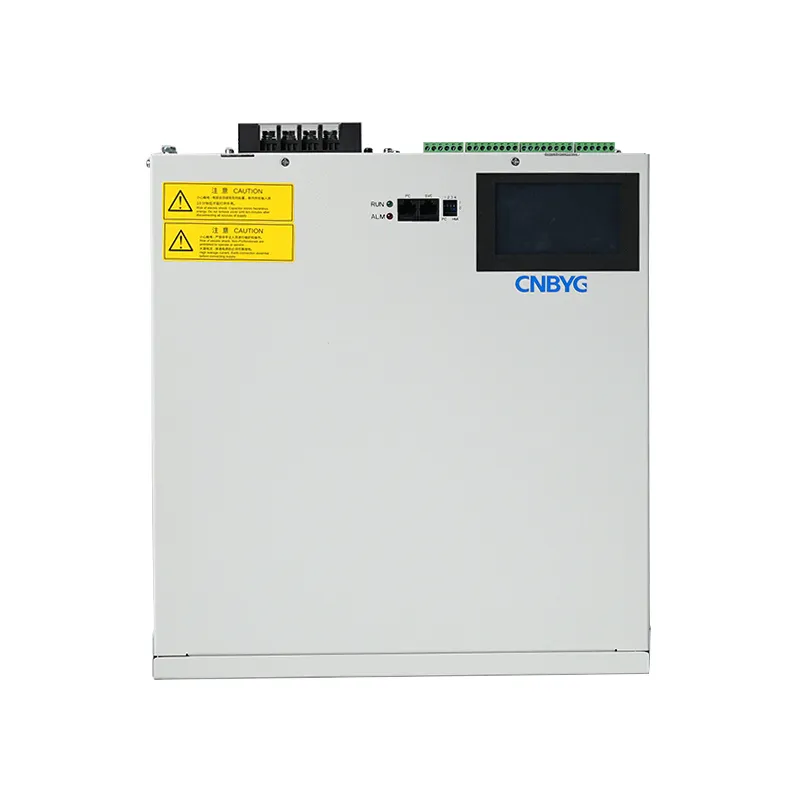
CNBYG can review measurement data and recommend products from the Power Quality System portfolio, including APF/AHF and SVG equipment. Share your single-line diagram and power quality report through the contact page.
FAQ
What causes welding robot harmonics?
Nonlinear rectifiers, inverter welding power supplies, and fast pulsed welding current create harmonic currents and voltage distortion.
Which harmonic orders are common in welding lines?
3rd, 5th, 7th, 9th, and 11th may appear, but the actual spectrum must be measured on site.
Can SVG remove welding harmonics?
No. SVG corrects reactive power and power factor. APF/AHF is used for harmonic current mitigation.
Do welding robots always need APF?
No. APF is justified when measurements show excessive harmonic current, TDD, voltage distortion, or related equipment issues.
Why are capacitor banks risky in weld shops?
Capacitors can be overstressed or resonate with nonlinear welding harmonics if not engineered and detuned correctly.
Where should APF or SVG be installed?
At the welding-line switchboard, body-shop distribution board, or PCC depending on measured disturbance location and project targets.
How long should welding power quality be measured?
Record representative production, including peak welding, changeovers, and idle periods; short no-load snapshots are not enough.
What should be sent for a CNBYG RFQ?
Send the single-line diagram, welding load list, measurement report, targets, voltage, wiring, cabinet constraints, and expansion plan.