Energy Meter Pulse Output: Constants, Scaling and Verification
An energy meter pulse output converts accumulated electrical energy into countable events. To obtain kilowatt-hours, divide the recorded pulses by the documented pulses-per-kWh constant, or multiply them by the documented Wh-per-pulse weight. These are different conventions. Before connecting a counter, confirm the exact meter option, output circuit, permitted voltage and current, pulse width, energy direction and whether transformer ratios are already included. A flashing front indicator does not establish that an electrically compatible external output is fitted.
For a factory energy manager, a reliable pulse record can connect production schedules to consumption without requiring a complete communications network. However, an incorrect constant can make every subsequent energy comparison wrong. This guide explains scaling and verification; it does not replace the terminal diagram or authorize work inside energized switchboards.
Establish which signal you actually have
Start with the ordered model, serial number and option code. An electrical pulse output may use an isolated transistor, an open-collector arrangement, a relay or another documented interface. A receiving input may supply its own sensing voltage, require a separate approved supply, or expect a potential-free contact. Similar terminal names do not guarantee compatibility.
An optical LED is another possibility. A suitable optical reader can observe it without making an electrical connection to the meter. The LED constant can differ from a separately configurable electrical-output constant. Do not copy the marking beside the LED into an external counter configuration until the manual confirms that relationship.
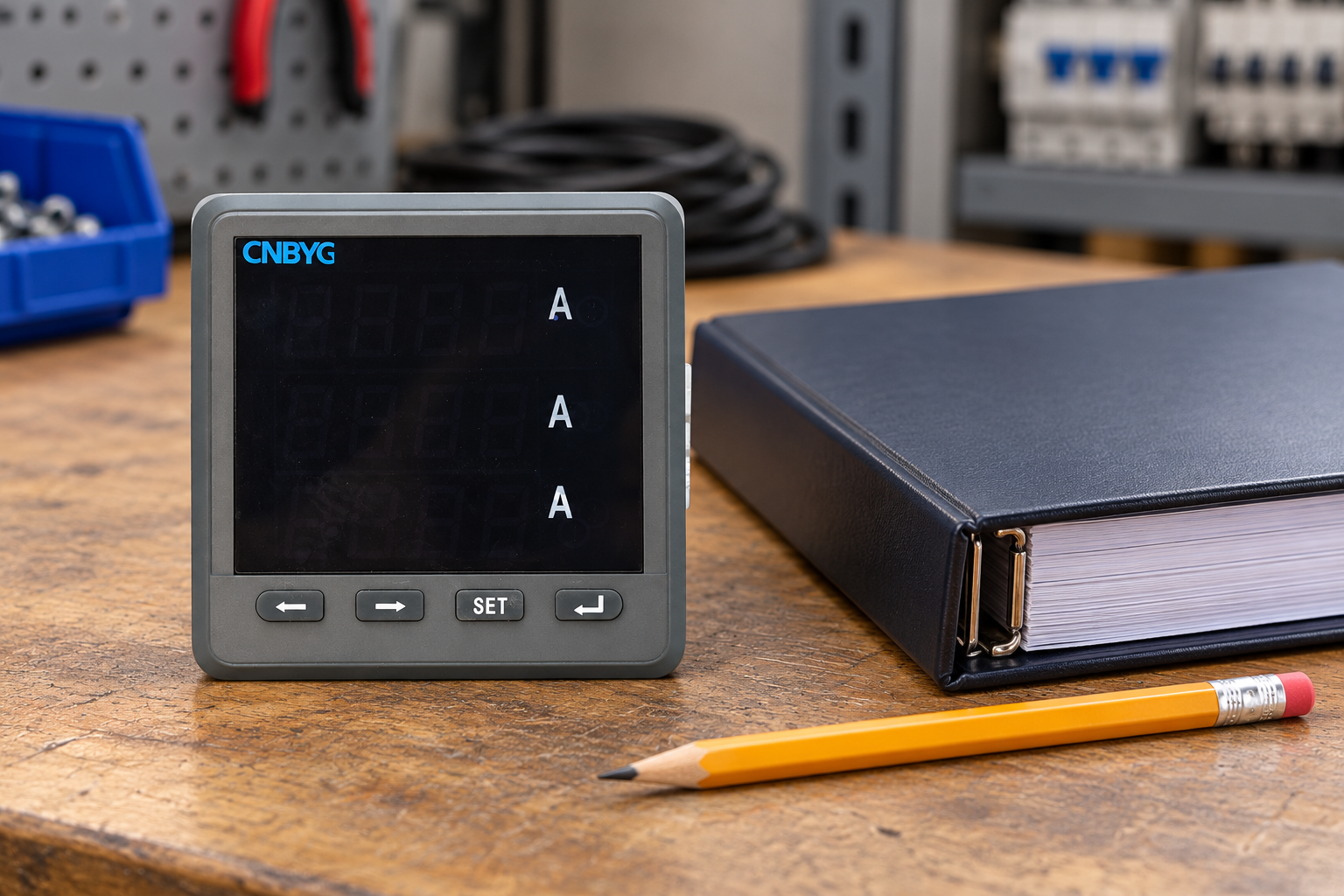
The CNBYG BY194 multifunction power instrument lists an electric-energy pulse module among its selectable expansion functions. This establishes a product-family connection, not that every BY194 variant has the same output terminals or ratings. Ask for the exact installed module documentation before preparing the interface.
Read the constant with its units
Two common descriptions are pulses per kilowatt-hour and watt-hours per pulse. They describe the same conversion in reciprocal forms, but entering one numerical value into a field expecting the other can produce a large error. Keep the unit beside every number in the commissioning sheet.
For a constant K expressed in pulses/kWh:
Energy E, in kWh = pulse count N / K.
For a pulse weight W expressed in Wh/pulse:
Energy E, in kWh = N × W / 1,000.
As a purely illustrative example, a documented constant of 1,000 pulses/kWh and a count of 2,500 pulses correspond to 2.5 kWh. The reciprocal pulse weight is 1 Wh/pulse. These example values are not BY194 specifications and must not be copied into a live configuration without verification.
OpenEnergyMonitor’s pulse-counting introduction explains the relationship between meter pulses and measured energy. The U.S. Energy Information Administration’s electricity measurement guide explains the distinction between power and energy units. Those principles support the calculations here; hardware compatibility still comes from the actual manufacturer instructions.
Separate primary scaling from secondary scaling
A transformer-operated meter may measure through current transformers and, where applicable, voltage transformers. Depending on the meter and output configuration, its pulses may represent primary energy after ratio correction or a secondary quantity requiring a multiplier. The receiving system must apply the appropriate multiplier exactly once.
Suppose a project record establishes that the meter already applies its configured CT ratio to the output energy. Applying that ratio again in a building-management system will overstate consumption. Conversely, assuming primary scaling for an output documented as secondary-scaled will understate it. The output specification, not the appearance of a sensible dashboard, resolves the question.
Record the primary and secondary CT ratings, any voltage-transformer ratio, the meter’s ratio settings and the output scaling description in one place. Use the separate CT selection guide for sensor compatibility and the multifunction meter wiring guide for the broader measurement circuit. Neither replaces a model-specific pulse-output diagram.
Check interface compatibility before counting
| Item to confirm | Evidence to obtain | Why it matters |
|---|---|---|
| Output type and isolation | Exact module terminal drawing and circuit description | A transistor output and a dry contact need different receiving arrangements |
| Electrical limits | Permitted voltage, current, polarity and supply arrangement | An incompatible input can damage the interface or fail silently |
| Pulse duration | Documented width and receiving-input timing limits | A counter can miss pulses that are too short or merge events that are too close |
| Energy register | Active or reactive energy, import or export, total or selected channel | A correct count from the wrong register answers the wrong question |
| Scale convention | Pulses/kWh or Wh/pulse with primary/secondary basis | Prevents inverse constants and repeated transformer multipliers |
| Wiring environment | Cable route, screening and installation instructions | Electrical noise or unsuitable routing can create unreliable event detection |
This is a documentation checklist, not a universal wiring instruction. Do not assume a polarity, pull-up resistor, supply voltage or terminal number from a different meter. Obtain written clarification when a drawing and a module label disagree.
Estimate pulse rate and useful resolution
For an output documented as K pulses/kWh and a steady active power P in kW, the expected average pulse frequency is:
f, in pulses per second = P × K / 3,600.
At an illustrative 36 kW and 1,000 pulses/kWh, this gives 10 pulses per second. Both the meter output and the receiving input must support the resulting event rate with the selected pulse duration. This calculation does not prove that a particular configuration is supported.
At low load, a long time can pass between pulses. One pulse may represent more energy than the load uses during a short reporting interval. A dashboard can therefore show repeated zeros followed by a jump even when the underlying consumption is steady. That pattern can be a resolution effect rather than a meter fault.
Choose reporting periods with that quantization in mind. If a process decision needs rapid power changes, consider an appropriate power register or a validated measurement instrument instead of inferring instantaneous behavior from sparse energy pulses. See power data logging for the wider distinction between event counting and time-series measurements.
Verify against the meter’s own energy register
Use a documented observation period with stable start and finish records. Capture the meter register, counter total and time at both ends. Compare the meter’s change in energy with the converted change in pulse count, allowing for display resolution and a pulse that may cross the observation boundary.
For example, if a test begins halfway through the energy represented by one pulse, exact agreement to the last pulse is not expected over a very short period. A longer controlled observation can reduce the relative effect. Specify the project acceptance method rather than inventing a universal percentage tolerance.
The test also needs a consistent register basis. Import active energy cannot be compared directly with net import-minus-export energy when onsite generation is exporting. Likewise, a total three-phase energy register should not be compared with a pulse channel assigned to a different quantity. Write down the register names exactly as the manual defines them.
Diagnose common mismatches in a useful order
A fixed ratio between the calculated energy and the register change often points to a scaling problem. Check the inverse constant, Wh versus kWh, transformer multipliers and any counter software multiplier. A factor-of-two issue can also arise when software counts both rising and falling edges but the specification defines one complete pulse as one event.
Intermittent undercounting calls for a different investigation. Review the highest pulse rate, minimum input pulse width, filtering and debounce settings, supply stability and event-buffer capacity. An input configured for slow mechanical contacts can reject legitimate rapid pulses. Changing filters without recording the original settings can conceal the cause.
Unexpected counts when the measured load is absent require verification of the actual energy register, standby loads, export behavior and wiring integrity. Do not immediately conclude that the meter is inaccurate. Separate the electrical signal, counter logic and energy conversion into three testable stages.
A sudden restart or network outage creates another risk: the receiver may reset a local counter while the meter’s cumulative energy continues. The data system needs a documented restart policy, retained totals and an explicit way to identify missing intervals. Adding zeros to a missing interval can make energy performance appear better than it was.
Make the handover record useful for future maintenance
Save the approved output diagram, option code, constant with units, scaling basis, counter input configuration and test results with the meter’s asset record. Include photographs of labels taken under the site’s electrical work procedure. Restrict configuration changes and keep a dated change log.
For an inquiry, provide the supply and sensing arrangement, CT details, required energy direction, receiving equipment input specification, expected maximum demand and desired reporting interval. Ask the supplier to confirm module availability and compatibility. Do not order solely from a generic statement that a product supports pulse output.
When pulse monitoring is later used to evaluate reactive-power work, compare production conditions and measurement periods consistently. A corrected power factor does not automatically mean that active-energy consumption fell by the same percentage. The pulse record helps establish measured kWh; it does not independently prove the cause of a change.
Further learning: power and accumulated energy
The following Khan Academy Physics lesson explains electrical power as energy transferred per unit time. That relationship underlies conversion from accumulated meter energy to average power. It does not demonstrate the wiring or output options of a BY194 instrument.

Frequently asked questions
Does 1,000 pulses per kWh mean 1,000 Wh per pulse?
No. It means one pulse represents 1 Wh, because 1 kWh contains 1,000 Wh. Always check which unit the receiving system expects.
Can I use the front LED constant for an electrical pulse output?
Only when the exact manual confirms that both signals use that constant. A configurable output module can have a different pulse weight or register assignment.
Should the counter multiply by the CT ratio?
Only if the documented output basis requires that multiplier. Applying it again when the meter already produces primary-scaled pulses creates an incorrect total.
Does a pulse-output check prove the meter’s billing accuracy?
No. It verifies a particular signal and conversion path under recorded conditions. Formal accuracy verification requires the applicable test method, suitable reference equipment and the relevant approval requirements.
For the related measurement workflow, see our guide to energy meter reference accuracy verification.